


Bulk Custom Award Pricing Guide: Costs & Discounts
Table of Contents
- Understanding Bulk Custom Award Pricing Guide Fundamentals
- Factors Influencing Custom Trophy Cost
- Corporate Award Pricing: Tiered Models and Quantity Breaks
- Award Customization Options and Their Cost Impact
- Volume Discounts Awards: How to Maximize Savings
- Total Cost of Ownership: Beyond the Per-Unit Price
- How to Request a Custom Quote and Compare Manufacturers
- Conclusion: Planning Your Bulk Custom Award Purchase
Bulk Custom Award Pricing Guide: Costs & Discounts
Last Updated: July 27, 2026
Understanding bulk custom award pricing fundamentals is the difference between smart procurement and budget overrun. The real cost depends on material selection, design complexity, order quantity, and timeline. Below, we'll break down how manufacturers calculate pricing, where hidden costs hide, and how to structure your bulk order for maximum savings.
Understanding Bulk Custom Award Pricing Guide Fundamentals
What Drives Award Costs
Award pricing is determined by materials, labor, customization, and overhead. Material costs form the foundation, crystal costs significantly more than acrylic, and die-cast medals require different processes than stamped ones. Labor and customization add another layer: custom engraving, logo printing, and vector art design all require skilled technicians and setup time.
Manufacturing overhead gets distributed across your order. A supplier's facility has fixed costs; on a 10-unit order, those costs per unit are high. On a 500-unit order, they're spread thin. This is why bulk orders unlock lower per-unit pricing.
Why Bulk Orders Differ from Single Awards
Ordering 5 trophies versus 500 trophies are fundamentally different transactions. For a single award, the supplier must recover all setup costs in that one unit. For a bulk order, setup costs spread across hundreds of units. The engraving machine gets programmed once, then runs 500 times. The die-casting mold is created once, then produces 500 medals.
Volume also affects shipping and lead time. Fifty plaques fit in one box with consolidated logistics. A single plaque requires individual packaging and higher per-unit shipping rates. Lead time changes too, a single custom award might ship in 2-3 weeks, while a 500-unit order might take 6-8 weeks through a production queue.
Factors Influencing Custom Trophy Cost
Material Selection and Base Materials
Material selection is often the largest single cost driver. Acrylic awards are the most budget-friendly option, lightweight and easy to customize. Crystal trophies sit in the mid-to-premium range, conveying quality and prestige. Metal awards, whether die-cast, stamped, or machined, represent another tier. Wood-based awards combine material cost with finishing labor. Composite materials blend cost efficiency with appearance, mimicking metal or crystal at lower cost.
The material you choose cascades through your entire cost structure. Heavier materials increase shipping costs. Delicate materials require premium packaging. Materials that are easy to customize reduce labor costs. When evaluating options, consider total cost of ownership across customization and shipping.
Design Complexity and Custom Engraving
Simple engraving means text only, names, dates, achievement titles. A skilled technician can complete dozens of units per hour. Custom vector art introduces complexity; logos and emblems require design work before production. Photo reproduction and full-color printing add another cost tier, requiring specialized equipment and careful quality control.
Character limits vary by engraving method. Laser engraving on acrylic handles long text with minimal cost increase. Rotary engraving on metal is more time-sensitive. Most suppliers allow 50-100 characters per line without surcharge.
Proof approval is critical for quality control. Reputable suppliers provide a digital mockup or physical sample before full production, typically taking 3-5 business days and often included in standard pricing. Rush proof approval (same-day turnaround) may incur fees.
Manufacturing Overhead and Setup Fees
Design setup covers time to prepare artwork for production. If you provide print-ready files, setup might be minimal or free. Engraving setup applies when using rotary or laser engraving, the equipment must be programmed and the first piece test-engraved. Die-casting setup is expensive, sometimes hundreds of dollars, but once the die exists, producing 1,000 units costs only marginally more than 100.
Quality control and inspection add overhead. Packaging and preparation vary by order size. Understanding setup fees helps you negotiate intelligently. Setup fees incentivize larger orders, which is why tiered pricing exists.
Corporate Award Pricing: Tiered Models and Quantity Breaks
Entry-Level vs. Premium Award Materials
Entry-level awards use budget-friendly materials: acrylic, basic die-cast medals, or composite materials. These work well for large-scale recognition programs. Premium awards use crystal, high-quality metal, or custom-designed pieces, conveying prestige and significance. Premium awards cost more per unit but are reserved for fewer recipients.
The decision isn't just about budget, it's about message. A company recognizing 500 employees for safety might use entry-level medals. The same company recognizing 5 executives for leadership might use premium crystal to emphasize significance.
Bulk Discount Structures and Per-Unit Costs
Tiered pricing incentivizes larger orders. A typical structure:
- 1-25 units: base price
- 26-50 units: 10-15% discount
- 51-100 units: 15-25% discount
- 101-250 units: 25-35% discount
- 251-500 units: 35-50% discount
- 500+ units: custom pricing
Focus on per-unit cost, not total price. A $10,000 order for 200 units costs $50 per unit. A $15,000 order for 500 units costs $30 per unit. The second option is more expensive in total dollars but cheaper per unit.
Some suppliers offer quantity breaks within a single order, applying tiered pricing to total units across multiple product types. Wholesale pricing applies when you're a reseller or event planner ordering regularly. Gino's Awards, Inc. works with corporate procurement teams to establish volume pricing agreements for 200-500+ annual units.
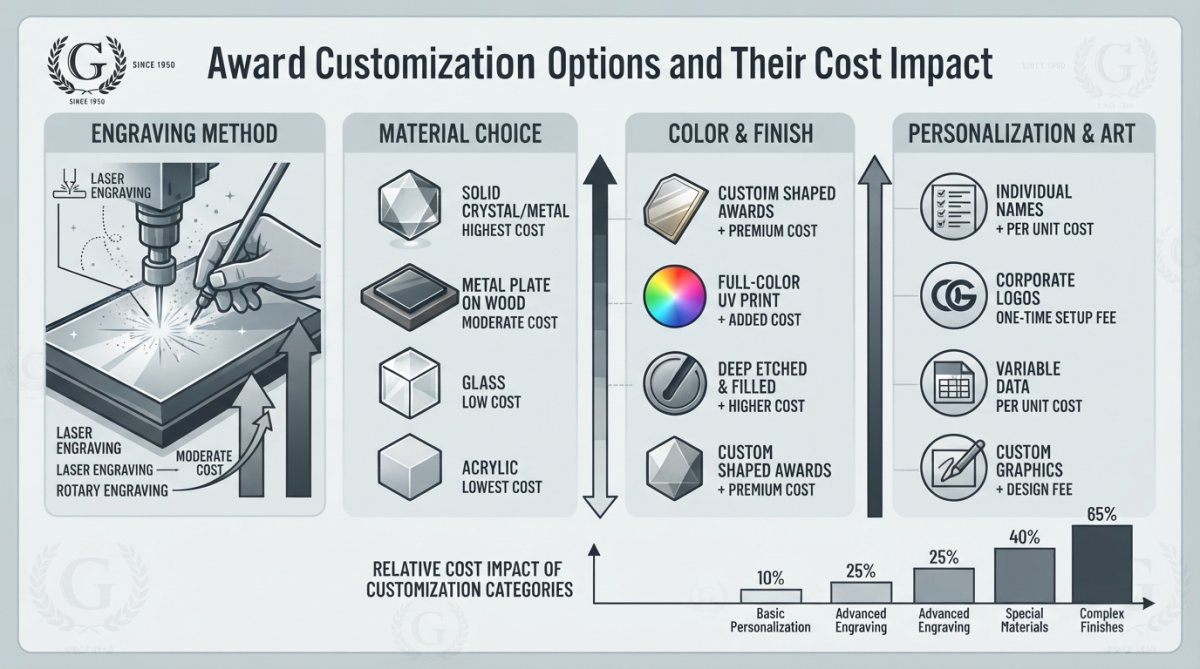
Award Customization Options and Their Cost Impact
Engraving Character Limits and Proof Approval
Character limits vary by engraving method. For bulk orders with varying names, calculate total character count across all units. Some suppliers charge by total characters; others charge per unit based on character count.
Proof approval typically takes 3-5 business days and is often included in standard pricing. Rush proof approval (24 hours) may incur a rush fee. Multiple proof rounds beyond the first revision may be charged. Careful proof review is essential, especially on large orders, you typically bear the cost of reprinting if you approve a proof with errors.
Vector Art, Custom Branding, and Finish Quality
Vector art design allows complex logos. If you provide a vector file, the supplier can scale it perfectly. If you provide a raster image, the supplier may need to recreate it as vector art, adding design labor and cost.
Custom branding incorporates your company colors, logos, and design elements into the award itself. This increases per-unit cost but creates a more distinctive, branded award.
Finish quality affects appearance and cost. A basic finish is standard. A polished finish requires additional labor. A brushed or matte finish requires specific equipment. Anodizing and plating apply to metal awards, adding cost and time but significantly improving appearance and durability.
Volume Discounts Awards: How to Maximize Savings
Hidden Costs in Award Production
Most organizations focus on per-unit award cost and miss expenses that accumulate around the edges.
Shipping costs are often underestimated. A single trophy might cost $15 to ship; fifty might cost $45 ground shipping, less than $1 per unit. Expedited shipping jumps costs significantly. Packaging materials for bulk orders are often absorbed by suppliers; for smaller orders, packaging might be a line item.
Design revision costs accumulate if you request changes after the initial quote. Rush production fees apply when you compress the timeline, standard production might take 6-8 weeks; rush production in 3-4 weeks incurs a 10-25% fee.
Setup fee waivers sometimes apply to large orders. A supplier might waive a $300 design setup fee on orders over 300 units. Minimum order quantities for certain materials can add hidden costs.
Rush Production and Shipping Logistics
Standard production timelines typically run 6-10 business days for standard customization. Rush production compresses this to 3-5 business days, typically costing 15-30% more. Express rush delivers in 1-2 business days, often 50%+ above standard pricing.
Shipping method dramatically affects cost and timeline. Ground shipping is cheapest but slowest (5-10 business days). Air shipping costs 3-5 times more but arrives in 1-3 days. Lead time negotiation is worth attempting, flexibility on delivery date may earn a discount.
Total Cost of Ownership: Beyond the Per-Unit Price
Eco-Friendly Material Pricing and Sustainability
Recycled materials for awards often cost slightly more than virgin materials. Sustainable finishing methods reduce environmental impact. Certifications like FSC for wood-based awards add cost but provide third-party verification.
For bulk orders, the sustainability premium is often modest. A 500-unit order using recycled materials might cost $500-1,000 more than virgin materials, $1-2 per unit, a meaningful but manageable increase.
Lead Time and Procurement Planning
Advance planning allows suppliers to batch your order with others, reducing per-unit costs. Seasonal demand peaks in Q4 (October-December). Ordering in July for a December event gives suppliers 5 months to plan and cost-optimize.
Forecast accuracy matters for suppliers. Committed volume often qualifies for better per-unit pricing than spot purchases. Inventory management affects total cost, ordering 1,000 units at once costs less per unit than ordering 200 units five times, though carrying costs apply.
Reorder capability should be discussed upfront. If you need to reorder later, can your supplier reproduce the exact same award and match colors, finishes, and engraving styles?
How to Request a Custom Quote and Compare Manufacturers
Preparing Your Specifications and Order Details
A detailed, accurate request for quote (RFQ) is the foundation of getting a fair price.
Gather essential information:
- Order quantity (be realistic)
- Award type and material
- Dimensions and weight preferences
- Customization details (engraving, logo printing, colors)
- Artwork files (if available)
- Desired timeline and deadline
- Budget range (if you have one)
- Shipping destination
Provide artwork in the right format. Vector files (AI, EPS, PDF) are ideal. High-resolution images (300 DPI) work for raster graphics.
Specify customization precisely. Provide exact names, spelling, and line breaks. Provide logo files and specify size and position. Precision prevents revisions that delay and cost money.
Request itemized quotes breaking out per-unit material cost, setup fees, customization costs, shipping, rush fees, and total cost. An itemized quote lets you compare suppliers apples-to-apples.
Evaluating Wholesale Pricing and Manufacturing Methods
Manufacturing method affects quality and cost. Die-cast awards are created from a mold, allowing consistent quality at scale. Laser-engraved awards allow customization but may vary slightly unit to unit.
Quality guarantees should be explicit. What happens if you receive a shipment with engraving errors? Supplier location matters for lead time and quality control. Gino's Awards, Inc. manufactures on-site in Cleveland, Ohio, allowing faster turnaround and direct quality oversight.
Certifications and standards indicate quality commitment. Customer references are worth requesting. Warranty and guarantee terms should be documented in writing before ordering.
Conclusion: Planning Your Bulk Custom Award Purchase
Bulk custom award pricing decisions require balancing material quality, customization complexity, order volume, and timeline. The lowest per-unit cost doesn't always mean the best value.
Gino's Awards, Inc. brings nearly 75 years of manufacturing experience to every bulk order. We offer on-site production in Cleveland, Ohio, providing faster turnaround, direct quality oversight, and flexibility for custom requests. Our team provides free personalization consultation, itemized quotes, and a commitment to getting your order right the first time. With orders over $50, we provide free shipping.
Ready to get started? Call (216) 831-6565 to discuss your bulk custom award needs. Our team will help you navigate material options, design choices, and timeline decisions to create awards that recognize achievement and reflect your organization's values.
Association for Talent Development recognition best practices
Corporate recognition program ROI research
Sustainability in awards manufacturing standards
Frequently Asked Questions
What factors influence the cost of bulk custom awards?
Bulk custom award pricing depends on material selection (acrylic, crystal, metal, die-cast), design complexity, quantity ordered, customization level, setup fees, engraving character limits, finish quality, and manufacturing methods. Larger quantities typically reduce per-unit costs through tiered pricing models. Rush production, vector art requirements, and proof approval processes may add to the base price. Lead time and shipping logistics also affect total cost.
How do volume discounts work for corporate award pricing?
Corporate award pricing uses tiered discount structures where per-unit costs decrease as order volume increases. A 25-unit order typically costs more per unit than a 100-unit order. Quantity breaks are common at intervals like 25, 50, 100, and 250 units. Setup fees, the manufacturing overhead for initial design and production setup, are spread across more units in larger orders, lowering individual award costs. Bulk discounts reward procurement planning and larger event budgets.
What are hidden costs in award production that buyers should know about?
Hidden costs include setup fees (one-time charges for design and production preparation), rush production fees (for expedited turnaround), proof approval delays, complex vector art processing, engraving character limits that require redesign, shipping logistics for bulk quantities, and custom branding complexity. Some manufacturers charge for design revisions after proof approval. Confirm whether personalization, engraving, and shipping are included or separate line items when comparing quotes.
How can I get an accurate quote for a bulk custom award order?
Provide manufacturers with specific details: exact quantity needed, preferred materials (acrylic awards, crystal trophies, die-cast medals), design specifications, custom engraving text and character count, logo files in vector art format, desired finish quality, preferred lead time, and delivery location. Request a detailed quote breaking down per-unit costs, setup fees, customization charges, and shipping. Compare at least three manufacturers to evaluate wholesale pricing and manufacturing methods. Ask about quantity breaks and bulk discount structures.
What is the typical turnaround time for bulk custom award orders?
Standard lead times vary by manufacturer and order complexity, typically ranging from 2-4 weeks for standard orders. Rush production is available but increases costs. Lead time depends on design complexity, proof approval speed, material availability, and manufacturing capacity. Event planning requires coordinating your approval timeline with the manufacturer's production schedule. Confirm rush fees and expedited shipping options when requesting quotes, especially for time-sensitive corporate events or recognition programs.
Are eco-friendly materials available for bulk custom awards, and do they cost more?
Yes, sustainable award options exist, including recycled acrylic, responsibly sourced crystal, and eco-certified base materials. Pricing for eco-friendly materials varies, some cost slightly more due to sourcing and certification, while others are competitively priced. Sustainability considerations may affect lead time and manufacturing methods. Request information about environmental certifications and material sourcing when comparing bulk orders. Many event planners value eco-conscious procurement for corporate awards and recognition programs.
What's the difference between entry-level and premium award materials for bulk orders?
Entry-level awards use budget-friendly materials like basic acrylic or standard metal alloys with simpler finish quality. Premium awards feature high-grade crystal, die-cast metals with detailed finishes, or specialty materials. Premium options justify higher per-unit costs through superior appearance, durability, and perceived value. For bulk orders, material choice significantly impacts total cost. Evaluate recipient expectations and event prestige when selecting between tiers. Premium materials often enhance corporate recognition impact.
This article was written using GrandRanker