


Corporate Award Etching Techniques Explained
Table of Contents
- What Is Corporate Award Etching and Why It Matters
- Laser Engraving for Corporate Awards: Precision and Versatility
- Sandblasting Corporate Awards: Creating Frosted Designs
- Award Engraving Materials: Matching Technique to Material
- Deep Etching and Chemical Etching Methods
- Custom Corporate Award Personalization: Design Clarity and Branding
- Comparing Corporate Award Etching Techniques: A Practical Framework
- Sustainability and Eco-Friendly Etching Approaches
Corporate Award Etching Techniques Explained
Last Updated: July 22, 2026
Corporate award etching transforms blank trophies, plaques, and crystal awards into meaningful recognition pieces. At Gino's Awards, Inc., we've spent over 75 years perfecting these techniques to help businesses commemorate achievements with precision and lasting quality. Understanding the differences between laser engraving, sandblasting, deep etching, and hand engraving will help you select the right approach for your recognition program.
A poorly executed award looks cheap in person, regardless of base material quality. The engraving process directly impacts how professional and prestigious your recognition feels when recipients hold it. Below, we'll walk you through how each technique works, which materials suit which methods, and how to match your choice to your budget, timeline, and desired aesthetic.
What Is Corporate Award Etching and Why It Matters
Corporate award etching is the process of permanently marking text, logos, and designs onto awards using specialized equipment. Unlike printing or adhesive labels, etching creates a lasting mark that won't fade, peel, or require maintenance over decades.
The right etching method influences the final perception of quality. A frosted design on crystal looks elegant; the same technique on metal looks industrial. A laser-engraved logo maintains crisp detail on acrylic; sandblasting softens edges. Corporate recognition programs live for years, employees frame plaques and display trophies on shelves. An etched award that looks professional today will still look professional a decade from now.
Laser Engraving for Corporate Awards: Precision and Versatility
Laser engraving uses focused light energy to vaporize a thin layer of material, creating sharp, detailed marks with minimal heat damage. The laser beam traces your design across the material surface at high speed, burning away a microscopic layer and leaving a dark mark or frosted appearance depending on material type.
Laser engraving excels at reproducing vector graphics with fine detail. Thin lines stay sharp, small text remains legible, and company logos with intricate elements reproduce cleanly. This precision makes laser engraving the default choice for corporate awards where branding clarity matters.
How HD Laser and Subsurface Laser Technology Work
HD laser engraving uses fiber lasers or advanced CO2 systems with precise beam control, achieving line widths as thin as 0.003 inches for crisp reproduction of small text and detailed graphics.
Subsurface laser technology creates fractures and stress points within the material (usually crystal or glass) rather than vaporizing the surface. The laser beam penetrates the material and creates internal damage that appears as a white, frosted mark. This technique creates a three-dimensional effect, the mark exists within the material rather than on top of it. Subsurface laser technology is particularly valuable for optical crystal awards, creating a frosted design that contrasts beautifully against clear crystal. The trade-off: subsurface engraving requires thicker materials (minimum 0.5 inches of crystal) and cannot achieve the fine detail that surface laser engraving delivers. Text smaller than 0.25 inches becomes difficult to read.
Best Materials for Laser Engraving
Laser engraving works exceptionally well on optical crystal (producing frosted marks with premium three-dimensional effects), acrylic (taking sharp detail with frosted appearance), glass, anodized aluminum (removing the coating to reveal bright metal), and stainless steel (creating discoloration marks).
Laser engraving struggles with polished brass and copper (producing subtle marks), painted surfaces (burning through paint inconsistently), and transparent dark-colored acrylic (insufficient contrast).
Sandblasting Corporate Awards: Creating Frosted Designs
Sandblasting uses compressed air to propel fine sand or glass beads against the material surface at high pressure, removing a layer of material and creating a frosted or matte finish in the engraved area. A rubber or vinyl stencil protects areas you want to keep smooth while exposing the design to the abrasive stream.
Sandblasting creates soft-edged, matte-textured designs that work exceptionally well on glass and crystal. The contrast between frosted design and polished background creates visual depth without requiring color fill.
Surface Abrasive Etching Process
The sandblasting workflow involves design preparation (converting vector graphics into a cutting file), stencil creation (cutting rubber or vinyl stencils), stencil application (adhering stencils to the award), sandblasting (propelling abrasive material against exposed areas), and stencil removal (revealing the frosted design). The depth depends on blast pressure, abrasive material type, and duration.
When Sandblasting Outperforms Other Methods
Sandblasting is best when you want a frosted design on glass or crystal, your design includes large solid areas, you need a matte surface texture, budget is a concern, or you're working with thick glass or crystal. Sandblasting falls short with fine detail or thin lines, small text (legibility suffers), color contrast needs (sandblasting creates frosted white marks), or tight timelines (stencil creation adds 2-3 days).
Award Engraving Materials: Matching Technique to Material
The material you choose constrains which engraving techniques are viable.
Optical Crystal, Glass, and Acrylic Awards
Optical crystal is the premium choice for corporate recognition. It's heavier than acrylic, catches light beautifully, and feels substantial. Laser engraving on crystal creates a frosted mark; subsurface laser engraving creates the most dramatic effect with the design appearing to float inside the crystal. Sandblasting on crystal also produces a frosted look with softer edges.
Glass behaves similarly to crystal but costs less. Standard glass engraves cleanly with both laser and sandblasting methods. The main limitation is durability, glass is more prone to chipping than crystal if dropped.
Acrylic is the budget-friendly option and works well with laser engraving. The engraved area appears frosted or slightly darker depending on acrylic color. Acrylic accepts color fill effectively. However, acrylic is softer than crystal or glass, so engraved edges can show wear over time, and it's prone to crazing if exposed to solvents or extreme temperature changes.
Metal Engraving and Rotary Techniques
Laser engraving on metal creates marks by discoloring the surface or removing a thin oxide layer. Contrast is usually subtle unless using anodized aluminum, where the laser removes the colored coating and exposes bright metal.
Rotary engraving uses a spinning carbide or diamond-tipped bit to physically cut grooves into metal. This mechanical approach creates deep, visible marks that don't fade and works on all metals with excellent contrast.
Hand engraving involves a skilled artisan using hand tools to cut grooves into metal. This labor-intensive method produces the most prestigious appearance and feels like an heirloom. Cost is significantly higher, but the result is unmistakable quality.
Deep Etching and Chemical Etching Methods
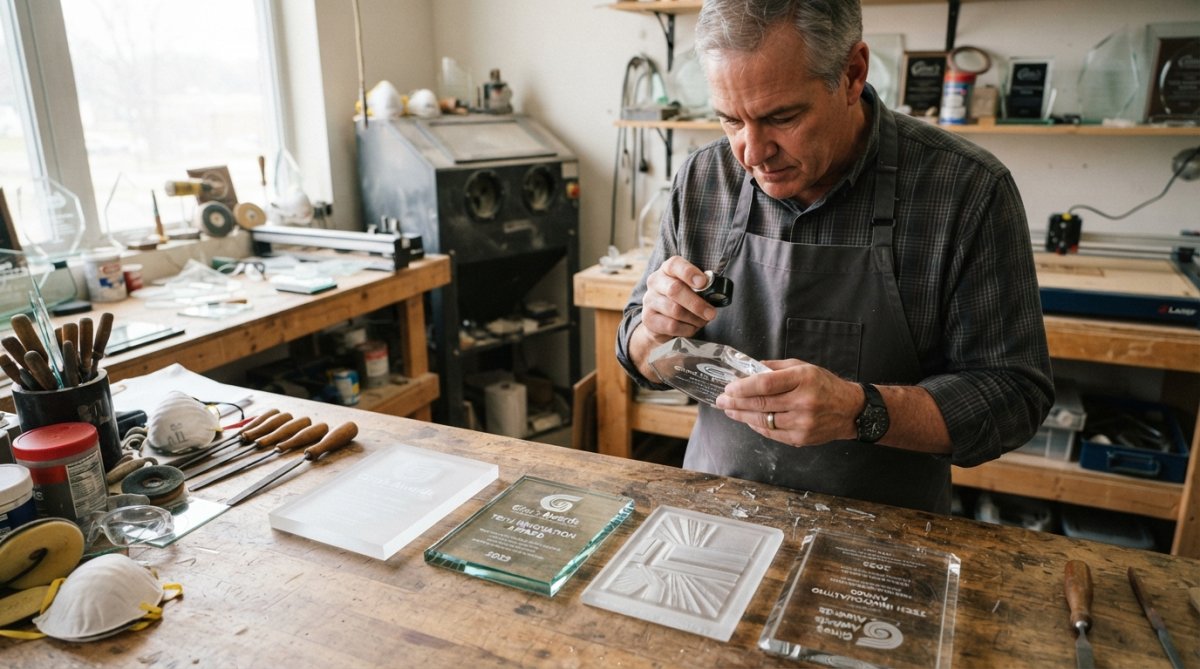
Deep etching refers to laser or rotary engraving that creates grooves deeper than standard surface engraving (typically 0.05 to 0.25 inches). Deep etching produces dramatic shadow effects and adds tactile dimension. Recipients can feel the engraved design when running their fingers across it.
Chemical etching uses acid or alkaline solutions to dissolve material in specific patterns. Chemical etching is rarely used for corporate awards today because laser and rotary engraving are faster and more precise.
Custom Corporate Award Personalization: Design Clarity and Branding
Personalization transforms a generic award into a meaningful recognition piece. Effective personalization requires clear branding, legible text, and design hierarchy. Your company logo should be prominent but not overwhelming. Employee names should be large enough to read from arm's length. Dates and achievement descriptions should be secondary but still visible.
The engraving technique you choose directly impacts personalization quality. Laser engraving preserves fine detail in logos and small text. Sandblasting softens edges, which works for bold designs but struggles with intricate logos or small text.
Vector Graphics and Logo Reproduction
Your logo must be converted to vector graphics before engraving. Vector graphics use mathematical curves and lines rather than pixels, so they scale infinitely without losing quality. A raster logo (JPG, PNG) won't engrave cleanly and requires redrawing as a vector file, which costs extra and introduces design change risks.
Logo reproduction on awards is where precision matters most. Laser engraving delivers the sharpest logo reproduction. Rotary engraving on metal also works well. Sandblasting is acceptable for bold logos but softens fine detail.
File Preparation Best Practices for Engravers
Design file requirements: Vector format (AI, EPS, PDF) with all fonts converted to outlines, single color or separated color layers if using color fill, minimum line weight of 0.01 inches, text minimum size of 0.125 inches, and high contrast between design elements.
Approval process: Request a digital proof showing exactly how your design will appear, verify text spelling and logo accuracy before approval, check that names or personalization are spelled correctly, and confirm color fills match your expectations.
Common mistakes to avoid: Submitting raster logos instead of vector files, using fonts that aren't embedded, requesting text smaller than 0.1 inches, assuming the engraver will "clean up" your design, and providing vague color specifications.
Comparing Corporate Award Etching Techniques: A Practical Framework
Choosing the right technique requires balancing aesthetics, durability, budget, and timeline. No single method is "best", the right choice depends on your specific needs.
Technique |
Best Material |
Design Detail |
Durability |
Cost |
Timeline |
|---|---|---|---|---|---|
Laser Engraving |
Crystal, acrylic, glass |
Excellent (fine lines, small text) |
Very good |
Moderate |
Fast (1-2 days) |
Subsurface Laser |
Optical crystal |
Good (3D effect) |
Excellent |
Higher |
Moderate (2-3 days) |
Sandblasting |
Glass, crystal |
Good (bold designs) |
Very good |
Lower |
Slower (3-5 days) |
Rotary Engraving |
Metal, wood |
Excellent (deep grooves) |
Excellent |
Moderate |
Fast (1-2 days) |
Hand Engraving |
Metal, crystal |
Excellent (artistic) |
Excellent |
High |
Slow (5-10 days) |
Chemical Etching |
Specialized metals |
Excellent (fine detail) |
Excellent |
High |
Moderate (3-5 days) |
Cost-Benefit Analysis and Durability Considerations
Laser engraving on acrylic offers the best value for high-volume orders. Cost per award is low, turnaround is fast, and results look professional. For employee recognition programs with 50+ awards, this approach makes sense financially.
Subsurface laser on crystal costs more per unit but creates a premium appearance that justifies higher price points. For executive awards or milestone recognition, the investment pays dividends in perceived value.
Rotary engraving on metal delivers durability that outlasts other methods. Metal plaques can last centuries without fading or degradation. If your awards will be displayed in high-traffic areas or exposed to the elements, metal with rotary engraving is the right choice.
Hand engraving is the premium option reserved for the most important recognition. Cost is 2-3 times higher than other methods, but the result is unmistakable quality. For C-suite awards or lifetime achievement recognition, hand engraving sends a powerful message.
Durability varies by technique and material. Laser-engraved crystal will look sharp for decades. Laser-engraved acrylic may show wear after 10-15 years if handled frequently. Metal engraving lasts indefinitely. Glass is durable but prone to chipping if dropped.
Maintenance and Longevity of Etched Surfaces
Most engraved awards require minimal maintenance. A soft cloth and warm water clean dust and fingerprints without damaging the engraved surface.
Crystal and glass are extremely durable. The engraved frosted areas won't fade or deteriorate. Avoid abrasive cleaners that might scratch the polished surface.
Acrylic requires gentler care. Avoid alcohol-based cleaners, which can cause crazing. Use only mild soap and water.
Metal plaques develop a natural patina over time, which many consider attractive. Use metal polish occasionally to preserve the original finish.
Color-filled engraving is durable as long as the resin is UV-stable. Standard epoxy resin will fade in sunlight. Premium color fills resist fading better, but nothing is completely UV-proof.
Engraved awards look professional decades later. Printed or adhesive labels fade, peel, and deteriorate. If your recognition program will be displayed long-term, engraving is the only choice that ages gracefully.
Sustainability and Eco-Friendly Etching Approaches
Laser engraving is relatively eco-friendly compared to other manufacturing processes. Modern CO2 lasers are energy-efficient, and the process produces minimal waste with no chemical byproducts or toxic fumes.
Sandblasting generates dust that must be captured and disposed of. Air filtration systems are required to prevent environmental contamination.
Chemical etching produces acid or alkaline waste requiring proper disposal and has the highest environmental impact.
Material choices matter significantly. Crystal and glass are infinitely recyclable. Acrylic is recyclable but less commonly recovered. Metal awards are fully recyclable. Choosing recyclable materials reduces overall environmental impact.
At Gino's Awards, Inc., we've worked to minimize waste in our Cleveland, Ohio facility by using efficient laser systems and optimizing material usage. We also offer recycled acrylic options for environmentally conscious clients.
The most sustainable choice is often the most durable choice. An award that lasts 50 years has lower environmental impact than one that degrades in 10 years. This is another reason crystal and metal engraving make sense for long-term recognition programs.
Choosing the right engraving technique for your corporate awards matters far more than most businesses realize. The difference between a laser-engraved crystal award and a poorly executed sandblasted acrylic piece is immediately visible when recipients hold them.
Gino's Awards, Inc. specializes in matching your recognition goals to the right engraving technique. With over 75 years of experience and on-site manufacturing in Cleveland, we deliver fast turnaround times, free personalization, and the precision that turns generic awards into meaningful recognition pieces. Call (216) 831-6565 to discuss your award needs and get a quote tailored to your budget and timeline.
Frequently Asked Questions
What are the main differences between laser engraving and sandblasting for corporate awards?
Laser engraving uses focused light to create precise marks on materials like crystal, glass, and acrylic, producing sharp detail and fine text legibility. Sandblasting uses abrasive particles to create a frosted, matte surface finish. Laser engraving offers faster turnaround and finer detail; sandblasting creates a softer, more traditional look. Laser works best on reflective surfaces; sandblasting excels on larger, bolder designs. Choose based on your desired aesthetic and material preference.
Which award engraving materials work best with different etching techniques?
Optical crystal and 3D crystal are ideal for laser engraving and subsurface laser technology, creating stunning depth effects. Glass and acrylic work well with both laser and sandblasting. Metal awards respond best to rotary engraving and hand engraving for precision. Deep etching and chemical etching suit metals and certain glasses. Acrylic awards offer versatility across multiple techniques. Your choice depends on the desired surface finish, durability needs, and customization complexity for your corporate recognition program.
How important is file preparation when submitting designs for award etching?
File preparation is critical for successful etching. Vector graphics ensure crisp, scalable designs without pixelation. High-resolution files prevent blurry text and logos. Specify exact dimensions, fonts, and color requirements if color fill is desired. Provide clear artwork with adequate contrast. Poor file preparation leads to design clarity issues, text legibility problems, and potential rework costs. Before submitting, verify that your logo reproduction matches your brand standards and that all text is spelled correctly to avoid costly corrections after approval.
What's the typical lifespan of etched corporate awards, and how do I maintain them?
Quality etched awards are designed for permanent recognition and can last decades with minimal maintenance. Laser-engraved crystal and glass require only occasional dusting with a soft cloth. Sandblasted surfaces may benefit from light cleaning to maintain the frosted finish. Metal awards with rotary or hand engraving maintain their appearance indefinitely if protected from extreme corrosion. Avoid abrasive cleaners that can scratch engraving grooves. Store awards in dry environments to prevent tarnishing. Proper care ensures your prestige awards remain legible and beautiful for years of display.
This article was written using GrandRanker