


Corporate Gala Award Presentation Tips: A Complete Guide
Table of Contents
- Define Your Ceremony Purpose and Award Categories
- Plan Your Event Budget and Logistics
- Select the Right Venue and Stage Design
- Master Award Presentation Script Examples
- Award Ceremony Timing: Creating the Perfect Pacing
- Corporate Award Ceremony Ideas for Guest Engagement
- Virtual Award Ceremony Tips and Hybrid Event Logistics
- Technical Production, AV Support, and Lighting
Corporate Gala Award Presentation Tips: A Complete Guide
Last Updated: July 29, 2026
When Gino's Awards, Inc. works with corporate clients planning their annual galas, one question surfaces consistently: how do you transform an awards ceremony from forgettable to unforgettable? The answer lies in mastering corporate gala award presentation tips that go beyond simply handing out plaques. The ceremonies that stand out treat awards as strategic moments, opportunities to reinforce culture, celebrate achievement, and build momentum for the year ahead.
This guide covers the essential strategies for executing a gala your team will remember.
Define Your Ceremony Purpose and Award Categories
Your ceremony needs a clear mission before you book a venue or order awards. The purpose shapes everything, from event duration to which awards you highlight and how your emcee frames each presentation.
Start by asking what you want your ceremony to accomplish. Are you recognizing top performers to drive competition? Celebrating company values to reinforce culture? Marking a milestone year? These goals demand different approaches.
Once your purpose is locked, design award categories that align with it. Generic categories like "Employee of the Year" work, but they miss an opportunity. Consider creating categories that reflect your corporate values or strategic priorities. A tech company might include "Innovation Award" and "Collaboration Excellence." A nonprofit might emphasize "Community Impact" and "Volunteer Leadership." Specific categories tell a story about what your organization actually values.
Research from Harvard Business Review on organizational culture shows that recognition tied to specific values reinforces those behaviors across teams. The number of award categories depends on your organization size and event duration. A good rule: one award per 20-30 employees, capped at 8-10 major categories.
Plan Your Event Budget and Logistics
Budget planning for a corporate gala requires thinking beyond obvious line items. Most teams account for venue, catering, and entertainment but underestimate AV coordination, staff time, contingency reserves, and the physical awards themselves.
Start with your total budget ceiling, then work backward. Allocate roughly:
- Venue and catering: 40-50% of total budget
- Entertainment and AV/technical support: 20-25%
- Awards, decor, and materials: 15-20%
- Staffing, contingency, and miscellaneous: 10-15%
Create a clear ownership matrix before you start. Someone needs to manage vendor coordination, someone else handles guest confirmations, another person owns the awards engraving timeline. Build in buffer time for every critical path item. If you're ordering custom awards through Gino's Awards, Inc., factor in their turnaround time plus 2-3 weeks for your own proofing and approval process.
Select the Right Venue and Stage Design
Your venue choice determines the ceremony's tone before anyone arrives. A ballroom says "formal celebration." A warehouse with exposed brick says "creative, energetic." Choose accordingly.
When evaluating venues, walk through the actual space during the time of day your event will occur. Lighting changes everything. Ask about house lighting capabilities, good venues let you control ambient light to match your event's energy.
Stage design deserves serious attention. Request a floor plan showing all seating, then verify that every seat has a clear view of the stage. You want enough space for the emcee to move, for recipients to walk to the podium without bumping into anyone, and for a genuine moment before the next award begins.
Lighting and backdrop elevate the entire experience. Professional stage lighting, even basic uplighting and spotlights, transforms a generic hotel ballroom into a branded space. A simple backdrop with your company logo or event theme photographs dramatically better than a blank wall.
Master Award Presentation Script Examples
A scripted presentation doesn't mean robotic, it means intentional. The best award presentations follow a clear structure: context, nominee recognition, the award itself, and a moment of genuine celebration.
Opening Remarks and Emcee Transitions
Your emcee sets the tone for the entire ceremony. A strong emcee creates energy, manages pacing, and makes transitions feel natural rather than clunky.
A solid opening script might follow this pattern:
Good evening, everyone. Thank you for being here tonight. We've had an extraordinary year, we hit our revenue targets, launched three new products, and grew our team by 25%. But the numbers don't tell the real story. The real story is the people in this room. Tonight, we're here to recognize the individuals who made that growth possible. We're celebrating people who went beyond their job descriptions, who lived our values, and who lifted their teams in the process.
This grounds the ceremony in concrete achievement, connects that achievement to people, and frames the awards as recognition of behavior that matters.
Transitions between awards matter more than most people realize. Instead of "Next award, please," try connecting the awards thematically:
We've celebrated innovation and collaboration. Now let's recognize the people who ensure our operations run like clockwork. The Operational Excellence Award goes to...
Nominee Recognition and Award Presentation Flow
When you announce an award winner, the nominee recognition section is where you build genuine emotion. Tell the story of why they won.
A strong nominee recognition script includes three elements: what they did, why it mattered, and how it embodied your values.
Sarah joined our marketing team two years ago. This year, she led the rebrand project, a massive undertaking that required coordinating across five departments and managing a compressed timeline. What impressed me wasn't just her project management skills. It was how she treated people. Team members told me she made them feel heard, celebrated their contributions, and never let the pressure of deadlines erode her kindness. That's what our value of "respect" looks like in action. Sarah, please come accept the Excellence in Collaboration Award.
The award presentation flow should be: emcee reads nominee recognition → audience applauds → nominee walks to stage → brief moment of acknowledgment → nominee returns to seat. Keep it tight.
Closing Remarks and Call to Action
Your closing remarks should reinforce the ceremony's purpose and leave people energized. A strong closing is 3-4 minutes maximum.
Tonight, we've recognized 12 people who embody what makes this company special. But here's the truth: recognition is only one part of the equation. The other part is all of you, in your daily work, making choices that align with our values. The people we celebrated tonight didn't do anything extraordinary. They did ordinary work extraordinarily well. They showed up with intention. They cared about their teammates. They focused on impact. That's what we're celebrating. As you leave tonight, I want you to think about one way you can bring that same intention to your work next week. Thank you for being here.
Award Ceremony Timing: Creating the Perfect Pacing
Pacing determines whether your ceremony feels tight and engaging or bloated and exhausting. A common mistake is underestimating how long each element takes.
Here's a realistic timeline for a 10-award ceremony with 150 guests:
| Element | Duration | Notes |
|---|---|---|
| Welcome and opening remarks | 5-7 min | Sets tone, brief and energetic |
| Award 1-3 presentations | 12-15 min | ~4-5 min each |
| Break / entertainment | 10-15 min | Prevents fatigue, allows mingling |
| Award 4-7 presentations | 12-15 min | ~4-5 min each |
| Special recognition or keynote | 8-10 min | Optional but impactful |
| Award 8-10 presentations | 12-15 min | ~4-5 min each |
| Closing remarks | 3-4 min | Energetic, brief |
| Total | 60-75 min | Excludes pre-ceremony cocktails |
Don't run awards back-to-back for an hour. Insert breaks. Let the audience stand, move, grab a drink. This prevents the glazed-over look that sets in around award six.
Corporate Award Ceremony Ideas for Guest Engagement
A ceremony where people sit passively and watch is a missed opportunity. The best award ceremonies create moments of genuine engagement and connection.
Live Entertainment and Walk-Up Music
Live entertainment breaks up the award presentations and maintains energy. A solo musician, a brief comedy set, or a well-curated playlist with live vocals works effectively.
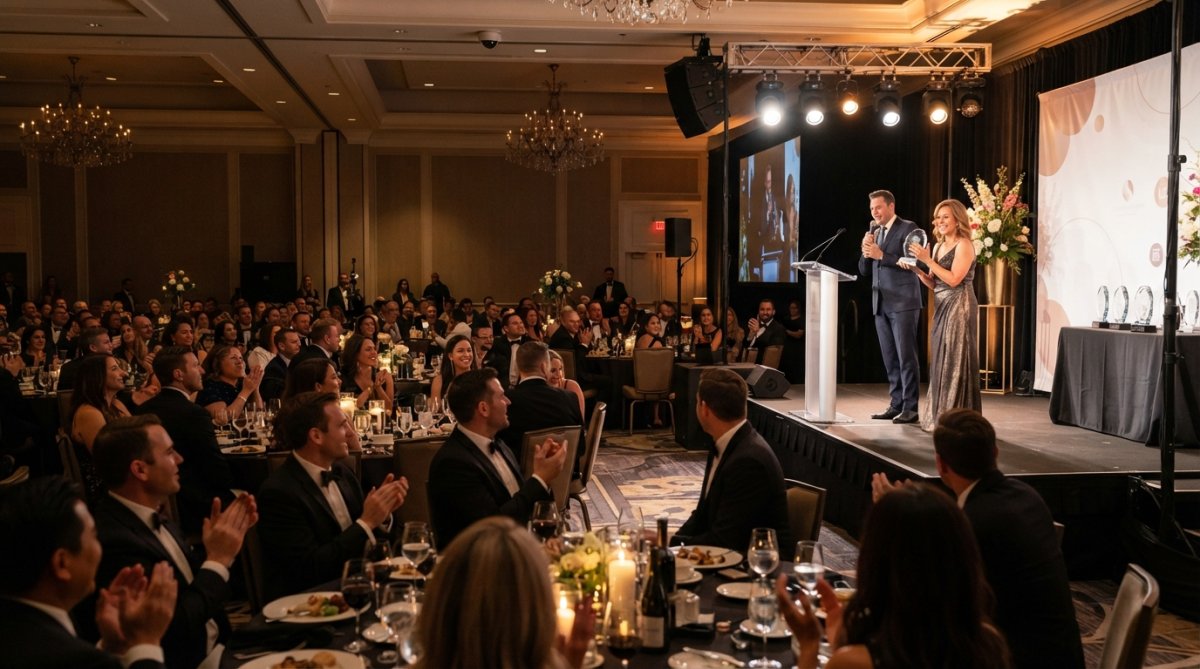
Walk-up music, the song that plays as the award winner walks to the stage, creates a moment of celebration. Choose music that fits your company culture. The walk-up music should be 30-45 seconds long, just enough for the winner to reach the stage, shake hands, and pose for a photo.
Interactive Elements and Networking Opportunities
Most award ceremonies have a predictable structure: sit, listen, applaud, repeat. Breaking that pattern creates memorable moments.
Consider adding interactive elements: audience voting on certain awards, a peer recognition wall where attendees write brief messages recognizing colleagues, a branded photo booth with props, or networking tables that mix departments instead of assigning by department.
Virtual Award Ceremony Tips and Hybrid Event Logistics
If your team is distributed or you want to include remote employees, virtual or hybrid award ceremonies present unique challenges.
Virtual award ceremonies require multiple camera angles, professional lighting, and clear audio. A single static camera doesn't work, it's boring and hard to follow.
For hybrid events, ensure that remote attendees can see the stage clearly, hear the audio without lag, and feel included rather than like second-class participants. This requires a dedicated AV operator managing camera angles and audio levels throughout the event.
Virtual attendees need something to do during breaks. Build in structured breaks, a 10-minute "networking breakout room" where remote employees can chat with colleagues, or a brief video message from leadership.
Virtual award ceremonies also change pacing. What feels natural in-person feels like dead air on video. Tighten your pacing for virtual events. Keep transitions snappy.
Clarify the logistics of physical awards. Will winners receive their award by mail? Will they come to an office to pick it up? Will you ship it immediately after the ceremony?
Technical Production, AV Support, and Lighting
The difference between a ceremony that feels polished and one that feels amateur often comes down to technical execution.
Professional AV support means having a dedicated operator who manages audio levels, camera angles, and transitions throughout the event. This person should arrive hours early to test microphone levels, verify that video content plays correctly, and confirm that the emcee can hear cues and timing signals.
Audio is often the most overlooked element. A microphone that cuts out during an award presentation derails the moment. Invest in quality audio equipment and a trained operator.
Lighting transforms a generic hotel ballroom into a branded space. Professional stage lighting should include spotlights on the emcee and award recipients, uplighting on the stage backdrop to add depth, and ambient lighting that can be dimmed or brightened to match the ceremony's energy.
Video content deserves attention. If you're showing nominee highlight reels, company videos, or testimonials, ensure they're professionally edited and properly integrated into the ceremony flow. The technical rehearsal, running through the entire ceremony with all AV elements, is non-negotiable.
A corporate gala award presentation requires attention to dozens of details, but the fundamentals are consistent: clear purpose, intentional pacing, genuine recognition, and polished execution. When you combine these elements, you create a ceremony that people talk about for months afterward.
For the physical awards themselves, Gino's Awards, Inc. has been the trusted partner for organizations since 1950. We specialize in custom-engraved plaques and awards that feel premium in hand, the kind of recognition that employees actually value and keep on their desks. With fast turnaround times, free personalization, and made-in-America quality, we handle the details so you can focus on the ceremony itself. For a quote on custom awards for your next gala, call (216) 831-6565 or visit our website. Your recognition moments deserve awards as exceptional as the people receiving them.
Frequently Asked Questions
What are the key elements of a successful corporate gala award presentation?
A successful corporate gala award presentation combines clear ceremony objectives, well-paced event flow, professional emcee transitions, engaging nominee recognition, and quality AV support. Essential elements include defining award categories aligned with corporate values, scripting opening and closing remarks, managing speaker timing, and creating moments of audience engagement through live entertainment or interactive elements. The physical award itself, whether a custom plaque or trophy, should reflect the prestige of the recognition. Planning begins 8-12 weeks prior to ensure all logistics, from venue selection to catering, align with your event objectives.
How long should a corporate award ceremony last, and what's the ideal award ceremony timing?
Most corporate award ceremonies run 60-90 minutes for optimal attendee engagement and retention. Opening remarks typically take 5-10 minutes, individual award presentations 2-4 minutes each, and closing remarks 5-10 minutes. Pacing is critical: intersperse awards with live entertainment, video tributes, or networking breaks to maintain energy. A gala dinner component can extend the event to 3-4 hours total. Avoid back-to-back presentations without breaks, as this fatigues the audience. Test your event timeline in advance to ensure smooth emcee transitions and no dead time between segments.
What should I include in an award presentation script?
An effective award presentation script includes: (1) an engaging opening that sets the tone and explains the award's significance, (2) a brief nominee bio highlighting their achievement, (3) a clear statement of why they won, (4) a call to the stage with walk-up music, and (5) a warm closing remark. Keep each script 90-120 seconds. Use conversational language, not corporate jargon. Personalize each script with specific examples of the recipient's impact. Include pauses for applause and photo opportunities. Provide scripts to your emcee in advance with pronunciation guides for names and titles to avoid errors during the live ceremony.
How do I present awards virtually or in a hybrid format?
Virtual award ceremony tips include: (1) Use professional video conferencing with high-quality camera angles and lighting, (2) Pre-record award winner announcements or conduct live video calls with remote recipients, (3) Ship physical awards to remote attendees beforehand so they can hold them during the announcement, (4) Use screen sharing to display nominee bios, photos, and corporate values alignment, (5) Ensure strong internet bandwidth and have a backup internet connection, (6) Schedule technical rehearsals with all speakers and honorees, (7) Create engaging visuals, holographic projections or animated award graphics, to compensate for lack of in-person energy. Hybrid events require separate runsheets for in-person and virtual segments with clear timing cues.
What creative corporate award ceremony ideas keep guests engaged?
Engagement strategies include: (1) Pair award presentations with live entertainment, musicians, comedians, or dancers, between categories, (2) Use walk-up music and professional lighting to create excitement when winners approach the stage, (3) Incorporate video tributes or peer testimonials before announcing winners, (4) Host a photo booth or neon lighting backdrop for post-award photos, (5) Offer bespoke drinks or specialty catering tied to the event theme, (6) Create networking opportunities with a cocktail hour before or after the ceremony, (7) Use interactive elements like audience voting for fan-favorite awards, (8) Offer premium seating or special recognition for top-tier honorees. The goal is balancing formal recognition with memorable, shareable moments.
How do I measure the success of my corporate gala after the event?
Post-event ROI measurement includes: (1) Track attendance numbers and compare to target, (2) Conduct post-event surveys to measure attendee satisfaction and engagement, (3) Monitor social media mentions, hashtags, and photo shares from the event, (4) Calculate retention rates of honored employees over the following 6-12 months, (5) Measure internal engagement metrics, repeat award nominations, increased employee referrals, to assess morale impact, (6) Gather feedback from emcees and speakers on pacing and flow, (7) Document cost per attendee and compare to budget, (8) Assess brand perception and corporate values alignment through follow-up interviews. Use this data to refine future events and justify investment in recognition programs.
What sustainability and green event practices should I consider for a gala?
Sustainable gala practices include: (1) Choose venues with LEED certification or strong environmental practices, (2) Minimize printed materials, use digital programs and signage instead, (3) Source catering from local vendors to reduce carbon footprint, (4) Use reusable or compostable serving ware instead of single-use plastics, (5) Select awards made from recycled or sustainable materials, or choose digital recognition options, (6) Implement waste management with recycling and composting stations, (7) Encourage carpooling or provide shuttle service to reduce attendee transportation emissions, (8) Use LED lighting to reduce energy consumption. Communicate your sustainability commitment to guests, it aligns with corporate values and enhances brand reputation.
This article was written using GrandRanker