


How Laser Engraving Benefits Award Recognition
Quick Summary
Laser engraving produces permanent, precise text and artwork on many materials, so each award carries exact names, dates and logos. Software-driven beams reproduce the same design consistently across an entire order, which matters for large recognition programs.
- The engraved mark is part of the material, so it does not wear off like paint or printed vinyl.
- Vector logo files generally give the cleanest engraving result.
- Test the exact material and design combination before running the full order.
- Match the material to handling and display: acrylic and glass for indoor pieces, metal and wood for frequent handling.
Table of Contents
- Why Laser Engraving Stands Out for Award Recognition
- Precision and Fine Detail: Logos, Small Print and Sharp Corners
- Laser Engraving Materials: Acrylic, Glass, Wood, Metal and Crystal Compared
- Laser vs. Rotary Engraving for Awards: Which Method Fits Your Program
- Laser Engraving Trophies, Plaques and Medals for Recognition Programs
- Award Design Ideas and Artwork Preparation for Laser Engraving
- Choosing Your Next Engraved Award With Gino's Awards
- Frequently Asked Questions
Why Laser Engraving Stands Out for Award Recognition
Laser engraving is a method used to personalize recognition pieces, and it earns its place because it produces permanent, precise text and artwork on many materials. Recognition programs depend on details like names, service years and logos being exactly right, and a laser beam controlled by software reproduces that artwork the same way on every piece.
A laser engraver directs a focused beam onto the surface of an award, vaporizing or discoloring a thin layer of material to leave a mark. Because the path is driven by a digital file rather than a hand-guided tool, the result matches the artwork closely from one plaque to the next. That consistency matters when an HR team orders forty service anniversary awards over a single quarter.
Several benefits set laser engraving apart for recognition work:
- Permanence: The mark is part of the material itself, so it does not wear off like paint or printed vinyl.
- Personalization: Names, dates, logos and short messages can change on every piece in the same run.
- Material range: The same process works on acrylic, glass, wood, metal and crystal, which lets a program keep one visual style across different award tiers.
- Clean presentation: Engraved text reads as deliberate and high-end, which suits executive and gala settings.
A common mistake is treating engraving as a cosmetic final step. The artwork file, the material choice and the font weight all shape how the finished award looks, so they should be settled before production begins.
Precision and Fine Detail: Logos, Small Print and Sharp Corners
Fine detail is where laser engraving separates itself from older methods. A thin beam can reproduce hairline strokes, small type and intricate logo edges that would be difficult to cut by hand. For a corporate logo with thin lines or a service emblem with tiny lettering, this precision keeps the brand mark recognizable.
Small print has practical limits, however. Text that is too small or too thin can blur on certain materials, particularly darker surfaces where the contrast between the engraved area and the surface is low.
Sharp corners and clean edges also depend on the material. Acrylic and metal generally hold crisp corners well, while wood grain can soften edges slightly. Knowing this in advance lets you choose a typeface and logo style that will reproduce cleanly on the chosen surface.
A logo file that looks sharp on screen may still engrave poorly if it is a low-resolution raster image. Vector artwork generally gives the cleanest result.
Laser Engraving Materials: Acrylic, Glass, Wood, Metal and Crystal Compared
Material choice affects appearance, durability and cost more than most buyers expect. Each surface responds to the laser differently, so the same design can look quite different from one material to another. The comparison below explains what each material actually does under the beam, where it falls short, and when to pick it.
- Acrylic: The laser vaporizes a thin layer to leave a frosted white mark that stands out against clear or colored acrylic. Acrylic is lightweight and holds small text and fine lines well. Limitation: acrylic scratches and can craze or crack under impact, so it suits indoor display better than rough handling.
- Glass and crystal: The beam creates a subtle frosted mark that catches light. Limitation: fine text needs careful sizing because low contrast between the frosted mark and the clear body can make small type hard to read at a distance.
- Wood: Engraving burns or carbonizes the surface, giving a warm, natural finish. Limitation: grain direction and density can make thin strokes uneven, and soft woods can char or blur fine detail.
- Metal: The laser removes or anneals a coating or marks the bare surface, producing a durable result. Limitation: bare polished metals may show low contrast unless a coating or fill is used, and simple, bold designs read best.
A practical selection rule: match the material to how the award will be handled and displayed. Indoor desk and wall pieces suit acrylic and glass; pieces that will be handled frequently or mounted outdoors suit metal and wood.
Always test the actual material and design combination before a full run, because contrast, grain and coating differences can turn a proof that looked right on screen into a mark that reads poorly on the finished piece. For current pricing and a quote on a specific piece, contact Gino's Awards, Inc. directly.
Laser vs. Rotary Engraving for Awards: Which Method Fits Your Program
Rotary engraving uses a spinning cutting tool to carve into a surface, and it remains common for traditional trophies and cast-metal pieces. Laser engraving uses light energy instead of a physical tool, so it does not wear down a bit.
The comparison below summarizes how the two methods typically differ for award work:
| Factor | Laser engraving | Rotary engraving |
|---|---|---|
| Fine detail | Strong for small text and thin logo lines | Limited by tool size |
| Material range | Acrylic, glass, wood, metal, crystal | Mostly metal and hard materials |
| Customization per piece | Easy to change on each item | Setup can take longer |
| Edge quality | Clean on suitable materials | Depends on tool condition |
| Best for | Personalized, detailed recognition pieces | Traditional, high-relief metal pieces |
Laser engraving fits programs that need many personalized pieces with fine artwork. Rotary methods may still suit a program that wants a classic, deeply carved look on a specific metal trophy. Many programs use both, matching the method to each award tier.
Laser Engraving Trophies, Plaques and Medals for Recognition Programs
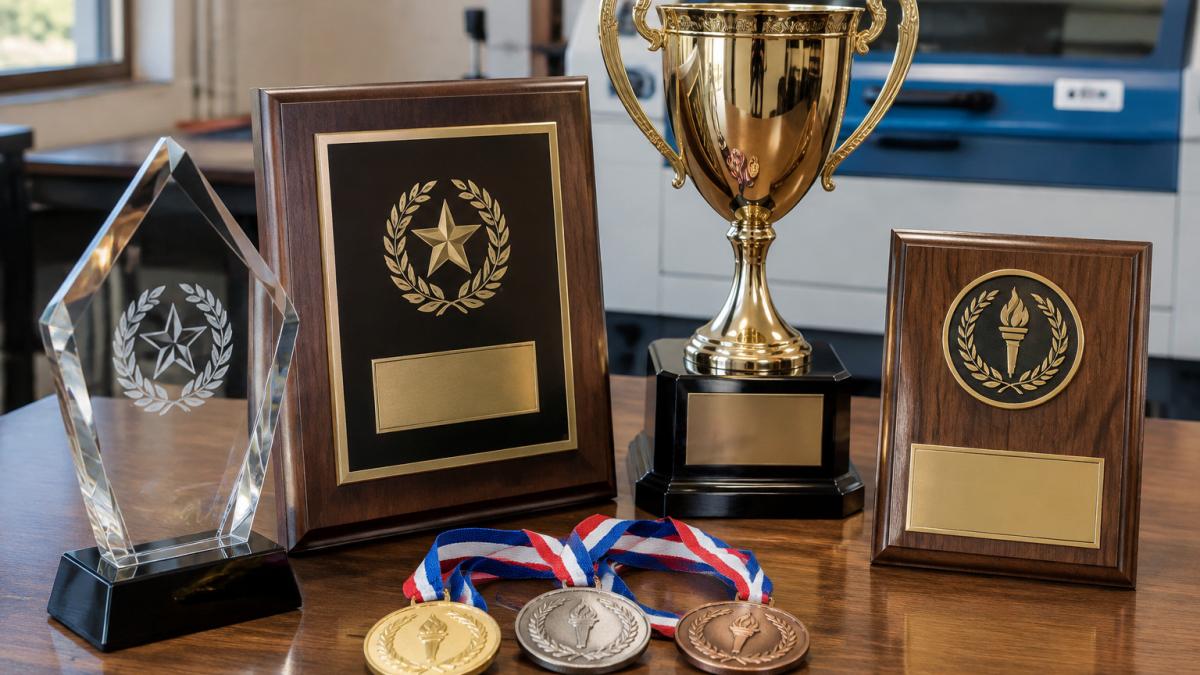
Trophies, plaques and medals each suit a different level of recognition. Trophies work well for team athletics and competitions, where a dimensional piece reads as an achievement. Plaques suit service anniversaries and retirements, because the flat surface gives room for names and dates.
When you choose a format, consider how much text it must carry and where it will be displayed. A plaque with a long list of names needs more surface area than a single-name trophy. If you are weighing options for a team or championship, see how custom ring designs are made and ordered on Design Custom Championship Rings for Teams.
The person in the photo is American.
Award Design Ideas and Artwork Preparation for Laser Engraving
Good engraving starts with a clean file, and the choices made before production determine how the finished award looks. Vector formats such as SVG, AI, EPS or PDF let the engraver trace exact lines at any size, while high-resolution raster files work only for simpler designs. Confirm that text is converted to outlines or that the fonts are supplied, so the layout does not shift when the file opens on the production system.
Logo quality is the most common failure point. A logo that looks sharp on a website may be a low-resolution raster image that engraves with jagged edges or fills in small gaps. Request the original vector logo from the brand owner, or have a clean version redrawn before production.
Design choices also affect readability at viewing distance. Use one or two typefaces, keep recipient names large enough to read from several feet away, and leave margins between text and the edge of the piece so the mark does not crowd the border. For recognition programs, a repeatable layout, logo at the top, recipient name in the center, achievement line below, keeps a series of awards looking consistent over several years and makes reorders faster.
Contrast matters as much as size. Light text on a dark surface or dark text on a light surface reads best; low-contrast combinations, such as frosted marks on clear glass, need larger type and bolder strokes to stay legible. For inclusive design, avoid all-caps for long names, keep line spacing generous, and confirm that names with accents, hyphens or unusual spellings are entered correctly in the artwork file.
Proofing is the last line of defense. Review the proof carefully for spelling, name order, dates, titles and logo placement before production. A common pattern is to have a second person check names against the source list, since the person who typed the file often reads what they expect rather than what is there.
A proof approved on a phone screen can hide small errors, so review it at full size and zoom in on every name and date before signing off. For help preparing a file, contact Gino's Awards, Inc. directly.
Choosing Your Next Engraved Award With Gino's Awards
Start by matching the award format to the program: trophies for competitions, plaques for long-term recognition, medals for events and compact keepsakes. Then choose a material that suits the setting, from acrylic and wood for everyday service awards to crystal and metal for executive presentations.
Gino's Awards, Inc. manufactures awards in Cleveland, Ohio, with free personalization included and fast turnaround. Free shipping applies to orders over $50. For current pricing and a quote tailored to your program, call (216) 831-6565.
Frequently Asked Questions
What are the advantages of laser engraving for awards?
Laser engraving produces sharp, permanent marks on awards without the tool wear of traditional cutting. It reproduces logos, small print and fine lines accurately, works on acrylic, glass, wood and metal, and keeps engraved text legible over years of display. For recognition programs that need consistent, professional results across many pieces, laser engraving keeps every award looking uniform. Pricing depends on quantity, materials, dates and delivery, so request a quote from Gino's Awards for current costs.
How does laser engraving compare with rotary engraving for awards?
Laser engraving uses a focused beam to mark the surface, which gives finer detail, cleaner edges and better reproduction of logos than rotary engraving, which uses a spinning bit to cut grooves. Rotary engraving can suit deep, traditional cuts in some metals. Gino's Awards can advise which method suits your material and design.
Which award materials work best with laser engraving?
Acrylic, glass, wood and metal are common award materials for laser engraving. Choosing the right material depends on the award's setting and expected handling.
Can laser engraving reproduce logos and fine details on awards?
Yes. Laser engraving reproduces logos, fine lines, small type and sharp corners accurately when the artwork is prepared correctly. Vector files with clean lines and high-resolution images produce the most accurate results. Gino's Awards offers free personalization.