


How to Avoid Typos on Awards: A Complete Checklist
Table of Contents
- Why Typos on Awards Matter More Than You Think
- Understanding Award Inscription Mistakes and How to Spot Them
- Step-by-Step: How to Avoid Typos on Awards Before Submission
- Proofreading Award Certificates: Advanced Techniques for Accuracy
- Engraving Error Prevention: Protecting High-Stakes Documents
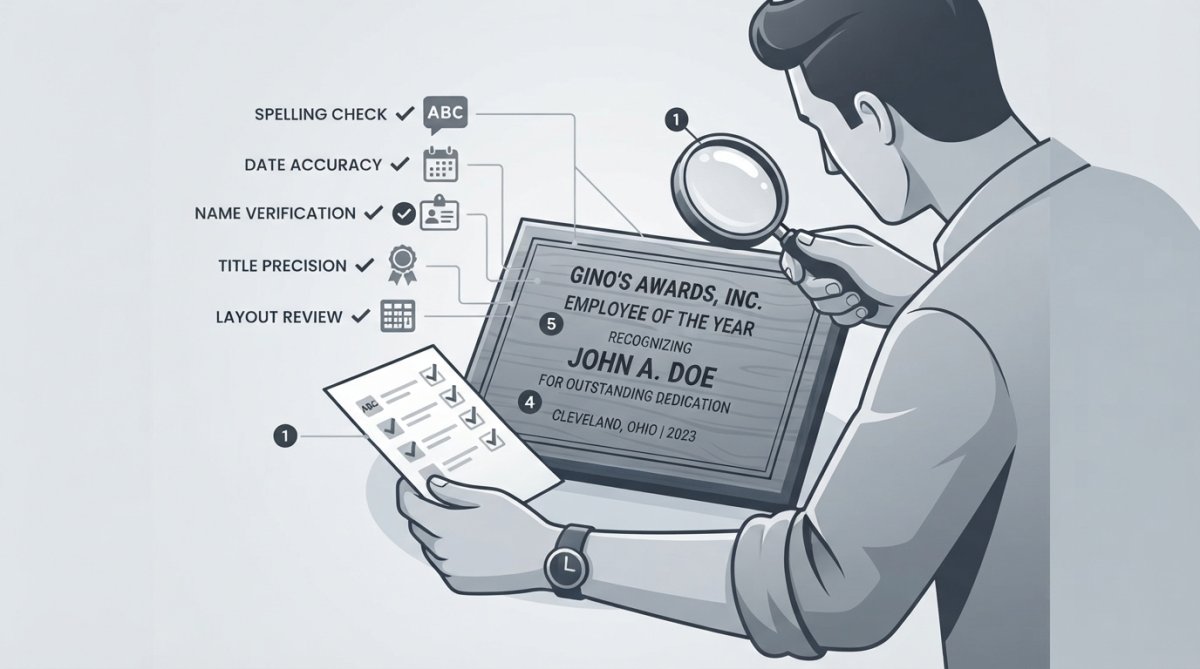
- Checklist for Award Accuracy: Your Pre-Submission Verification Tool
- Common Mistakes to Avoid When Ordering Custom Awards
- Partnering with a Reliable Awards Provider for Error-Free Results
Last Updated: July 23, 2026
Why Typos on Awards Matter More Than You Think
A misspelled name on a recognition plaque, an incorrect date on a certificate, or a missing word in an engraved message undermines the entire purpose of the award. At Gino's Awards, Inc., we've seen firsthand how a single typo diminishes the meaning of an achievement someone worked hard to earn. Unlike a typo in an email that can be quickly corrected, awards are permanent. They sit on desks, hang on walls, and get displayed in offices for years. They're photographed, shared on social media, and become part of official company records. A mistake on an award is visible, public, and irreversible without costly replacement.
Understanding Award Inscription Mistakes and How to Spot Them
Award inscription mistakes fall into predictable categories. Understanding these patterns helps you know exactly what to look for during proofreading.
Common Typos and Spelling Errors
Spelling errors on awards typically come from three sources: autocorrect mishaps, phonetic misspellings, and keystroke errors. Autocorrect is particularly dangerous because it replaces your intended word with a real word that looks correct at first glance. A name like "Shaun" becomes "Shawn." Your spell checker won't flag these because they're real words. The most common spelling mistakes involve double letters being reduced to single letters, vowel substitutions (e/a, i/o), and silent letters being included incorrectly.
Name Misspellings and Formatting Issues
Names require special attention because they're the most personal element of an award. A misspelled name signals the organization didn't care enough to get it right. Name errors typically involve first and last name reversal, missing or incorrect middle initials, dropped parts of hyphenated names, and simplified cultural name variations (José becomes Jose, Müller becomes Muller). Consistency matters because inconsistency signals carelessness.
Step-by-Step: How to Avoid Typos on Awards Before Submission
A systematic approach to proofreading catches errors that random scanning misses. Each technique catches errors the previous method overlooked.
Step 1: Draft with Intention and Clarity
Before proofreading, your draft needs to exist in its final form. Decide exactly what text will appear: the recipient's full legal name, the exact award title, the specific achievement, dates, organizational details, and any additional text. Write this information in a document separate from the award design. Use a consistent format throughout: decide whether names will be "First Last" or "Last, First," whether titles will be capitalized, and whether dates will be written out or abbreviated.
Step 2: Use Spell Check and Grammar Tools Strategically
Spell check is essential but insufficient. Modern tools catch misspellings and grammar errors, but they miss context-dependent mistakes. Copy your award text into a dedicated grammar tool like Grammarly or the Hemingway Editor. However, review each suggestion carefully, tools sometimes suggest changes that would be incorrect in an award context.
Step 3: Read Your Content Aloud
Reading text aloud engages a different part of your brain than silent reading. You're forced to process each word individually rather than skimming. Slow down deliberately and pay special attention to names and numbers.
Step 4: Change Font Style or Size for Fresh Perspective
Your brain becomes accustomed to text appearance. Changing the visual presentation forces your brain to re-read it as new. Change the font to something dramatically different from the award's final font or try changing the font size to 18-point or larger.
Step 5: Read Text Backwards for Accuracy
Reading backwards forces you to focus on individual words rather than meaning. Start at the last word and read each word individually moving backwards. This technique is particularly effective for catching misspelled names, repeated words, and transposed letters.
Proofreading Award Certificates: Advanced Techniques for Accuracy
Beyond the basic five-step process, advanced techniques catch errors that standard methods miss.
Take a Break Before Proofreading
Your brain needs distance from your own writing to see it objectively. If you proofread immediately after drafting, your brain fills in missing words and corrects misspellings automatically. Set a minimum time gap between drafting and proofreading. For simple awards, 24 hours is sufficient. For complex awards, wait 48 hours or longer.
| Proofreading Stage | Time Gap | Best For |
|---|---|---|
| Initial draft review | Same day | Catching obvious errors, structural issues |
| First serious proofread | 24 hours | Spelling, formatting, name accuracy |
| Final verification | 48+ hours | Logic errors, consistency issues, missed details |
Get Fresh Eyes Through Peer Review
Your own eyes will miss errors that someone else catches immediately. Choose someone who has not seen the award text before, has attention to detail, and can ask clarifying questions. Give them the text in isolation, separate from the design.
Line Editing for Clarity and Conciseness
Award language should be concise, powerful, and free of jargon. Every word should earn its place. Read through the text line by line and ask: Can this sentence be shorter? Is this word the strongest choice? Does this phrase add meaning or is it filler? For example: "This award is presented to [Name] in recognition of their outstanding efforts and dedication to excellence in the field of customer service" is wordy. Stronger: "This award recognizes [Name]'s excellence in customer service."
Engraving Error Prevention: Protecting High-Stakes Documents
Once an award is engraved or printed, errors become permanent. Prevention is far cheaper than replacement.
The Psychology of Blind Spots in Proofreading
Your brain is wired to see what it expects to see. When you read your own writing, your brain doesn't read every letter, it recognizes word shapes and patterns. You see "Smith" even if the text says "Smyth." Understanding these blind spots is the first step to overcoming them. You can't eliminate them entirely, but you can work around them by using techniques that force different text processing: reading aloud, reading backwards, changing fonts, taking breaks, and getting fresh eyes.
Why Automation Alone Isn't Enough
Spell checkers and grammar tools are valuable but have fundamental limitations. They catch surface-level errors and obvious mistakes. They miss context-dependent errors like a correct name belonging to the wrong person, a date that's technically correct but refers to the wrong year, or inconsistency within the same document. Think of automation as a filter, not a solution.
Checklist for Award Accuracy: Your Pre-Submission Verification Tool
Before submitting an award to production, work through this detailed checklist.
Names and Spelling Verification
- Recipient's first name is spelled correctly (verify against official records)
- Recipient's last name is spelled correctly (check for common variations)
- Middle initial or middle name is included if required, omitted if not
- Suffix is correct if applicable (Jr., Sr., III, Ph.D., M.D., Esq.)
- First and last names are not reversed
- Hyphenated names are hyphenated consistently throughout
- Names with accents or special characters are rendered correctly
- All proper nouns are capitalized consistently
- No names appear twice unless intentional
- Spell check has been run and all suggestions reviewed
Dates, Titles, and Organizational Details
- Award date is correct (the actual presentation date, not the order date)
- Year is correct
- Date format is consistent throughout
- Recipient's job title matches their official title
- Department name is spelled correctly and matches official records
- Company or organization name is spelled correctly and capitalized consistently
- Award name is spelled correctly and capitalized consistently
- Any referenced achievements or metrics are accurate
Design, Formatting, and Final Review
- Text is centered or aligned consistently
- Font size is readable when engraved
- Line breaks occur at logical places
- All text fits within the designated space
- Punctuation is consistent
- Quotation marks or special characters are rendered correctly
- Color contrast is sufficient if applicable
- The award has been proofread by someone other than the writer
- The award text has been read aloud
- The award text has been read backwards
- A final visual inspection confirms all text matches the approved version
Common Mistakes to Avoid When Ordering Custom Awards
Most award errors happen during the ordering process, not the design phase. The first mistake is assuming the award vendor will catch errors. While professional award makers like Gino's Awards, Inc. do review orders carefully, they're looking for production issues, not contextual errors. You must verify content accuracy before submission.
The second mistake is rushing the approval process. When timelines are tight, people skip steps, no break before proofreading, no peer review, no reading aloud. Build in extra time specifically for proofreading. The third mistake is not requesting a proof before production. A proof is a mockup showing exactly how the text will appear. Review it carefully against your original text and official records.
Partnering with a Reliable Awards Provider for Error-Free Results
The awards provider you choose significantly impacts your ability to avoid typos. A reliable provider has systems in place to catch errors, communicates clearly about what will be engraved, and offers proofs for review.
Gino's Awards, Inc. has been manufacturing custom awards since 1950. They provide free personalization, working with you to get details right. They offer fast turnaround times, even on rush orders, without sacrificing accuracy. Their on-site manufacturing facility in Cleveland, Ohio means they have direct control over quality and can catch errors before awards leave production.
When choosing an awards provider, ask about their proofreading process. Do they provide proofs? How long do they allow for proof review? What happens if you catch an error in the proof? A good provider will ask clarifying questions about your order and flag anything that seems unusual or potentially incorrect.
Typos on awards damage the meaning of recognition and hurt the people being honored. The proofreading process outlined here, drafting with intention, using tools strategically, reading aloud, changing visual presentation, reading backwards, taking breaks, getting peer review, and working through the detailed checklist, catches errors that would otherwise slip through.
When you're ready to order, partner with Gino's Awards, Inc. Their 75+ years of experience, on-site manufacturing, and free personalization ensure your awards reflect the quality of the achievement being recognized. Call (216) 831-6565 to discuss your award needs and get started with a provider that prioritizes accuracy.
Frequently Asked Questions
What are the most common award inscription mistakes?
Common award inscription mistakes include misspelled names, incorrect dates, wrong job titles, and formatting inconsistencies. Names are particularly vulnerable because readers often skip over them during proofreading, a phenomenon called 'blind spots.' Other frequent errors involve autocorrect changing specialized terms, missing punctuation, and inconsistent capitalization. Typos in awards are especially damaging because they're permanent, visible, and undermine the credibility of the recognition itself.
How do I proofread an award certificate to avoid typos?
To proofread award certificates effectively, use multiple techniques: read content aloud to catch awkward phrasing, take a break before reviewing to reset your focus, get fresh eyes from a colleague, and read text backwards to isolate individual words. Change the font style or size temporarily to force your brain to process the text differently. Use spell check and grammar tools, but don't rely on them alone. Verify names letter-by-letter and dates numerically. The most effective approach combines automated checking with manual, human review.
What information should always be double-checked on an award?
Always verify: recipient names (spelling and capitalization), dates (year, month, day), job titles and organizational names, award category or honor being given, and any special designations or credentials. Check formatting consistency, punctuation, and spacing. Confirm that logos, colors, and design elements match your specifications. For engraved awards, verify that all text will fit properly on the physical space. Each detail deserves individual attention because even small errors damage professionalism and the perceived value of the recognition.
How can I ensure correct spelling of names on awards before ordering?
Request names directly from recipients in writing whenever possible, rather than relying on memory or previous documents. Create a separate verification list where you spell out each name phonetically and have the recipient confirm it. Use a peer review process where a second person independently verifies each name. When working with a custom awards provider like Gino's Awards, submit a detailed proof showing exactly how each name should appear, then review that proof carefully before final approval. Never assume you know the correct spelling, always verify in writing.
This article was written using GrandRanker