



How to Implement Peer-to-Peer Recognition Programs
Table of Contents
- Why Peer-to-Peer Recognition Programs Matter
- Defining Peer-to-Peer Recognition and Setting Program Goals
- Peer Recognition Program Examples That Drive Results
- Building Your Recognition Criteria and Nomination Process
- Peer-to-Peer Recognition Message Templates to Get Started
- Best Practices for Employee Recognition Implementation
- Measuring Impact and Sustaining Your Program
- Frequently Asked Questions
Last Updated: September 20, 2026
Why Peer-to-Peer Recognition Programs Matter
Recognition drives engagement and retention. Peer-to-peer recognition programs create a culture where colleagues celebrate each other's wins, not just wait for annual reviews. Teams with strong recognition cultures report higher morale, lower turnover, and increased mentorship.
Recognition works best when it comes from people who understand the work, peers see the effort, collaboration, and when someone steps up.
This guide covers everything you need to launch and sustain a peer-to-peer recognition program that actually sticks.
Defining Peer-to-Peer Recognition and Setting Program Goals
Peer-to-peer recognition programs are structured systems where employees nominate and celebrate each other's achievements. Unlike top-down recognition from management, these programs let colleagues acknowledge the work they see and value every day.
Start with clear goals: Do you want to strengthen culture, improve retention, or boost collaboration? Common goals include recognizing employees who embody company values, celebrating milestones, and highlighting collaborative or behind-the-scenes work. Your goals determine who can nominate, what behaviors get recognized, and what rewards matter. A vague goal leads to a vague program.
Peer Recognition Program Examples That Drive Results
Organizations use different approaches: monthly cycles with committee review and team announcements; real-time systems through Slack or Teams; service anniversary recognition with peer stories and custom awards; or quarterly in-person celebrations with rewards from providers like Gino's Awards, Inc. The key is consistency, pick an approach that fits your culture and run it regularly. Programs that fade damage trust.
Building Your Recognition Criteria and Nomination Process
Define what "recognition-worthy" means by tying recognition to company values. Without clear criteria, nominations become random. If collaboration is a core value, recognize cross-team partnerships. If innovation matters, recognize new ideas that solve problems.
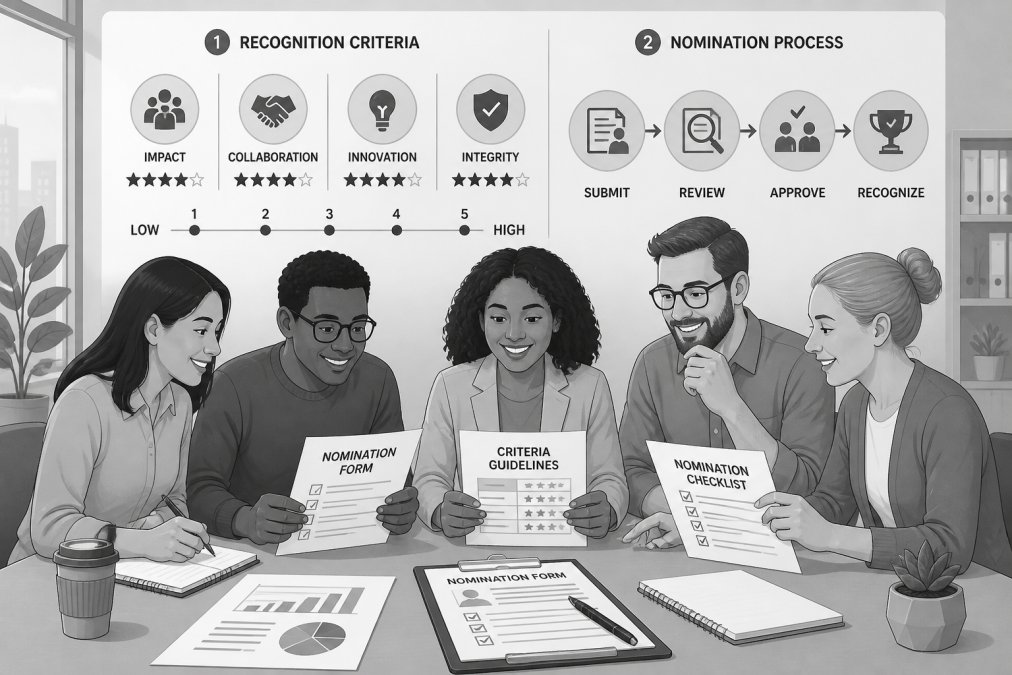
Keep the nomination process simple, complex processes kill participation. Use a one-page form asking: nominee name and department, specific behavior or achievement, which company value it reflects, a concrete example, and nominator name. Set a clear deadline (monthly or quarterly).
Peer-to-Peer Recognition Message Templates to Get Started
Templates help people write nominations. Basic template: "I want to recognize [name] for [specific action]. This matters because [impact]. [Name] embodies our value of [company value] by [specific example]." For collaboration: "[Names] worked together on [project]. What impressed me was [specific action] showing our commitment to [value]." The key is specificity, generic praise doesn't stick; specific examples make recognition meaningful.
Best Practices for Employee Recognition Implementation
Start small with one department for three months, then expand. Make recognition public, share nominations in team meetings and internal channels. Public recognition builds culture.
Preventing Recognition Fatigue and Maintaining Long-Term Engagement
Combat recognition fatigue by tracking who's been recognized in the last six months and flagging repeat recipients. Create separate recognition tracks for different contributions, project wins, mentorship, problem-solving, cultural fit, and behind-the-scenes support, to ensure broader recognition.
Managing Misuse and the Popularity Contest Problem
- Specificity: Does the nomination describe a specific achievement or behavior, not just "great person"?
- Alignment: Does the achievement reflect a company value or program goal?
- Fairness: Has this person been recognized recently? Are we recognizing a range of departments and roles?
- Authenticity: Does the nomination feel genuine, or does it look like a friend doing a favor?
"Nominations must describe a specific achievement or behavior that reflects our company values. Generic praise or nominations for routine work will not be selected. We aim to recognize a diverse range of employees and contributions each cycle."
Technical and Communication Best Practices
- What the program is
- How to nominate (step-by-step)
- When nominations are due
- What happens next (review process, announcement timeline)
- Examples of strong nominations
- Program rules and fairness guidelines
Choose a nomination method that fits your culture. Options:
- Online form (Google Forms, Typeform): Works for all company sizes. Easy to track and organize. Requires email access.
- Slack or Teams integration: Real-time, low friction. Works if your team uses these tools daily. Harder to track and review systematically.
- Paper form: Works for smaller teams or less tech-savvy groups. Harder to organize and share results.
- Dedicated platform (Bonusly, Karma, 15Five): Purpose-built for recognition. Integrates with HRIS and payroll. Higher cost.
Pair recognition with tangible rewards when possible. A message is meaningful. A physical award is memorable. Custom plaques, trophies, or branded items create keepsakes. Employees display them. Visitors see them. The recognition lasts. Alternatively, offer gift cards, extra PTO, or a choice of rewards so employees feel the recognition reflects their preferences.
Measuring Impact and Sustaining Your Program
Track what matters. At minimum, monitor:
- Number of nominations per cycle
- Percentage of employees nominated (aim for at least 50% over a six-month period)
- Repeat nominators vs. new nominators (increasing new nominators signals growing engagement)
- Departments or teams with high participation (identify pockets of strong culture)
- Common themes in nominations (which values get recognized most?)
- Time-to-recognition (how quickly does an achievement get recognized after it happens?)
These numbers tell you if the program is working. If nominations drop after month two, something's wrong. Maybe the process is too complicated. Maybe people forgot about it. Adjust.
Connecting Recognition Data to Business Outcomes
Peer recognition programs should drive measurable business impact. To prove ROI, connect recognition metrics to outcomes your leadership cares about.
Engagement: Administer a brief engagement survey twice yearly. Ask:
- "I feel valued by my peers at work" (1-5 scale)
- "I know what my colleagues are working on" (1-5 scale)
- "I would recommend this company as a great place to work" (yes/no)
Compare scores before and after program launch.
Integrating Recognition Data with HRIS and Payroll Systems
HRIS integration steps:
-
Export nomination data monthly from your recognition platform (or form) into a CSV file with columns: nominee name, nominator name, date, value recognized, department, reward given.
-
Match employee records in your HRIS by name and employee ID. Most HRIS systems (Workday, BambooHR, ADP) allow bulk imports via CSV.
-
Tag recognized employees in your HRIS with a custom field: "Peer Recognition Recipient, [Month/Year]." This creates a searchable record.
-
Pull reports quarterly: "How many employees in each department received recognition?" "Which employees have been recognized multiple times?" "What's the average time between hire date and first recognition?"
Payroll integration (if offering monetary rewards):
If your program includes cash bonuses or gift cards, coordinate with payroll to ensure proper tax treatment. Peer-to-peer recognition rewards are typically taxable income to the recipient. Work with your finance or HR team to:
- Document the business purpose of each reward ("Recognition for exceeding project goals")
- Ensure rewards are reported on the employee's W-2 or as taxable income
- Set a clear policy regarding the tax implications of rewards
- Communicate this to employees upfront so there are no surprises
Sustaining Momentum Beyond the Launch Phase
Survey employees quarterly. Ask:
- Have you nominated a peer in the last three months?
- Have you been nominated?
- Does the program feel fair?
- What would make you participate more?
- Do you understand how the program works?
"This quarter we received 52 nominations from 38 different employees. The most common value recognized was 'collaboration', 14 nominations highlighted cross-team teamwork. We also want to highlight Sarah's nomination for mentoring three new hires, and Marcus's recognition for solving a critical customer issue. These stories show what we value. Thank you all for participating."
Frequently Asked Questions
What are some examples of peer-to-peer recognition messages?
Effective peer-to-peer recognition messages highlight specific behaviors and their impact. Examples include: 'Thanks for staying late to help me finish the client proposal, your teamwork made the difference,' or 'Your creative problem-solving in the meeting today inspired our whole department. I really appreciated your perspective.' Keep messages authentic, specific about what the person did, and genuine in tone. The best messages connect individual actions to organizational values and team success.
How do you measure the success of a peer recognition program?
Track key performance indicators like participation rates (percentage of employees giving and receiving recognition), frequency of nominations, and employee engagement scores before and after launch. Monitor retention rates and conduct pulse surveys asking employees about workplace culture and appreciation. Watch for behavioral alignment with your organizational values in nominations. Success also shows in reduced turnover, improved collaboration, and higher scores on employee morale assessments. Set baseline metrics before launch so you can measure meaningful change.
What are common pitfalls to avoid when starting a recognition program?
Avoid launching without clear program guidelines, employees need to understand what behaviors earn recognition. Don't neglect communication; many programs fail because staff doesn't know they exist. Watch for recognition fatigue by setting reasonable nomination frequency limits. Ensure the reward fulfillment process works smoothly; delayed or incorrect rewards damage credibility. Prevent misuse by establishing clear criteria and monitoring for inappropriate nominations. Finally, don't set it and forget it, programs require ongoing stakeholder communication, feedback loops, and adjustment based on adoption metrics.
Can a peer recognition program integrate with tools like Slack or Microsoft Teams?
Yes, many modern peer recognition platforms integrate directly with Slack and Teams, allowing employees to nominate colleagues and celebrate wins without leaving their daily workflow. Integration increases program accessibility and participation by meeting employees where they already work. When selecting a platform or building your own solution, confirm it supports your existing HRIS and communication tools. Native integration reduces friction and makes recognition a natural part of your workplace culture rather than an add-on task.
Building a peer-to-peer recognition program takes planning, but the payoff is real. Employees feel valued. Engagement rises. Culture strengthens. When you're ready to recognize your top performers with custom awards that commemorate their achievement, Gino's Awards, Inc. creates high-quality plaques, trophies, and recognition items with fast turnaround and free personalization. Call (216) 831-6565 for a quote or visit our site to explore options that match your program's style.