


How to Plan Event Photography and Videography for Galas
Last Updated: October 31, 2026
Quick Summary
Plan event photography and videography for galas by starting with the story the room should remember, then building a shot list from the run of show and locking a shared timeline with your photo and video leads at least two weeks out. Brief the crew on sponsor proof and donor stories, walk the ballroom for lighting and audio, and confirm deliverables, turnaround, and usage rights in writing.
- Build the gala shot list from the run of show, not a generic checklist.
- Lock the gala timeline with photo and video leads at least two weeks out.
- Set a custom white balance for dinner lighting and a second preset for the stage.
- Get a direct soundboard feed plus a backup recorder near a podium speaker.
- Compare packages on coverage hours, crew size, deliverables, turnaround, and usage rights.
Table of Contents
- Start With the Story Your Gala Needs to Tell
- Build a Gala Photography Shot List Around the Run of Show
- Use an Event Photography Shot List Template to Brief Your Crew
- Lock the Gala Event Timeline With Your Photo and Video Team
- Handle Low-Light Ballrooms and Audio Capture Without Disrupting Guests
- Compare Event Photography and Videography Packages Before You Book
- Confirm Deliverables, Turnaround, and Usage Rights in Writing
- Book Your Gala Coverage and Order the Awards Together
- Frequently Asked Questions
Start With the Story Your Gala Needs to Tell
Great event photography and videography for galas starts before the first guest walks the red carpet, with a decision: what story should the room remember six months from now? The galas that land best are the ones where the camera crew knew the story in advance.
A gala is not a party with a camera in the corner. It is a fundraising event, a sponsor showcase, and a recognition ceremony running on one clock, and your coverage has to serve all three.
Match Coverage to Fundraising and Sponsor Goals
Every gala has a money story and a mission story. Coverage should capture both.
If sponsors paid for visibility, photograph logo placement, step-and-repeat branding, and sponsor moments on stage. Planners weighing the awards portion against the rest of the budget will find guidance in our breakdown of budgeting for corporate employee awards programs.
Write your goals down before you request quotes. A crew briefed on "photograph everything" delivers generic coverage; a crew briefed on "we need sponsor proof and donor stories" delivers assets you can use.
Build a Gala Photography Shot List Around the Run of Show
A gala photography shot list is a written inventory of every image and video moment the night must produce, organized in the order it happens, so your crew can anticipate instead of chase.
Build the list from the run of show, not from a generic checklist. If the program opens with a welcome toast at 7:15, the shot list says "welcome toast, wide and tight" at 7:15.
Arrivals, Step-and-Repeat, and Red Carpet Moments
Guest arrivals set the tone. Plan wide establishing shots of the venue and step-and-repeat, candid greetings, and posed photos of honorees and sponsors, with a two-minute window per VIP so the line never stalls.
Speeches, Awards, and Candid Reactions
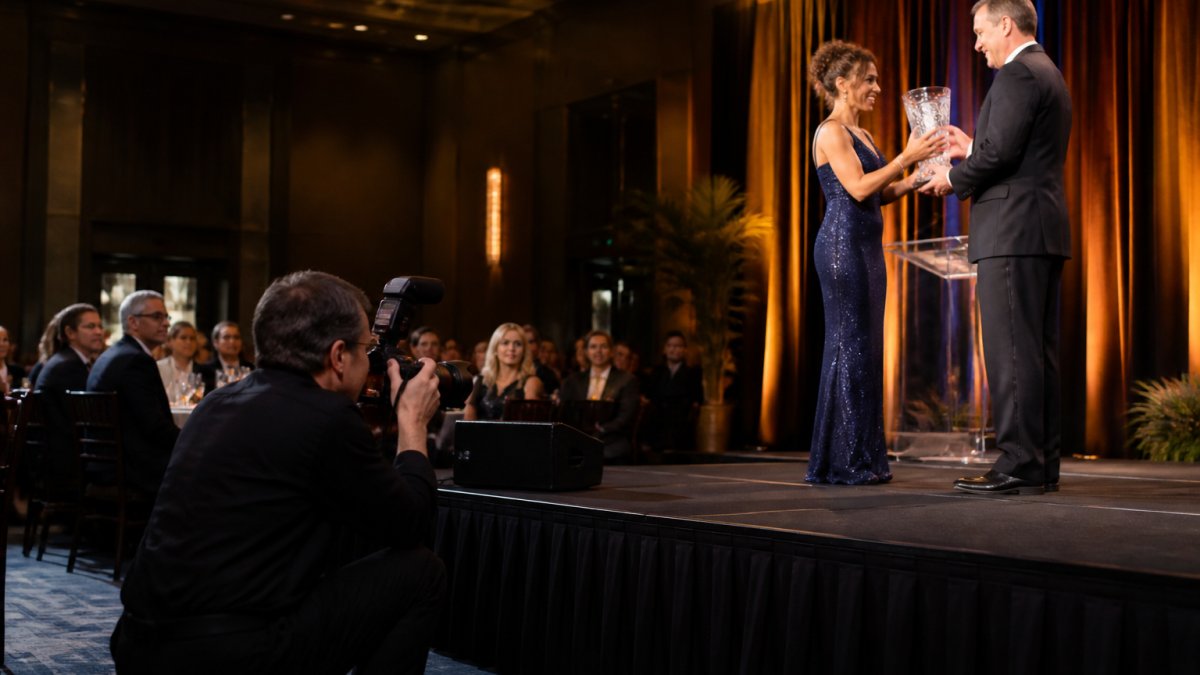
The award moment is the heart of the night. Capture the handoff, the handshake, the trophy in hand, and the recipient's face in the first three seconds, then the reaction shots: the table standing, the proud colleague, the tearful parent. Our guide to employee recognition award ceremonies covers how to run those moments so the camera has something worth capturing.
Use an Event Photography Shot List Template to Brief Your Crew
An event photography shot list template is a reusable document with columns for time, moment, shot type, subject, location, and owner. Fill it in once per gala and hand it to every crew member.
Here is a working structure you can copy:
| Time | Moment | Shot Type | Subject | Owner |
|---|---|---|---|---|
| 6:00 | Venue empty | Wide establishing | Ballroom, stage, tables | Photo lead |
| 6:30 | Guest arrivals | Candid + posed | Guests, step-and-repeat | Photo + video |
| 7:15 | Welcome toast | Wide + tight | Board chair, head table | Video lead |
| 8:00 | Award presentations | Tight + reaction | Honorees, tables | Both |
| 8:45 | Fundraising appeal | Medium + crowd | Speaker, donation moment | Video lead |
| 9:30 | Sponsor recognition | Tight | Sponsor reps on stage | Photo lead |
A template like this forces you to name an owner for each moment and exposes gaps before the night does. If nobody owns the sponsor recognition shot, you have found the problem in advance.
Lock the Gala Event Timeline With Your Photo and Video Team
A gala event timeline is the shared schedule that tells your crew when each moment happens, where it happens, and how much time they have.
Most gala timelines break in the same three places: the cocktail hour, the award block, and the dinner-to-program transition. Crews need to know when they can move freely and when they must stay out of sight.
- Cocktail hour: roving candid coverage, minimal flash
- Dinner service: table shots and sponsor candids, no stage work
- Award block: fixed positions, no movement during speeches
Share the timeline with the venue and AV team too. A videographer who knows the lighting cue changes will not miss the moment the room goes dark for the tribute video.
Handle Low-Light Ballrooms and Audio Capture Without Disrupting Guests
Ballrooms are built for atmosphere, not cameras. Dimmed chandeliers, colored uplighting, and a bright stage against a dark room create the hardest lighting conditions in event work. Most gala coverage fails here, not at the arrivals line, so brief this section hardest.
Read the Room Before You Shoot It
Walk the ballroom during the venue walkthrough and note four things: the color temperature of the chandeliers, the color of the uplighting, the brightness and angle of the stage wash, and where the room goes fully dark for the tribute video or candle lighting. Write those into the shot list next to the moments they affect.
A common pattern is a room lit at roughly 2700-3200K tungsten with saturated blue or amber uplighting on the walls. Auto white balance will drift every time the stage cue changes, so set a custom white balance for the dinner lighting and a second preset for the stage look, and switch deliberately.
Exposure and Gear Choices That Hold Up
Fast prime lenses in the f/1.4 to f/2.8 range and a camera body that stays clean at high ISO are the baseline for dim rooms. At f/1.4 a table of eight will not all be sharp, so choose the honoree's face and let the rest fall off. For group table shots, stop down and add light rather than pushing ISO into mush.
Flash etiquette is where crews get noticed for the wrong reasons:
- Arrivals and step-and-repeat: bounced or diffused flash is fine and expected.
- Cocktail hour: available light with a fast lens; flash reads as intrusive in a crowded room.
- Speeches and toasts: no flash. It distracts the speaker and blows out the stage look the AV team built.
Audio: Get the Feed, Then Get a Backup
Do not rely on the camera microphone for speeches. The on-camera mic picks up room noise, clinking glassware, and the table nearest the lens, and it makes a highlight film nearly worthless.
The reliable approach is two sources:
- A direct feed from the AV soundboard. Ask the AV lead for an output of the podium and handheld microphones, and confirm the connector type and level in advance. Bring your own cable and adapter; do not assume the venue has a spare.
- A small backup recorder near a podium speaker. A compact recorder placed on a stand or taped to a speaker captures a clean second track if the board feed fails or the AV team changes a cue mid-program.
Record the board feed and the backup on separate tracks, and slate each speech with a hand clap or a spoken marker so the editor can sync audio to video quickly.
Coordinate Positions So Nobody Blocks the Room
Crew positions are a lighting and audio problem as much as a sightline problem. A videographer in front of a stage wash throws a shadow across the honoree; a photographer leaning into the aisle blocks a table's view of the award.
Lock positions during the walkthrough and write them into the run of show:
- Photo lead: house left, near the front of the stage, with a clear angle to the handoff and the recipient's face.
- Video lead: center house, behind the last row of tables, on a monopod or tripod for the wide stage shot.
- Second shooter: house right, roving the tables for reactions during applause.
Agree on a no-movement rule during speeches and the tribute video, and identify the one transition window where the crew can reposition. Share that window with the AV team so lighting cues and crew moves do not collide.
Compare Event Photography and Videography Packages Before You Book
Event photography and videography packages vary widely in coverage hours, crew size, deliverables, and turnaround. Compare them on the same criteria so the cheapest quote does not win by default.
The Five Cost Drivers
Almost every gala quote is built from the same five inputs. Ask about each one explicitly.
| Cost Driver | What to Ask | Why It Matters |
|---|---|---|
| Coverage hours | How many hours are included, and does setup and teardown count? | Galas often run past the program, and setup time is real labor |
| Crew size | One photographer, or a photo and video team? | One person cannot cover simultaneous moments |
| Deliverables | Edited gallery, highlight film, raw files, social cuts? | Raw files are rarely included by default |
| Turnaround | When do edited assets arrive, and is rush delivery priced separately? | Marketing reuse depends on speed |
| Usage rights | Social, print, sponsor use, and paid media included? | Reuse rights vary by contract and can carry add-on fees |
A lower quote that excludes editing, limits usage rights, or prices rush delivery separately is not a lower price. It is a smaller package with the expensive parts moved off the invoice.
Photo-Only, Video-Only, or Combined
The three package shapes solve different problems, and the right choice depends on what the gala needs to do after the night ends.
- Photo-only is the lowest-cost way to document the room, the honorees, and the sponsors. It is the right call when the primary need is a gallery for the website, the annual report, and sponsor proof. The trade-off is that stills cannot carry a speech or an emotional appeal.
- Video-only is the right call when the gala's job is to raise money and tell a mission story. A highlight film and a clean recording of the appeal travel further than a gallery. The trade-off is that video crews are less able to cover every table and every handshake.
- Combined photo and video is the standard for galas that need both sponsor proof and a fundraising film. It costs more because it requires at least two crew members and a coordination plan, but it prevents the most common failure: a planner who books one and then scrambles for the other two weeks out.
Coverage-Hour Tradeoffs
Coverage hours are the easiest line to trim and the easiest to regret. A gala that opens arrivals at 6:00 and ends dancing at 11:00 is a five-hour event before setup; if the quote includes four hours, the crew will either leave before the dancing or charge overtime.
Ask each provider to price the same three scenarios: arrivals through the award block, arrivals through the end of the program, and full-night coverage through dancing. The difference tells you what the last two hours actually cost, which is the number to weigh against candid dancing and celebration shots.
Build a Comparison Brief
Ask every provider to quote against the same brief: your shot list, your timeline, and your deliverable list. Then compare line by line rather than on the total. The provider who itemizes editing, usage rights, and backup equipment is easier to compare and easier to hold to the contract.
Decide on deliverables first, then match the package to that list, and confirm every line in writing before you sign.
Confirm Deliverables, Turnaround, and Usage Rights in Writing
Usage rights matter more than most planners expect. If you plan to announce winners publicly, our ideas for announcing employee award winners pair well with a delivery schedule that gets photos back fast.
Also confirm the backup plan. Ask what happens if a crew member cancels, and whether the provider carries backup equipment. A written answer is worth more than a verbal promise.
Book Your Gala Coverage and Order the Awards Together
The last step is the one planners most often split in two: booking the crew and ordering the awards. Readers ordering physical awards alongside their gala can learn what large custom award shipping costs.
At Gino's Awards, Inc., we have made custom awards and engraved plaques since 1950, with free personalization. When the crew and the awards are planned on one schedule, the night tells a cleaner story.
Frequently Asked Questions
What should a gala photographer capture?
A gala photographer should cover guest arrivals and the step-and-repeat, table settings and decor, speeches and presentations, award handoffs, candid reactions, sponsor signage, and the closing moments of the night. Build the gala photography shot list directly from the run of show so nothing gets missed. Include group shots of honorees holding their awards, since those images often become the photos sponsors and honorees share afterward.
How many photographers and videographers do you need for a gala?
A single photographer can handle a small gala with one room and one stage, but most galas with 150 or more guests benefit from two photographers: one covering the stage and one working the room for candid reactions. Add a videographer if you want a highlight film or speeches recorded. Crew size should follow your event photography and videography packages, since coverage hours and the number of crew members are usually the two biggest cost drivers.
How long does it take to receive gala photos and video?
Ask for the turnaround in writing before you book. Video takes longer because of editing. If you need images for a sponsor recap or board meeting, tell the team your deadline up front and confirm it fits their standard delivery window.
What should you ask when hiring a gala photographer and videographer?
Ask about experience with ballroom lighting and stage audio, how they coordinate photo and video so they are not blocking guests, what the gala event timeline looks like from their side, and what usage rights come with the files. Also confirm deliverables, backup equipment, and whether they carry liability insurance, which many venues require. Get the shot list and coverage hours written into the agreement.
A gala only happens once, and the photos and film are what your organization lives with afterward. Gino's Awards, Inc. can supply the recognition pieces that make those moments worth capturing, with free personalization, fast turnaround, and free shipping on orders over $50. Get started with Gino's Awards, Inc. and give your next gala an award moment the camera cannot miss. Call (216) 831-6565.