



How to Write Employee Award Inscriptions: 7 Steps
Table of Contents
- How to Write Employee Award Inscriptions: The 7-Step Framework
- Employee Recognition Award Wording Examples by Achievement Type
- Award Inscription Templates You Can Customize
- What to Write on an Award Plaque: Essential Content Guide
- Years of Service Award Wording That Honors Dedication
- Industry-Specific Inscription Examples
- Common Mistakes to Avoid When Writing Award Inscriptions
- Design Tips for Professional Award Plaques
Last Updated: July 21, 2026
How to Write Employee Award Inscriptions: The 7-Step Framework
A poorly worded plaque feels generic and forgettable, while a thoughtfully crafted inscription transforms an award into a meaningful keepsake. The difference comes down to specificity. A vague inscription like "Thanks for your service" sits in a desk drawer. A specific one that names the achievement, acknowledges impact, and reflects the recipient's unique contribution becomes something worth displaying.
Below is a proven 7-step process for writing award inscriptions that feel personal, professional, and permanent.
Step 1: Define the Achievement or Milestone
Start by getting crystal clear on what you're actually recognizing. What did this person accomplish? Is it a service anniversary (5, 10, 20 years)? A specific project success? An award for leadership, innovation, or team contribution?
For years of service awards, specificity still matters. "10 Years of Excellence in Customer Support, 2016-2026" tells a story and marks a specific era. For performance-based awards, identify the actual accomplishment and document the dates involved, they transform the plaque from generic recognition into a historical record.
Step 2: Choose Your Inscription Style
The tone and structure of your inscription set the emotional register of the award.
Formal and Corporate works best for traditional industries and executive-level recognition. Example: "Presented to [Name] in recognition of outstanding leadership and dedicated service to [Organization], 2016-2026."
Warm and Personal suits organizations with strong cultures. Example: "To [Name], whose commitment, creativity, and kindness have made [Organization] stronger every single day."
Inspirational and Aspirational includes a relevant quote or principle. Example: "To [Name], who embodies our belief that 'Excellence is not a destination, it's a habit.' 10 Years of Proven Dedication."
Step 3: Include Essential Information
Every award inscription needs core information to be complete and meaningful.
Recipient's Full Name is non-negotiable. Use the name the person prefers professionally and check spelling multiple times, a misspelled name on a permanent award cannot be undone.
The Achievement or Award Title captures what's being recognized. "10 Years of Service," "Excellence in Customer Support Award," or "Leadership Innovation Award" should be specific enough that someone reading it five years from now understands what was accomplished.
Organization Name anchors the achievement to a specific context. Dates matter more than many realize, for service awards, include start and end years; for achievement awards, include the year of recognition. A brief recognition statement like "In recognition of" acknowledges the impact with sincerity.
Optional but powerful additions include the recipient's title, company logo, and a brief quote. But remember: every addition takes up space. Stick to essentials unless you have a large plaque with room to breathe.
Step 4: Personalize with Recipient Details
Generic awards feel like participation trophies. Personalized inscriptions feel like genuine recognition.
Reference something unique about the recipient's contribution. Instead of "For outstanding performance," try "For transforming our customer onboarding process and reducing implementation time by 40%." Include their title or role if relevant. A single line showing you know this specific person makes the difference between a generic award and one they'll treasure.
Step 5: Review for Tone and Clarity
Before approving anything, read your inscription aloud. Does it feel genuine or stilted? Does it match your organization's voice?
Check for awkward phrasing that sounds unnatural. Skip corporate jargon. "Synergistic collaboration" means nothing. "Teamwork" means everything. Ensure language is specific enough that it couldn't apply to anyone. "For hard work" is generic. "For leading the team through a critical transition and maintaining morale" is specific and meaningful.
Check grammar and punctuation carefully. Verify the length, award inscriptions should be readable in 10-15 seconds.
Step 6: Approve Your Proof
Before engraving begins, you'll receive a proof, a mockup of exactly what the plaque will look like. This is your last chance to catch errors.
When reviewing a proof, check three things: accuracy (every word spelled correctly, every name correct, every date accurate), appearance (font selection, font size, readability from arm's length), and alignment (text centered properly, adequate white space, logo positioned correctly).
Read the proof character by character against your approved inscription. If you spot an error, speak up immediately. Once you approve the proof and engraving begins, changes become expensive or impossible.
Step 7: Finalize Engraving Details
With your proof approved, final details determine how your inscription will look and feel in person.
Material selection affects how engraving appears. Crystal plaques create an elegant, upscale look. Wooden plaques offer warmth and tradition. Metal plaques project corporate professionalism. Engraving depth matters for durability and appearance. Deeper engraving is more visible and lasts longer but costs more. Font selection is finalized at this stage. Serif fonts feel traditional and formal. Sans-serif fonts feel modern and clean. Script fonts feel elegant but can be harder to read from a distance.
Logo placement and sizing should be prominent enough to be recognizable but not so large that it overwhelms the inscription. Color fill (if applicable) adds visual interest and improves readability. Confirm the production timeline to ensure your plaque is ready when needed.
Employee Recognition Award Wording Examples by Achievement Type
The right words depend on what you're actually recognizing.
Years of Service Recognition
"To [Name], in recognition of 10 years of dedicated service to [Organization], 2016-2026. Your commitment and reliability have been invaluable."
"Presented to [Name] in honor of 15 years of service. Your integrity, work ethic, and positive spirit have shaped our organization's culture."
Service inscriptions work best when they include both the years and a specific quality the person has demonstrated.
Performance Excellence
"To [Name], in recognition of exceptional performance in [Department/Role]. Your results and dedication set the standard for excellence."
"[Name], 2026 Excellence Award. Your innovative approach to [specific project/challenge] delivered measurable results and inspired your team."
Performance awards work best when they name the specific achievement or metric. The inscription should reflect the level of achievement.
Leadership and Innovation
"To [Name], in recognition of visionary leadership and commitment to innovation. Your ability to inspire and guide teams has transformed [Organization]."
Leadership inscriptions should acknowledge not just what the person did, but how they did it. These awards often have the most lasting impact because they recognize qualities that extend beyond a single achievement.
Team Contribution
"To [Name], in recognition of outstanding teamwork and collaboration. Your positive spirit and willingness to help lift the entire team."
Team contribution awards are often the most meaningful because they recognize character and culture-building.
Award Inscription Templates You Can Customize
Formal Corporate Template
[NAME]
[ACHIEVEMENT/AWARD TITLE]
Presented to [Name] in recognition of [specific achievement or quality]. Your [specific contribution] has strengthened [Organization] and set the standard for [area of excellence].
Warm and Personal Template
To [Name],
[ACHIEVEMENT/AWARD TITLE]
Thank you for [specific action or quality]. Your [character trait] and [character trait] have made [Organization] a better place. We're grateful for [specific impact], and we celebrate your [specific accomplishment].
Inspirational Quote-Based Template
To [Name],
[AWARD TITLE]
"[Relevant Quote]"
This inscription honors [Name]'s commitment to [specific value or achievement]. [Specific example of how they embody the quote]. We celebrate your contribution and the example you set.
What to Write on an Award Plaque: Essential Content Guide
Must-Have Elements
Recipient's Name is the foundation. Use the full, correctly spelled name. Award Title or Achievement answers the question "What is this award for?" Organization Name provides historical context. Year or Date marks when the achievement occurred. A brief recognition statement like "In recognition of" introduces the achievement.
These five elements create a complete, professional inscription that makes sense to anyone who reads it.
Optional Personalization Elements
Company Logo adds visual interest and organizational identity. Recipient's Title or Department provides context for the achievement. A relevant quote or company value adds inspiration (keep it to one sentence). Specific metrics or accomplishments add credibility. Personal touch or character reference makes the award feel genuinely about this person.
These optional elements should enhance, not clutter. If your plaque is getting crowded, cut optional elements and stick to essentials.
Layout and Spacing Considerations
White space is your friend. Cramming text onto every inch makes the plaque feel cluttered and hard to read. Text hierarchy guides the reader's eye, the recipient's name should be prominent, often larger or bold. Font size must be readable from arm's length.
Years of Service Award Wording That Honors Dedication
Milestone Year Phrases
5-Year Milestones mark where someone has truly invested in your organization. "To [Name], celebrating 5 years of growth and contribution. Thank you for becoming an integral part of our team."
10-Year Milestones mark a decade of dedication. "To [Name], in recognition of 10 years of dedicated service to [Organization], 2016-2026. Your commitment and excellence set the standard."
20-Year Milestones represent a career-defining tenure. "To [Name], celebrating 20 years of exceptional service to [Organization], 2006-2026. Your dedication, leadership, and character have been transformational."
The longer the tenure, the more significant the inscription should feel.
Industry-Specific Inscription Examples
Healthcare and Education
"To [Name], in recognition of 15 years of compassionate patient care and clinical excellence. Your dedication to healing and your mentorship of colleagues exemplify our mission."
"[Name], Excellence in Education Award. Your innovative teaching and commitment to educational excellence have transformed lives."
Manufacturing and Trades
"To [Name], in recognition of 20 years of exceptional craftsmanship and safety leadership. Your expertise and attention to detail set the standard for quality."
Nonprofit and Government
"To [Name], in recognition of 12 years of dedicated public service. Your commitment to our mission and your impact on the communities we serve have been transformational."
Common Mistakes to Avoid When Writing Award Inscriptions
Spelling and Name Errors
This is the most painful mistake because it's permanent. Check the spelling of the recipient's name three times. Don't assume. Verify with the person directly. Proofread the entire inscription character by character. Have someone else read it. Before engraving begins, verify every word in the proof.
Vague or Generic Language
"Thanks for your hard work" could apply to almost anyone. Instead of generic praise, include concrete details:
- VAGUE: "For outstanding performance"
- SPECIFIC: "For exceeding sales targets by 40% while maintaining 98% customer satisfaction"
Specificity makes the award feel earned and meaningful.
Overcrowding the Plaque
Trying to fit too much information creates a cluttered, hard-to-read result. Stick to essentials: name, achievement, organization, dates, and one line of genuine recognition. If you want to include more information, use a larger plaque. Test your inscription at the proof stage.
Inconsistent Tone or Formatting
If the first line is formal and the second is casual, the inscription feels disjointed. Tone should be consistent throughout. Check your inscription for consistent tone, capitalization, punctuation, and line breaks.
Design Tips for Professional Award Plaques
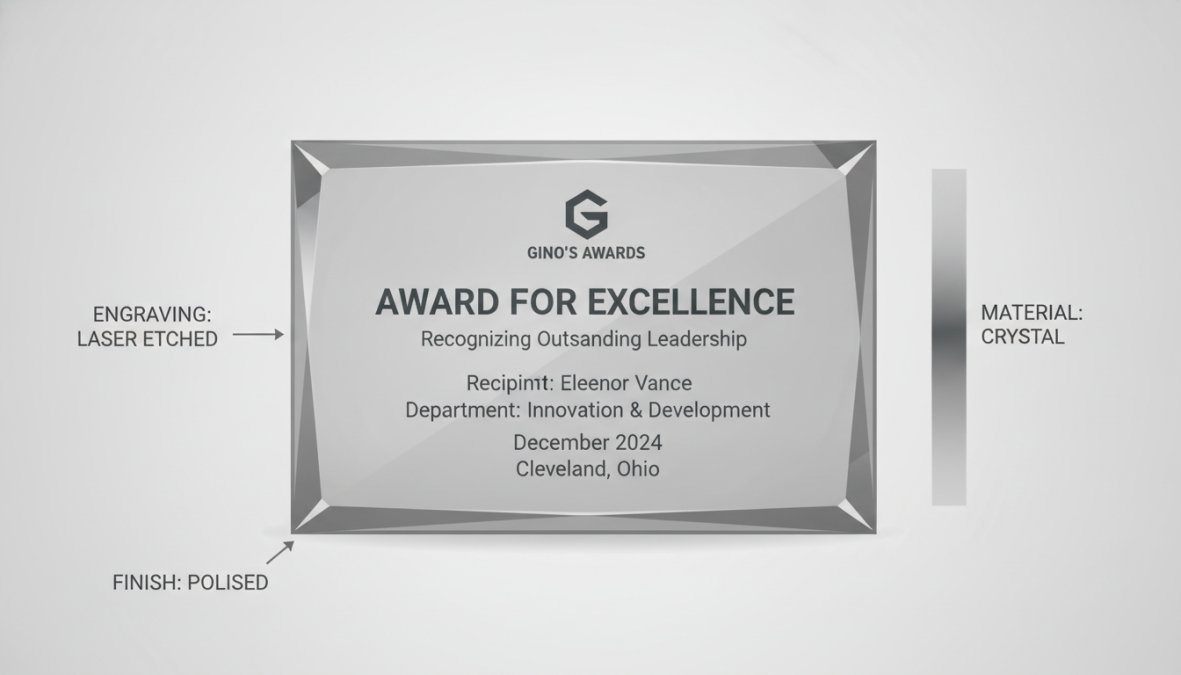
Font Selection and Readability
Serif fonts (with small lines at the ends of letters) feel traditional, formal, and elegant. These work well for formal corporate awards.
Sans-serif fonts (without the small lines) feel modern, clean, and professional. These are easier to read from a distance.
Script fonts feel elegant and decorative. These should be used sparingly, perhaps for the recipient's name only. Full inscriptions in script fonts are hard to read from a distance.
Font size matters more than most people realize. Can someone read the inscription clearly from across the room (6-8 feet away)? If not, increase the font size.
Material Quality and Engraving Depth
Crystal plaques create an elegant, upscale appearance with deep, crisp engraving. Wooden plaques offer warmth and tradition. Metal plaques (brass, aluminum, stainless steel) project corporate professionalism.
Engraving depth affects durability and appearance. Deeper engraving is more visible and more durable. For plaques that will be displayed for decades, invest in deeper engraving and quality materials.
Logo Placement and Personalization
Logo size should be prominent enough to be recognizable but not so large that it overwhelms the inscription. The words should be the focus.
Logo placement options include top center (traditional, formal), top left or right (modern, balanced), or watermark behind the text (subtle, elegant).
Personalization options include color fill in engraved areas, beveled or rounded edges, mounting hardware, and protective coating.
Writing employee award inscriptions is about creating a permanent record of achievement and appreciation. A well-crafted inscription transforms a physical award into a meaningful keepsake that employees display proudly and remember for years. The 7-step framework in this guide ensures your inscriptions feel personal, professional, and permanent. Whether you're recognizing years of service, celebrating performance excellence, or honoring leadership, the specificity and sincerity you bring to your inscription determines whether the award feels generic or genuinely meaningful.
| Inscription Element | Purpose | Example |
|---|---|---|
| Recipient's Full Name | Personalization and clarity | "To Sarah Martinez" |
| Award Title/Achievement | Context for recognition | "10 Years of Service" or "Excellence in Leadership Award" |
| Organization Name | Historical anchor | "[Organization Name], 2016-2026" |
| Recognition Statement | Sets tone | "In recognition of" or "In appreciation of" |
| Specific Achievement | Shows genuine knowledge | "For transforming customer support operations and reducing implementation time by 35%" |
| Optional Quote or Value | Inspiration or meaning | "Excellence is not a destination, it's a habit" |
Frequently Asked Questions
What should be included in an employee award inscription?
Essential elements include the recipient's name, specific achievement or award title, dates (start/end or service period), and a brief message of appreciation. Optional additions are the company logo, department name, or an inspirational quote. Keep the inscription concise, typically 3-5 lines, to ensure clarity and professional appearance on the plaque. Avoid generic language; instead, reference the employee's dedicated service or outstanding contributions.
How do you write years of service award wording that feels genuine?
Focus on specific accomplishments or qualities rather than generic praise. For example, instead of 'Thank you for your service,' try 'Recognizing 20 years of dedication, leadership, and outstanding contributions to our team.' Include the exact dates of employment and mention the impact they've made. Personalization is key, reference their role, team involvement, or memorable achievements. This approach transforms a standard years of service award into a meaningful recognition that honors their legacy.
How long should an employee award inscription be?
Keep inscriptions between 50-150 words, typically fitting 3-6 lines on the plaque. Shorter is often better, one powerful sentence with the recipient name, achievement, and date can be more impactful than lengthy text. Consider the plaque size and engraving space; overcrowded plaques are difficult to read. Test your inscription layout during proof approval to ensure proper spacing and font size. A concise, well-crafted message is more memorable than verbose recognition.
What's the best way to personalize an award inscription?
Include the recipient's full name, specific achievement (not just 'Employee of the Year'), exact dates, and details about their impact. Reference their department, team projects, or unique qualities. Avoid cookie-cutter phrases; instead, use language that reflects your company culture and the individual's contributions. Consider adding a company logo or department seal for visual personalization. Request proof approval before final engraving to catch any typos and ensure the inscription matches your vision for a truly customized award.
This article was written using GrandRanker