


Low Carbon Footprint Corporate Giveaway Ideas
Table of Contents
- How to Choose Corporate Giveaway Ideas With a Low Carbon Footprint
- Eco-Friendly Corporate Giveaways: 10 Ideas That Cut Emissions and Waste
- Sustainable Promotional Products: Materials and Useful Selection Criteria
- Eco-Friendly Conference Giveaways for Events and Trade Shows
- Recycled Material Corporate Gifts: Verifying Suppliers and Avoiding Greenwashing
- Budget, Cost per Use, and End-of-Life Planning for Sustainable Swag
- Conclusion: Build a Giveaway Program That Earns Its Carbon
- Frequently Asked Questions
Last Updated: October 12, 2026
How to Choose Corporate Giveaway Ideas With a Low Carbon Footprint
A corporate giveaway's carbon footprint is the total greenhouse gas emissions across its life cycle: extraction, manufacturing, shipping, use, and disposal.
We have spent more than 75 years making recognition products in our own facility, so we know how material choices and shipping distance shape what a giveaway costs the planet.
The Four Questions That Decide a Giveaway's Carbon Impact
Material comes first: virgin plastic and aluminum carry heavy extraction and processing emissions; recycled and renewable materials start lower.
Origin is second: a domestically made product travels a fraction of an imported one's distance, and freight emissions scale with distance and weight.
End of life is fourth: recyclable, refillable, or compostable items avoid landfill methane and disposal energy.
| Question | What to Look For | Why It Matters |
|---|---|---|
| Material | Recycled, renewable, or upcycled inputs | Lower extraction and processing emissions |
| Origin | Domestic or regional manufacturing | Shorter freight distance, fewer transport emissions |
| Durability | Multi-year usable life | Footprint spread across many uses |
| End of life | Recyclable, refillable, or compostable | Avoids landfill methane and disposal energy |
Eco-Friendly Corporate Giveaways: 10 Ideas That Cut Emissions and Waste
The strongest eco-friendly corporate giveaways share one trait: recipients actually use them. These ten prioritize reusable, recycled, and renewable materials over novelty items that end up in a drawer.
Reusable Drinkware: Bottles, Coffee Cups, and Collapsible Cups
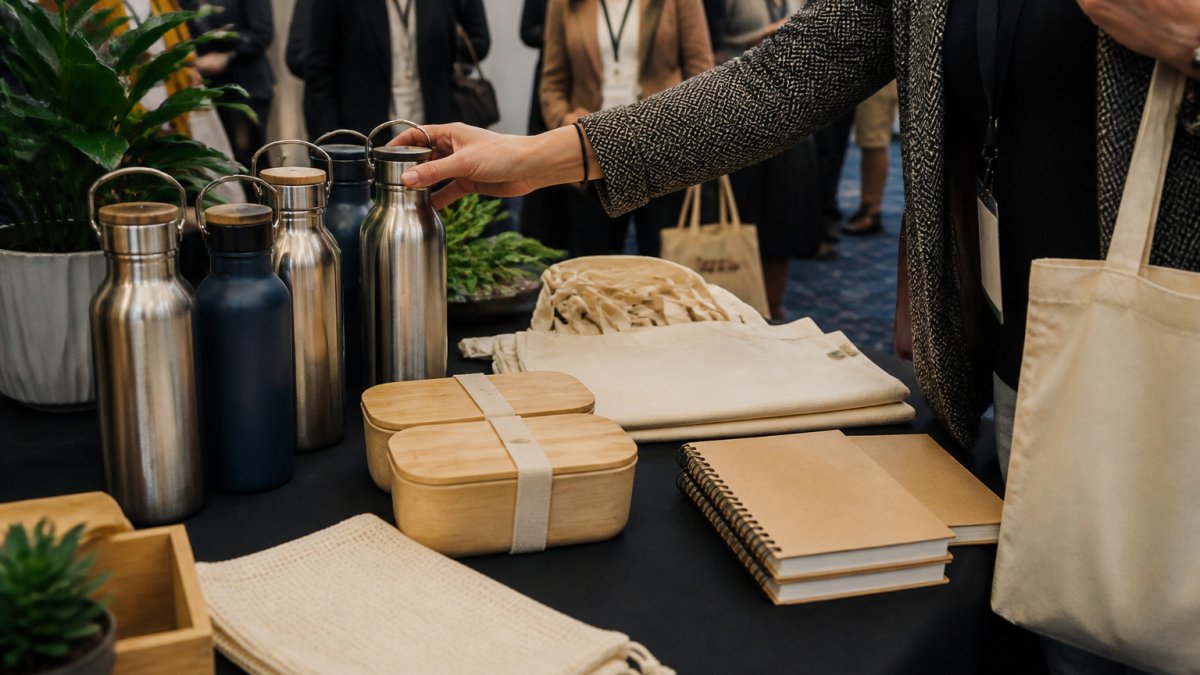
Reusable drinkware replaces hundreds of single-use cups and bottles over its life. A stainless steel bottle or insulated coffee cup carried daily displaces disposables again and again. Collapsible cups suit conferences where luggage space is tight: they pack flat and cut disposable cup waste.
Reusable Bags and Totes in Cotton, Recycled PET, and Jute
Tote bags are the workhorse of sustainable promotional products. Cotton bags are durable and washable, recycled PET totes keep bottles out of landfills, and jute offers a renewable fiber. The key is weight and stitching: a flimsy bag tears within weeks, while a reinforced one becomes a grocery staple for years.
Bamboo Lunch Boxes, Bento Boxes, and Utensil Sets
Bamboo is a fast-growing renewable material that regrows without replanting. Bamboo lunch boxes, bento boxes, and utensil sets replace disposable takeout containers and plastic cutlery. Pair a utensil set with a carrying pouch so recipients keep it in a bag or desk drawer, small details decide whether an item gets used or forgotten.
Recycled and Upcycled Material Corporate Gifts
Recycled material corporate gifts turn existing waste streams into new products. Recycled-fiber lanyards, recycled-paper notebooks, and reclaimed-fabric bags keep material in circulation. Upcycled products give discarded items a second life with minimal reprocessing. Both cut emissions versus virgin-material equivalents.
Low-Emissions Digital and Experience Gifts
Not every giveaway needs to be physical. Digital gift cards, online course access, and donation-in-honor certificates carry almost no shipping or manufacturing footprint. Experience gifts, such as a team lunch or a charitable contribution in a recipient's name, skip the supply chain entirely. For distributed teams, these often beat any shipped item on emissions and usefulness.
Sustainable Promotional Products: Materials and Useful Selection Criteria
The best sustainable promotional products are the ones recipients keep, so usefulness should outweigh novelty every time. But "useful" is not a strategy on its own, what separates a program that genuinely lowers emissions from one that just sounds green is a framework that scores materials, sourcing, and recipient behavior before you commit to a purchase order.
A Lifecycle View of the Materials You Are Choosing Between
Most ranking lists say "choose recycled or renewable materials" and stop there. A more honest approach compares where each common giveaway material's emissions actually come from across its life cycle: extraction, manufacturing, freight, use, and disposal.
- Virgin aluminum: High extraction and smelting energy, but highly recyclable and lightweight, which lowers freight emissions per unit. A reusable bottle amortizes that upfront energy across years of use.
- Recycled aluminum: A much lower processing baseline than virgin metal, with the same durability and recyclability. Usually the strongest metal option for a low-carbon giveaway.
- Virgin plastic: Cheap and light, but tied to fossil feedstock and rarely recycled in practice. Disposable plastic giveaways carry their full footprint with almost no use-phase return.
No single material wins everywhere: the same material can be low-carbon or high-carbon depending on origin, weight, and how long the recipient keeps it.
A Simple Scoring Method You Can Run Before You Order
Rather than argue about adjectives, score each candidate item on four dimensions and pick the highest total, a transparent assessment most published giveaway lists skip entirely.
| Criterion | What to Score | Low Score | High Score |
|---|---|---|---|
| Material baseline | Recycled, renewable, or upcycled inputs | Virgin plastic or virgin metal | Recycled or rapidly renewable content |
| Freight distance | Origin relative to your distribution point | Intercontinental air or ocean freight | Domestic or regional ground freight |
| Durability | Expected usable life in the recipient's hands | Weeks | Years |
| End-of-life path | Recyclable, refillable, or compostable | Landfill only | Closed-loop or take-back |
Weight the criteria to match your program: if your audience is distributed nationwide, freight distance deserves more weight than for a single-city event.
The Recipient Uptake Test
A giveaway nobody uses has a carbon footprint with zero return. Before you order, run three checks:
- Weekly use: Will the recipient touch this item at least weekly? Daily or weekly use justifies the footprint; occasional-use novelties rarely do.
- Displacement value: Does it replace a disposable alternative the recipient would otherwise buy? A reusable bottle that displaces single-use cups earns its emissions back quickly.
- Recipient fit: Match the item to the audience. A collapsible cup suits a frequent traveler; a desk utensil set suits an office worker. An unused gift wastes its entire footprint.
Supplier Verification: Turning Claims Into Documentation
This is where most sustainability claims fall apart, and where the ranking pages are thinnest.
Request the recycled content percentage, fiber or material type, and country of origin in writing.
The Federal Trade Commission's Green Guides set the standard for environmental marketing claims in the United States.
Where This Framework Pays Off
A scored, documented selection process does two things: it lowers your program's actual carbon footprint by steering you toward recycled content, shorter freight, and longer-lived items, and it protects your brand, because every claim you make can be traced back to a document rather than a marketing phrase.
Eco-Friendly Conference Giveaways for Events and Trade Shows
Eco-friendly conference giveaways work best when they double as event tools. A recycled-fiber lanyard holds a badge all week, then goes home as a usable keepsake. Solar power banks, recycled-paper notebooks, and reusable water bottle stations serve attendees while cutting waste, and seed-paper badges that recipients plant afterward turn a disposable item into something that grows.
Cutting Shipping and Event Distribution Emissions
Shipping and distribution often outweigh manufacturing emissions for giveaways, especially imported goods. Consolidate shipments, choose domestic suppliers where possible, and ship directly to the venue rather than to an office first. At the event, set up a single pickup station instead of distributing items across multiple booths, fewer trips, less packaging, and less waste all reduce the total footprint.
Recycled Material Corporate Gifts: Verifying Suppliers and Avoiding Greenwashing
Request the recycled content percentage, the fiber or material type, and the country of origin in writing.
The Federal Trade Commission's Green Guides set the standard for environmental marketing claims in the United States.
Watch for vague language like "planet-friendly" with no supporting data.
Budget, Cost per Use, and End-of-Life Planning for Sustainable Swag
Cost per use beats sticker price as a budgeting metric, but the math only works if you include the costs most programs ignore: freight, packaging, and the emissions that come with moving goods to a venue or a distributed workforce. This section covers the procurement math, the logistics decisions that often outweigh material choices, and end-of-life planning before you order.
Cost per Use: The Metric That Reframes the Budget Conversation
Calculate cost per use by dividing the total program cost, unit price plus freight, packaging, and customization, by the estimated number of uses across the item's life.
A reusable bottle that costs more upfront but gets used daily for two years can land at a few cents per use.
| Item Type | Typical Upfront Cost | Estimated Uses | Cost per Use |
|---|---|---|---|
| Insulated reusable bottle | Higher | Hundreds over years | Cents |
| Disposable cup | Low | One | Full unit cost |
| Reinforced tote | Moderate | Hundreds | Cents |
| Flimsy promotional bag | Low | A few | High relative to use |
| Recycled notebook | Low to moderate | Dozens to hundreds | Low |
| Novelty trinket | Low | Near zero | Effectively infinite |
Exact prices vary by supplier, quantity, and customization, so build the table with your own quotes.
Budget Ranges by Program Type
Procurement teams need a starting frame, not a single number. A common pattern tiers giveaways by audience and purpose:
- Broad event swag: Lowest unit cost, highest volume. Focus on items cheap to ship and genuinely reusable, such as recycled-fiber lanyards or seed-paper badges.
- Employee recognition: Mid-range unit cost with higher perceived value. Reusable drinkware, desk items, and quality totes fit here.
- Client and executive gifts: Highest unit cost, lowest volume. Durability and presentation matter most, and the per-use math is easy to justify because the recipient keeps the item for years.
Set a per-recipient budget ceiling before you shop, then let the cost-per-use calculation decide which items earn a place within it.
Shipping, Fulfillment, and Event Distribution Emissions
This is the gap most published giveaway lists miss. For many programs, freight and distribution emissions rival or exceed manufacturing emissions, especially for imported goods moved by air. Practical levers:
- Consolidate shipments. One bulk delivery to a single address beats many small parcels: fewer trips, less packaging, lower emissions.
- Choose domestic or regional suppliers where quality allows. Freight emissions scale with distance and weight, so a shorter supply chain is a direct carbon reduction.
- Right-size packaging. Oversized boxes and filler add weight and volume, both of which increase freight emissions. Ask suppliers to ship in packaging sized to the product.
Digital, Service, and No-Physical-Item Alternatives
Not every giveaway needs to be physical, and the lowest-carbon option is often the one that never ships. Digital gift cards, online course access, and donation-in-honor certificates carry almost no manufacturing or freight footprint, and experience gifts such as a team lunch or a charitable contribution in a recipient's name skip the supply chain entirely.
End-of-Life Planning Before You Order
Plan end of life at the purchasing stage, not after the event. Recyclable materials, refillable designs, and take-back programs all extend an item's value beyond its first owner.
Ask three questions before you commit:
- Can the recipient recycle it locally? A material that is technically recyclable but not accepted in most curbside programs will likely end up in landfill.
- Can it be refilled or repaired? Refillable designs keep the product in use and out of the waste stream.
- Does the supplier offer a take-back program? Some manufacturers accept returned items for recycling or reuse.
Where an item cannot be recycled, note that in your program records so future orders can improve.
| Metric | Weak Program | Strong Program |
|---|---|---|
| Primary metric | Sticker price per unit | Cost per use over item life |
| Freight planning | Default shipping, oversized boxes | Consolidated, right-sized, domestic where possible |
| Material sourcing | Unverified claims | Documented recycled or renewable content |
| End-of-life plan | None | Recycling or take-back pathway |
| Recipient uptake | Low, novelty items | High, daily-use items |
Putting the Numbers Together
Run the cost-per-use calculation, add freight and packaging to the total, and compare that against the emissions you avoid by choosing a domestic supplier or a digital alternative. The result is a budget that reflects what the program actually costs, financially and environmentally, not what the catalog page says.
Conclusion: Build a Giveaway Program That Earns Its Carbon
Building a giveaway program that earns its carbon takes more than ordering the cheapest catalog option: it takes material verification, honest cost math, and a plan for what happens after the event ends.
Gino's Awards, Inc. has manufactured custom awards and recognition products in our own facility since 1950, with free personalization, fast turnaround, and free shipping on orders over $50.
Frequently Asked Questions
What are some low carbon footprint corporate giveaway ideas?
The strongest options are reusable items people keep: stainless steel or glass water bottles, ceramic coffee cups, cotton or recycled PET tote bags, bamboo utensil sets, and recycled-material notebooks. Each one replaces disposable purchases the recipient would otherwise make. The lowest-impact corporate giveaway ideas go further: digital gifts, service donations, or experience vouchers that require no manufacturing or shipping at all.
What makes a corporate giveaway sustainable?
Four factors decide it: the material and how it was made, how far it travels to reach the recipient, how long the recipient keeps and uses it, and what happens at end of life. A locally sourced, reusable item that gets used daily for years beats a recycled item that ships overseas and sits in a drawer. Ask suppliers for material origin and manufacturing location before you commit.
What are the best eco-friendly conference giveaways?
For conferences, prioritize items attendees will use during the event and take home: collapsible cups, recycled-fiber lanyards, seed-paper badges, and solar power banks. Coordinate with the venue to hand items out at registration rather than shipping individually, and choose one quality item over a bag of small novelties. Fewer, better items cut both emissions and waste.
How can companies reduce the environmental impact of promotional products?
Start by cutting quantity: order closer to actual attendance, not a buffer. Choose reusable items over disposable ones, source from suppliers who can document recycled or renewable materials, and consolidate shipments to reduce freight emissions. Measure cost per use rather than cost per unit, since a $20 bottle used 300 times beats a $3 plastic item thrown away the same day.
How can I avoid greenwashing when choosing eco-friendly promotional products?
Ask for specifics, not adjectives. Request the percentage of recycled content, the certification behind a bamboo or organic claim, and the manufacturing location. Vague labels like 'eco-friendly' mean nothing without documentation. If a supplier cannot provide material details or third-party verification, treat the claim as marketing and look elsewhere.