


Perpetual Plaque Ideas for Small Schools: 9 Designs That Work
Table of Contents
- 1. Rotating Annual Perpetual Plaque with Modular Design
- 2. School Recognition Plaques with Mascot Integration
- 3. Engraving Ideas for School Plaques: Varsity and Athletic Recognition
- 4. Custom Perpetual Plaques for Schools: Memorial and Dedication Designs
- 5. Affordable School Awards: Budget-Friendly Perpetual Plaque Solutions
- 6. Mounting, Installation, and Ongoing Maintenance
- 7. Personalization and Design Layout Best Practices
- 8. Digital Integration and Sustainable Material Options
Perpetual Plaque Ideas for Small Schools: 9 Designs That Work
Last Updated: July 31, 2026
Small schools need recognition systems that balance affordability, durability, and meaningful acknowledgment without replacing entire displays or running out of wall space. Perpetual plaque designs that scale with growth while respecting tight budgets are a good solution. The solution isn't finding the cheapest option, it's selecting a design that works for years without constant maintenance.
Small schools operate with tighter budgets, smaller facilities, and more personal relationships with students and staff. Perpetual plaque ideas for small schools must account for these realities: modular systems requiring no professional installation, durable materials, and flexible designs that accommodate changing recognition needs. Below are nine proven approaches that work for schools like yours.
1. Rotating Annual Perpetual Plaque with Modular Design
The most cost-effective perpetual plaque ideas for small schools use modularity. Instead of commissioning new plaques annually, a rotating system adds a new plate each year to the same base structure. This works especially well for schools with limited wall space or tight recognition budgets.
A modular perpetual plaque consists of a fixed base in wood, aluminum, or bronze, with removable or stackable plates added annually. The initial investment covers the base and first plate; subsequent years require only engraving and mounting costs. This reduces per-year expense significantly compared to commissioning entirely new plaques. A single 12-by-18-inch base accommodates 10-15 individual 4-by-6-inch plates over time, creating a growing recognition wall that tells your school's story chronologically.
Aluminum plates are the most popular choice for modular systems because they're lightweight, affordable, and engrave beautifully. Anodized aluminum resists weathering and maintains a professional appearance for decades. For schools prioritizing durability, brass or bronze plates cost more upfront but require virtually no maintenance and develop an appealing patina over time.
2. School Recognition Plaques with Mascot Integration
Your school's mascot carries emotional weight and institutional identity. Integrating it into perpetual plaque ideas for small schools transforms a functional recognition piece into a symbol that resonates with the entire school community.
The mascot should occupy the visual center of the plaque. A 4-by-6-inch plate can accommodate a 2-inch mascot logo at the top, with recipient names and achievement details below. For schools with complex logos, simplify the design for engraving, detailed illustrations often lose clarity when etched. A silhouette of your mascot often works better than detailed rendering.
If your school uses specific colors, integrate them through the plaque base and lettering. Anodized aluminum accepts colored anodizing, and wood bases can be stained to match school colors. This cohesion makes the plaque feel intentional rather than generic.
Laser etching uses a focused beam to create precise lines and fine detail, working exceptionally well for logos with thin lines or shading. Traditional engraving uses a rotating bit to cut grooves, producing bold lettering easier to read from a distance. Many schools use a hybrid approach: laser-etch the logo for visual clarity, then traditionally engrave recipient names for durability.
3. Engraving Ideas for School Plaques: Varsity and Athletic Recognition
Athletic achievement deserves perpetual plaque ideas for small schools that capture competitive spirit and dedication. Athletic recognition plaques differ from academic ones in tone, design, and information conveyed.
Laser etching creates photographic quality and can include detailed action photos, team logos, and complex graphics, appealing for modern, dynamic looks. However, laser-etched surfaces can fade with direct sunlight for many years. Traditional engraving produces raised or recessed text that remains visible after decades of weathering. For outdoor installations near gymnasiums or sports fields, traditional engraving typically outlasts laser etching.
Many athletic departments choose laser etching for indoor displays and traditional engraving for outdoor installations. According to the American Institute for Conservation, engraved surfaces on bronze and aluminum maintain legibility for 75+ years when properly maintained.
Athletic plaques require different inscription formats than academic awards. A varsity football team plaque might read:
2026 State Championship Football Team "Undefeated Season", 12-0 Coached by [Coach Name] [List of player names]
Individual athletic honors follow a different structure:
[Athlete Name] State Track & Field Champion 100-Meter Dash, 10.42 seconds Class 2A Division 2026
Include context that explains the achievement. A simple name and date means little to future viewers. Adding the event, result, or competitive context transforms it into a meaningful record.
4. Custom Perpetual Plaques for Schools: Memorial and Dedication Designs
Memorial and dedication plaques honor individuals, commemorate significant events, or recognize major donors. These perpetual plaque ideas for small schools require sophisticated design and material selection because they're often viewed as permanent institutional fixtures.
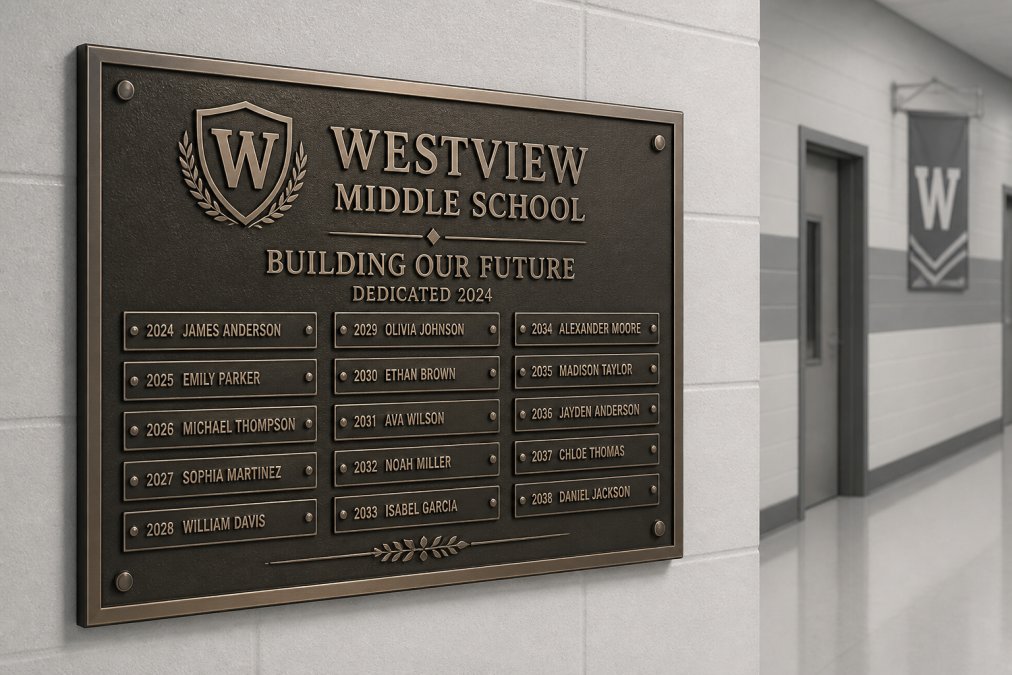
Cherry wood offers warmth and traditional elegance for indoor memorials honoring faculty or founders. Walnut provides similar aesthetics with darker tones suitable for formal settings. Both require periodic refinishing every 5-10 years. Bronze and aluminum require virtually no maintenance and develop character over time. Bronze develops a natural patina that deepens with age; aluminum maintains consistent appearance indefinitely and can be anodized in various colors. For schools with limited maintenance budgets, aluminum or bronze memorial plaques are practical choices.
Many schools mount plaques outdoors near building entrances, in courtyards, or on athletic facility walls. Bronze naturally resists corrosion and improves with age. Aluminum requires anodizing to resist oxidation, but properly anodized aluminum lasts indefinitely. Stainless steel offers maximum durability but costs significantly more.
5. Affordable School Awards: Budget-Friendly Perpetual Plaque Solutions
Perpetual plaque ideas for small schools must account for real budget constraints. Affordable doesn't mean cheap-looking. Strategic material choices and simple designs create professional results at modest costs.
Acrylic plaques cost 40-60% less than comparable wood or metal options while maintaining professional appearance. Modern acrylic accepts engraving beautifully and can be laser-cut into custom shapes. Many schools use clear acrylic bases with engraved plates mounted on top, a contemporary design that feels intentional.
Composite materials, engineered wood products designed to resist weathering, offer another budget-friendly option. They cost less than solid wood, require minimal maintenance, and work well for modular systems where plates are replaced annually. The trade-off is longevity; composites typically last 20-30 years before degradation becomes visible.
Most engravers offer significant discounts for bulk orders. If you're planning recognition plaques annually for five years, ordering all five plates at once can reduce per-plate costs by 20-30%. This ensures consistency and spreads costs across years while maintaining overall quality.
6. Mounting, Installation, and Ongoing Maintenance
A beautifully designed plaque loses impact if mounted poorly or deteriorates from neglect. Installation and maintenance determine whether your perpetual plaque ideas for small schools remain impressive for decades or become eyesores within years.
Wall mounting is the most common approach for perpetual plaques. It saves floor space, integrates the plaque into the school's architectural narrative, and makes additions straightforward. A properly mounted plaque requires minimal hardware, typically four stainless steel anchors and screws rated for the plaque's weight. Most schools mount plaques in high-traffic areas: hallway walls near the main office, gymnasium entrances, or athletic facility corridors.
Trophy base displays work well for smaller plaques when wall space is limited. A wooden or metal base holds the plaque at an angle, making it readable from across a room. This option works particularly well for rotating annual plaques, which can be moved to different locations as needed.
The ideal location for any perpetual plaque is somewhere students and families see regularly without disrupting traffic flow. Near the main office, adjacent to the gymnasium, or in a dedicated recognition hallway all work well.
For modular systems, plate replacement is straightforward: remove the old plate using a screwdriver, align the new plate, and secure it with the same fasteners. This takes 10-15 minutes and requires no special tools. Metal plaques benefit from occasional cleaning with a soft cloth and mild soap; avoid abrasive cleaners. Wood bases can be dusted regularly and refinished every 5-10 years. Acrylic plaques need only a gentle wipe with a microfiber cloth.
For outdoor plaques, inspect them annually for weather damage. Bronze develops patina naturally and requires no intervention unless you want to maintain a bright finish. Aluminum plaques should be checked for oxidation; if white powder appears, clean with a soft brush and mild acid cleaner.
7. Personalization and Design Layout Best Practices
The visual design of your perpetual plaque ideas for small schools affects how viewers perceive the achievement and the school itself. Professional layout and thoughtful typography communicate that the school takes recognition seriously.
Serif fonts convey tradition and formality, appropriate for academic and memorial plaques. Sans-serif fonts feel modern and clean, good for athletic or contemporary recognition. Many schools use a serif font for titles or school names and a sans-serif font for recipient names, creating visual hierarchy.
Recipient names should be large enough to read from across a room, typically 0.4-0.6 inches tall. Smaller text for dates, events, or additional context can be 0.25-0.35 inches. Centered alignment feels formal and balanced; left-aligned names feel contemporary and efficient.
Sublimation transfers full-color images onto specially treated surfaces, working well for photo-based recognition. However, sublimated surfaces are less durable than engraved ones and can fade with sun exposure. Engraving creates permanent, tactile results that last indefinitely. Laser etching combines the precision of engraving with the detail capability of sublimation, rendering fine lines, shading, and complex graphics while creating a permanent mark. Many schools use combinations: a laser-etched logo at the top, engraved text for names, and sublimated photo elements.
8. Digital Integration and Sustainable Material Options
Modern perpetual plaque ideas for small schools increasingly incorporate technology and environmental responsibility that appeal to contemporary values.
A QR code engraved into a plaque can link to a digital record, video of the achievement, photo gallery, or detailed biography of the honoree. Students scanning the code access rich multimedia content that the physical plaque alone cannot convey. This works particularly well for athletic plaques, where a QR code might link to game highlights or performance statistics. The QR code should occupy the lower right corner, clearly visible but not dominating the design.
Schools increasingly prioritize sustainability. Recycled aluminum plaques perform identically to virgin aluminum but reduce environmental impact. Sustainably harvested wood from certified forests maintains aesthetic appeal while supporting responsible forestry. Composite materials made from recycled plastic and wood fiber offer another sustainable option, performing well in modular systems where plates are replaced annually.
The EPA's guidance on sustainable procurement encourages institutions to consider environmental impact alongside performance and cost. The cost difference between sustainable and conventional materials is typically minimal, often less than 5-10%.
| Design Approach | Material | Cost Level | Best For | Durability |
|---|---|---|---|---|
| Rotating Modular | Anodized aluminum base + annual plates | Budget-friendly | Multi-year recognition programs | 20-30 years |
| Integrated Mascot | Wood base + laser-etched metal plate | Mid-range | Building school identity and pride | 30-50 years |
| Athletic Recognition | Bronze or stainless steel | Mid-to-premium | Outdoor installations, championship records | 50+ years |
| Memorial/Dedication | Walnut or cherry wood + bronze | Premium | Honoring significant individuals or events | 40+ years with maintenance |
| Acrylic Budget | Clear acrylic base + engraved plates | Budget-friendly | Schools with tight budgets | 15-20 years |
| Sustainable Hybrid | Recycled aluminum + sustainably harvested wood | Mid-range | Environmentally conscious institutions | 25-40 years |
Perpetual plaque ideas for small schools succeed when they balance recognition, durability, and budget reality. The designs covered here address different recognition needs while remaining affordable for institutions with limited resources.
The key is selecting a system that scales with your school's growth. A modular approach that accommodates annual additions costs less per year than commissioning entirely new plaques. Material choices like anodized aluminum and sustainably harvested wood provide durability without premium pricing. Thoughtful design, integrating your school's mascot, using professional typography, and considering digital integration, transforms a functional award into a meaningful symbol of achievement.
At Gino's Awards, Inc., we've helped small schools across the country implement recognition systems that endure for decades while remaining affordable year after year. Our team specializes in fast turnaround times, free personalization, and on-site manufacturing that ensures quality control. Whether you're designing your first perpetual plaque or expanding an existing recognition program, contact Gino's Awards for a consultation to explore options tailored to your school's needs and budget. Call (216) 831-6565 to discuss your project with our team.
Frequently Asked Questions
What materials work best for perpetual plaques in a small school setting?
The best materials depend on budget and display location. Cherry wood and walnut finishes offer durability and aesthetic appeal for indoor mounting. Bronze and aluminum provide weather-resistant options for outdoor plaques. Acrylic is a cost-effective alternative for schools with tight budgets. For perpetual plaques that need annual updates, consider materials with engravable surfaces that allow for plate replacement without replacing the entire base structure.
How can small schools keep perpetual plaque costs affordable?
Several strategies help control costs for affordable school awards. Modular perpetual plaque systems allow you to replace individual plates annually rather than purchasing new bases. Acrylic and composite materials cost less than wood or bronze. Bulk ordering reduces per-unit pricing. Sublimation engraving is often more economical than laser etching for large quantities. Request quotes from manufacturers like Gino's Awards to compare pricing based on your specific needs, quantity, and timeline.
What should be engraved on a school recognition plaque?
Effective engraving for school recognition plaques includes the award name, recipient name or team name, year, and achievement description. For varsity and athletic plaques, include the sport or activity. Use clear typography with proper visual hierarchy, larger text for the main award title, smaller text for details. Consider adding your school mascot or logo for school spirit. Inscription templates should balance professionalism with personalization. Laser etching and traditional engraving both work well; laser etching offers sharper detail for logos.
How do I display and maintain perpetual plaques in a school?
Wall-mounted plaques work well in hallways, offices, or trophy cases. Ensure proper mounting hardware is installed securely. For outdoor plaques, choose weather-resistant materials like bronze or aluminum. Maintenance is simple: dust regularly with a soft cloth and clean with mild soap and water. For perpetual plaques with replaceable plates, gently remove old plates and insert new engraved ones annually. Avoid harsh chemicals that can damage wood finishes or engravings.
Can perpetual plaques include digital features for small schools?
Yes. Modern perpetual plaques can integrate QR codes that link to digital recognition programs, alumni networks, or historical archives. This bridges physical and digital recognition, allowing schools to maintain historical records while displaying tangible awards. Digital integration works particularly well for donor recognition walls and alumni awards, creating an interactive experience for visitors while preserving the commemorative value of the physical plaque.
This article was written using GrandRanker