



What Makes a Quality Crystal Award: 7 Key Factors
Table of Contents
- What Makes a Quality Crystal Award: The Foundation
- Optical Crystal vs Lead Crystal: Understanding the Difference
- Crystal Award Engraving Techniques: Precision and Permanence
- Types of Crystal Awards and Their Quality Standards
- Durability and Longevity: What Separates Premium from Ordinary
- Choosing a Trusted Crystal Award Supplier
- Common Mistakes to Avoid When Selecting Crystal Awards
- Conclusion: Investing in Premium Recognition
Last Updated: July 17, 2026
Understanding what makes a quality crystal award requires examining material grade, optical clarity, engraving precision, and construction standards. At Gino's Awards, Inc., we've spent over 75 years crafting crystal awards that stand the test of time. Below, we'll walk you through the key factors that distinguish truly exceptional crystal awards from those that merely look impressive in a catalog photo.
What Makes a Quality Crystal Award: The Foundation
The foundation of any quality crystal award begins with understanding the material itself. Crystal isn't a single substance, it's a category of materials that includes optical crystal, lead crystal, and various specialty formulations, each with distinct properties affecting brilliance, weight, and longevity.
When you hold a quality crystal award, you should immediately notice its weight. Heavier pieces generally indicate denser material with fewer air bubbles or imperfections. The clarity should be exceptional, no cloudiness, yellowing, or visible inclusions. A quality award should catch and refract light beautifully, creating rainbow patterns when held at different angles.
Material grade matters most because it determines durability, optical properties, and how the award will age. Premium crystal maintains its clarity for decades, while lower-grade material can become cloudy or develop surface scratches.
Optical Crystal vs Lead Crystal: Understanding the Difference
Optical crystal and lead crystal represent two distinct approaches to crystal manufacturing, each with specific advantages and trade-offs.
Optical crystal is lead-free crystal manufactured using special glass formulations that create exceptional clarity and brilliance without environmental concerns. It's heavier than regular glass but lighter than lead crystal.
Lead crystal contains 24% or more lead oxide, which increases density, weight, and refractive index, the property that creates brilliant light-catching effects. Lead crystal pieces feel noticeably heavier and sparkle more dramatically. However, lead raises environmental and handling concerns, particularly for items in homes with children.
Clarity, Weight, and Brilliance
The clarity of your crystal award should be immediately apparent. When you look through a quality piece, you should see no cloudiness, bubbles, or discoloration. Premium crystal maintains optical clarity that allows light to pass through without distortion.
Weight is a tangible quality indicator. A standard 8-inch optical crystal award should weigh between 2-3 pounds. If it feels significantly lighter, the material likely contains more air or lower-density formulations.
Brilliance, the way crystal catches and reflects light, depends on both the material's refractive index and the quality of the polish. When light hits a quality crystal award, it should sparkle with clear, sharp reflections. Dull or muted light reflection suggests either lower-grade material or poor polishing.
Cost and Environmental Considerations
Lead crystal typically costs 15-25% more than optical crystal for equivalent pieces. However, the decision shouldn't be purely financial, environmental impact matters increasingly to organizations making bulk purchases.
EPA guidance on lead in consumer products provides context for why many companies are transitioning away from lead crystal. Organizations committed to sustainability often specify optical crystal awards to align with their environmental values.
Lead crystal does offer superior sparkle and weight that some organizations prefer for high-prestige awards. The choice depends on your priorities: maximum visual impact and traditional feel (lead crystal) versus environmental responsibility and modern appeal (optical crystal).
Crystal Award Engraving Techniques: Precision and Permanence
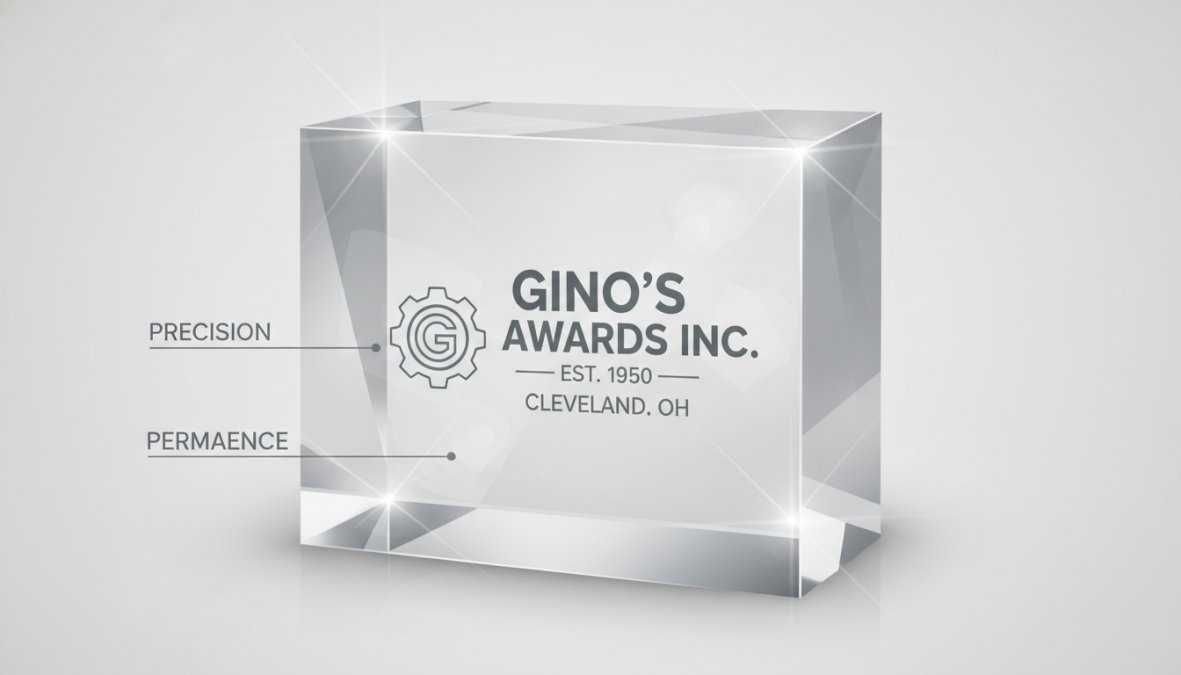
The engraving process determines whether your award will display crisp, professional details or fuzzy, difficult-to-read text. Engraving quality depends on three factors: the engraving method used, the depth and precision of the cut, and the skill of the technician operating the equipment.
Laser Engraving vs Traditional Methods
Laser engraving has become the standard for crystal awards because it offers precision that mechanical engraving methods struggle to match. A laser creates a fine, controlled burn mark on the crystal surface, producing clean lines and consistent depth across the entire design.
Traditional mechanical engraving uses physical tools to cut into the crystal. While capable of producing quality results, mechanical methods require more skill to maintain consistent depth and are more prone to tool marks. Sandblasting creates a frosted appearance by blasting the crystal surface with fine sand particles, working well for large background areas but lacking precision for fine details. Quality awards typically reserve sandblasting for background effects only, pairing it with laser engraving for text and fine details.
Quality Indicators in Engraved Details
Examine the edges of engraved text closely. In quality work, the edges should be clean and sharp, not fuzzy or feathered. The depth of engraving matters for longevity, shallow engraving can wear away over decades of handling. Quality awards typically feature engraving that's 1-2mm deep, deep enough to resist wear while remaining visually proportionate to the award size.
Color consistency in engraved areas is another quality marker. The engraved portions should match in tone and appearance across the entire design. Inconsistent coloring suggests the engraving was done in multiple passes or with equipment that wasn't properly calibrated.
Types of Crystal Awards and Their Quality Standards
Crystal awards come in numerous styles, each with specific quality considerations.
Beveled, Faceted, and Polished Finishes
Beveled edges create a sloped edge around the perimeter of the award, typically at 45-degree angles. Quality beveled awards have consistent bevel angles throughout, with no irregular edges or flat spots.
Faceted finishes incorporate multiple angled surfaces that catch light dramatically. These surfaces should be smooth, evenly spaced, and consistent in depth. Poor-quality faceting shows uneven angles or surfaces that don't align properly.
Polished finishes create a mirror-like surface that requires careful finishing work. Quality polished awards have no scratches, swirl marks, or dull spots. The polish should be uniform across the entire surface.
Shape and Design Complexity
Simple rectangular or round awards are easier to manufacture consistently than complex custom shapes. Complex shapes require more skilled craftsmanship and quality control to maintain consistent standards.
When evaluating a complex-shaped award, examine the corners and curves particularly carefully for rough edges or uneven finishes. The relationship between design complexity and price should be proportional, if a custom-shaped award costs only slightly more than a standard rectangle, the manufacturer may be cutting corners.
Durability and Longevity: What Separates Premium from Ordinary
A quality crystal award should maintain its appearance and structural integrity for decades. Scratch resistance depends on the crystal's hardness and surface treatment. Optical crystal rates around 6 on the Mohs hardness scale, making it relatively resistant to everyday scratches.
Resistance to Scratching and Clouding
Crystal can cloud over time when exposed to moisture, certain cleaning products, or environmental contaminants. Quality crystal resists this clouding because of superior material purity and surface treatment.
Test crystal clarity by looking through it at a light source. The light should pass through without distortion or visible particles. Micro-scratches accumulate on award surfaces over time. Quality crystal maintains its polish better, with scratches remaining less visible.
Maintenance and Care for Long-Term Brilliance
Proper maintenance extends the life of any crystal award, but quality pieces require less maintenance to maintain their appearance. Use a soft, dry cloth for dusting and occasional gentle cleaning with water and mild soap.
Avoid harsh chemicals, abrasive cloths, and vigorous scrubbing. Store crystal awards away from direct sunlight when not displayed. UV exposure can cause yellowing in lower-quality crystal over time.
Choosing a Trusted Crystal Award Supplier
Your supplier's experience and quality control processes matter as much as the raw materials. A manufacturer with decades of experience has developed systems to catch defects and maintain consistency.
Experience, Craftsmanship, and Quality Control
Look for suppliers with established track records. Gino's Awards, Inc. has been manufacturing quality awards since 1950, which indicates a commitment to quality that survives market changes. Quality control processes should be visible and verifiable, reputable suppliers inspect every award before shipping, checking for engraving accuracy, surface defects, and structural integrity.
Craftsmanship in crystal awards comes from skilled technicians who understand the material's properties. Suppliers who invest in training and retain experienced staff produce better awards than those cycling through entry-level workers.
Proof Approval and Customization Support
Quality suppliers provide digital proofs showing exactly how your custom design will appear on the finished award. This step is critical because it catches design issues before production. The proof process reveals a supplier's attention to detail and commitment to customer satisfaction.
Customization support matters when you need modifications. A quality supplier accommodates reasonable changes to designs, sizing, or engraving specifications and explains technical limitations honestly.
Better Business Bureau guidance on selecting award suppliers provides framework for evaluating supplier reliability and customer service standards.
Common Mistakes to Avoid When Selecting Crystal Awards
Prioritizing price over quality. The cheapest option rarely delivers acceptable quality. Crystal awards that cost significantly less typically use lower-grade material or skip quality control steps.
Ordering without seeing a proof. Approving designs without a detailed proof leads to surprises, text positioned incorrectly, logos appearing smaller than expected, or engraving quality below expectations. Always request and carefully review a proof before production.
Choosing complex designs without consulting the supplier. Some design elements look good on screen but don't translate well to crystal engraving. Suppliers can identify these issues during the proof stage if you involve them early.
Neglecting to specify material grade. Assuming all crystal is equivalent leads to disappointment. Specify optical or lead crystal and clarify material thickness and clarity standards.
Ignoring the supplier's experience. Ordering from an inexperienced supplier to save money often costs more in the long run through quality issues and poor customer service.
Selecting a quality crystal award requires attention to material properties, manufacturing precision, and supplier reliability. The difference between a premium award that impresses recipients for decades and a mediocre piece becomes apparent within weeks of presentation.
When you're ready to order custom crystal awards, Gino's Awards, Inc. brings over 75 years of manufacturing expertise to every project. We provide detailed digital proofs, use premium materials, and maintain rigorous quality control standards. Our on-site Cleveland facility allows us to manage every step of production. Call us at (216) 831-6565 to discuss your award needs and receive a custom quote.
Frequently Asked Questions
What is the difference between optical crystal and lead crystal awards?
Optical crystal is lead-free and eco-friendly, offering excellent clarity and brilliance without heavy metals. Lead crystal contains 24% or more lead oxide, making it denser, heavier, and more refractive, creating superior sparkle. Lead crystal is more traditional and prestigious but costlier. Optical crystal is the modern choice for environmentally conscious organizations. Both are high-quality when sourced from reputable suppliers, but your choice depends on budget, environmental values, and desired visual impact.
How can you tell if a crystal award is high quality?
Examine clarity, premium crystal should be transparent with no visible bubbles or cloudiness. Check weight and feel; quality crystal has substantial heft. Look at the finish: beveled or faceted edges should be sharp and precise, not rough. Test the engraving by running your finger over it; crisp, detailed engravings indicate laser precision. Ask for a digital proof before production. Finally, verify the supplier's experience and reputation, established manufacturers like Gino's Awards with decades of craftsmanship ensure superior quality standards.
What are the best engraving methods for crystal awards?
Laser engraving is the gold standard for crystal awards, offering precision, durability, and fine detail reproduction. It creates a permanent frosted mark without damaging the crystal surface. Laser-engraved logos and text remain sharp indefinitely and resist fading. Traditional sand-blasting is less precise and can create uneven surfaces. Digital proofs before production are essential to catch errors. Quality suppliers use high-powered lasers calibrated for crystal and provide detailed proofs so you see exactly how your design will appear on the final award.
What types of crystal awards are available, and how do I choose?
Crystal awards come in many forms: towers, obelisks, plaques, cubes, and custom shapes. Premium options feature beveled or faceted finishes that enhance light refraction and visual appeal. Consider your event's tone, modern designs suit corporate settings, while traditional shapes work for formal galas. Custom shapes add uniqueness but may cost more and require longer lead times. Discuss your vision with your supplier to explore design options, review samples, and ensure your choice aligns with your budget and timeline.
Why should I choose a crystal award over other recognition options?
Crystal awards convey prestige, permanence, and high regard. Unlike plaques or trophies made from less durable materials, crystal maintains its brilliance for decades with minimal maintenance. The weight and visual beauty create an emotional impact that recipients treasure. Crystal is versatile, suitable for corporate recognition, academic achievements, sports awards, and milestone celebrations. Premium crystal from experienced suppliers like Gino's Awards ensures your recognition feels genuinely special and reflects the value you place on the achievement being honored.
How do I maintain a crystal award to keep it looking new?
Crystal requires minimal care. Dust regularly with a soft, lint-free cloth to prevent buildup. For deeper cleaning, use lukewarm water with mild soap and a soft cloth, then dry immediately to prevent water spots. Avoid harsh chemicals or abrasive scrubbers that can scratch the surface. Store in a stable environment away from extreme temperature changes, which can cause internal stress. Keep away from direct sunlight for extended periods to prevent discoloration. Proper maintenance preserves the brilliance and clarity of your award for generations.
This article was written using GrandRanker