



Best Microfiber Cloth for Crystal Awards: Top Picks Tested
Quick Summary
The best microfiber cloth for crystal awards is a soft, lint-free cloth with fine fibers that lift dust and fingerprints with light pressure. Use a flat-weave cloth for smooth plaque faces and a plush cloth for engraved detail, washing each new cloth once before use.
- Crystal shows every fingerprint and speck of dust, so the cloth matters as much as the cleaning solution.
- Paper towels, rough fabrics and some sponges can leave micro-scratches that dull crystal over time.
- Use one flat-weave cloth for smooth faces and a plush cloth for deep engraving.
- Wash any new cloth once before first use, and avoid fabric softener, which reduces its dust-trapping ability.
- Test a cloth at home for lint, streaks and snagging before trusting it on an award.
Table of Contents
- Why Microfiber Is the Right Material for Crystal Awards
- What to Look for in a Microfiber Cloth for Crystal
- Top Microfiber Cloths for Crystal Awards Compared
- Step-by-Step: How to Clean Crystal Awards
- Chamois vs Microfiber Cloth for Crystal Care
- How to Clean Glass Without Streaks
- Caring for Your Microfiber Cloths and Choosing Your Next Step
- Frequently Asked Questions
Why Microfiber Is the Right Material for Crystal Awards
Last Updated: November 5, 2026
Choosing the best microfiber cloth for crystal awards matters because the wrong cloth can leave scratches, lint and streaks on a surface that customers and recipients look at closely.
Microfiber is a practical choice for this job because its fibers are fine and split, which lets them trap dust and oils instead of pushing them around.
The main concern is abrasion. Paper towels, rough fabrics and some household sponges can leave micro-scratches that dull the surface over time.
What to Look for in a Microfiber Cloth for Crystal
Most buying advice stops at "soft and lint-free." Those two words do not tell you which of two similar-looking cloths will scratch a crystal award or leave lint on a polished face. The specifications below are the ones that actually predict performance, and each comes with a practical way to judge it before you buy.
Fiber and Pile
Microfiber is measured in denier, the thickness of the individual filament. Finer filaments split into more edges, and more edges mean more dust and oil pickup.
Pile length is the visible height of the fibers. Short, flat pile glides across a smooth plaque face and sheds little. Longer, plush pile lifts dust and fingerprints better but can catch on engraved edges.
Weave and GSM
GSM (grams per square meter) is the standard weight measure for microfiber fabric. A light cloth in roughly the 200-300 GSM range feels thin and dries fast; a heavier cloth in roughly the 300-400 GSM range feels denser and holds more water. Heavier is not automatically better for crystal: a dense cloth can leave more water behind on a smooth face if you press hard, and it takes longer to air dry between uses.
Edge Construction
Edges are where most lint comes from. Cut edges are the cheapest and shed the most. Sewn or overlocked edges shed less but can release a few threads on the first wash. A cloth with a sealed or bonded edge is the least likely to shed, and it is worth the small premium for an award you display. Whatever the edge type, wash the cloth once before first use and check the edge for loose thread before each cleaning.
Lint Performance
"Lint-free" on a label is a claim, not a test. Judge it yourself: wipe a clean glass surface in one direction, then look at it under a desk lamp at a low angle. A cloth that leaves visible fibers is a dusting cloth, not a buffing cloth. Repeat the check after the first wash, because some cloths shed more once the factory finish is gone.
Absorbency and Dry Time
A cloth that holds water well is useful for damp wiping but slow to air dry, and a cloth stored damp develops odors that transfer to the award. Look for a cloth that feels damp rather than soaked after wringing, and plan to air dry it fully between uses. Two thinner cloths often outperform one heavy cloth because you can keep one dry for buffing while the other is in use.
Size and Pack Format
A cloth around 12 by 12 inches covers most awards and folds into a smaller pad for detail work. Larger cloths suit display cases; smaller cloths give more control around engraved text and bases. Pack format matters more than most buyers expect: a multi-pack lets you dedicate separate cloths to dusting, damp wiping, and buffing, which is the single biggest step toward streak-free results.
Care Instructions Before You Buy
Check the care label before committing to a pack. A cloth that requires special detergent or cannot be machine washed will cost more over time than its price suggests.
Watch out: a cloth marketed as "scratch-free" can still scratch if grit is trapped in the fibers. Shake out and inspect the cloth before every use, and retire any cloth that has picked up grit from a floor or a dirty surface.
Top Microfiber Cloths for Crystal Awards Compared
Most cleaning roundups test cloths on kitchen counters and windows, not on crystal. That matters, because a cloth that streaks on a granite counter can still be fine on glass, while a cloth that sheds on a flat plaque face will leave visible lint on an award.
| Cloth | Format and construction | Why it suits crystal awards | Watch-outs |
|---|---|---|---|
| Norwex EnviroCloth | Plush, dense pile; sewn edges | Dense pile lifts fingerprints with light pressure; holds up to repeated washing | Premium price; the plush face can snag on sharp engraved burrs |
| Mr. Siga Microfiber Cleaning Cloths | Multi-pack, medium pile, overlock edges | Low cost per cloth, so you can keep a clean one for dry buffing and a separate one for damp wiping | Overlock thread can shed on very smooth faces until the cloth is washed once |
| E-Cloth Window Cleaner Kit | Flat, short-pile weave with a smooth side | Flat weave glides across broad plaque faces and leaves little lint | Short pile has less grab for dust in deep engraving; pair with a plush cloth for detail |
| Fixsmith Microfiber Cleaning Cloth | Thicker pile, high absorbency | Good for damp wiping and picking up soap film | Thicker pile takes longer to air dry, so store it dry to avoid musty odors |
| AIDEA Microfiber Cloths | Multi-pack, medium pile, sewn edges | Practical for routine dusting across a display case | Verify the edge finish on arrival; some packs vary between batches |
| Casabella Microfiber All-Purpose Cloth | Medium pile, all-purpose weave | Fine for routine dusting and light buffing | Not a dedicated glass cloth; check for lint on the first use |
| Amazon Basics Microfiber Cleaning Cloths (24-pack) | Bulk pack, medium pile | Cheap enough to dedicate separate cloths to dusting, damp wiping, and buffing | Bulk packing can leave fold creases; wash before first use on an award |
How to Read the Table
Pile length is the first decision. A short, flat weave is the safer choice for a smooth, flat crystal plaque face because it glides and sheds little. A plush, longer pile picks up dust and fingerprints better but can catch on a sharp engraved edge or a chipped corner.
Edge construction is the second decision. Sewn or overlocked edges shed less than cut edges, but even a sewn edge can release a few loose threads on the first use.
A Repeatable Check You Can Run at Home
You do not need a lab to compare two cloths. Run the same four checks on each candidate, using a clean, dry cloth and a scrap of glass or an old award you do not display:
- Lint check. Wipe a clean glass surface in one direction, then look at it under a desk lamp at a low angle. Count the visible fibers. A cloth that leaves more than a few specks is a dusting cloth, not a buffing cloth.
- Streak check. Dampen the cloth with plain water, wring it until it is barely damp, wipe, and let the surface air dry in shade. A uniform haze means residue; distinct streaks mean the cloth is pushing water rather than absorbing it.
- Snag check. Run the cloth lightly across an engraved edge or a textured base. If fibers catch and pull, reserve that cloth for flat faces only.
- Wash check. Wash the cloth once with a mild, fragrance-free detergent and no fabric softener, air dry it, and repeat the lint check. A cloth that sheds more after washing will keep shedding on your awards.
Watch out: a cloth that passes the lint check on glass can still fail on acrylic, which carries more static and attracts loose fibers. Test on the same material as the award you plan to clean.
Matching the Cloth to the Award
- Smooth, flat crystal plaques and obelisks: a flat-weave or short-pile cloth for wiping, plus a dry plush cloth for the final buff.
- Deeply engraved or sandblasted crystal: a plush cloth to lift dust from the cuts, worked gently so fibers do not catch on the edges.
- Gold-accented, painted, or printed awards: the softest plush cloth you can find, used dry or barely damp, and no rubbing over the decorated area.
- Display cases and shelving: a bulk multi-pack so a clean cloth is always available and dirty cloths never go back on the glass.
Step-by-Step: How to Clean Crystal Awards
Work on a clean, padded surface, such as a towel on a table, so an accidental slip does not chip the piece.
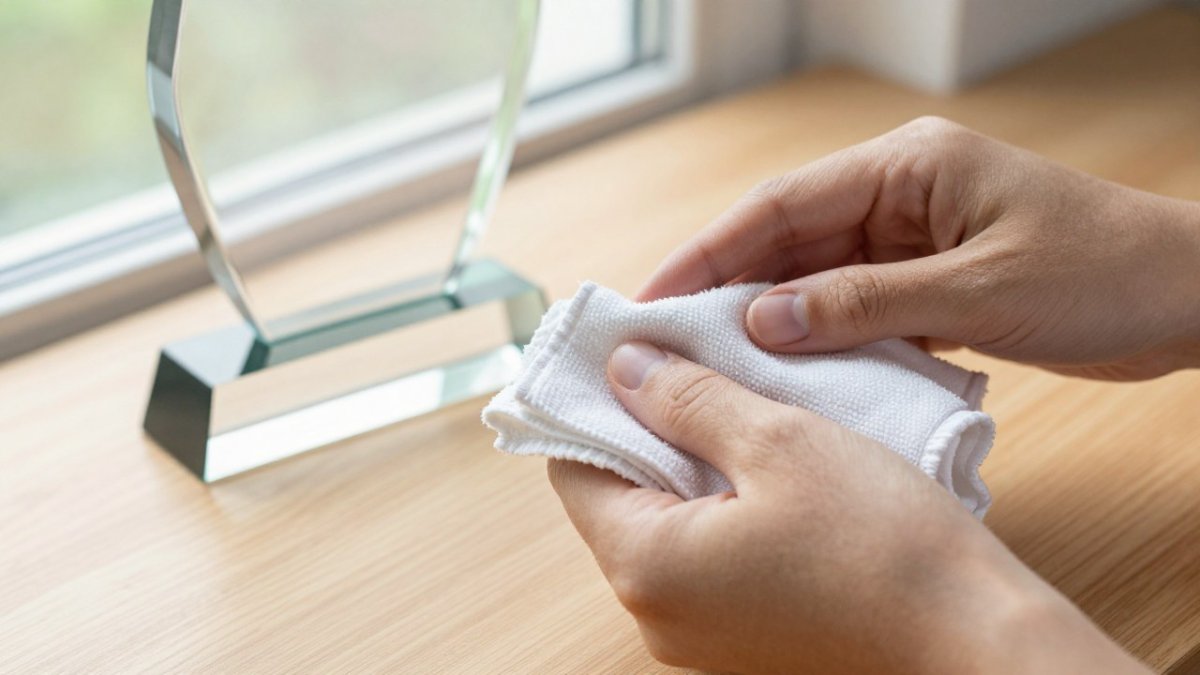
- Dust first. Use a dry microfiber cloth to remove loose dust from all surfaces, including the base and any engraved areas.
- Dampen lightly if needed. For fingerprints or residue, mist the cloth lightly with warm water and a small amount of mild dish soap. Wring it out well so the cloth is damp, not wet.
- Wipe gently. Use small, circular motions across one section at a time. Let the fibers do the lifting instead of pressing hard.
- Rinse if soap is used. Wipe the same area with a clean, barely damp cloth to remove any soap film.
- Dry and buff. Finish with a separate dry cloth. Buff in one direction to bring out the shine.
Apply cleaner to the cloth rather than directly onto the award.
Chamois vs Microfiber Cloth for Crystal Care
Chamois can still be useful for quick drying after a damp wipe, especially on large flat surfaces. Many owners use a microfiber cloth for cleaning and a dry chamois for the final polish. If you prefer a single tool, choose microfiber, since it handles dusting, damp cleaning and buffing in one cloth.
How to Clean Glass Without Streaks
Streaks usually come from too much cleaner, a dirty cloth or drying in direct sun. Use a barely damp microfiber cloth instead of a sprayed solution, and change to a dry cloth for the final buff.
Most streaks on glass come from residue left by soap or hard water. Rinsing with a clean, damp cloth after cleaning removes that film.
Caring for Your Microfiber Cloths and Choosing Your Next Step
A microfiber cloth lasts longer when you keep it clean. Wash cloths separately from towels, cotton and fabric softener, because softener coats the fibers and reduces their ability to trap dust.
Once your awards are clean and polished, the next question is where to display them. If you are maintaining a collection of crystal awards, you may also find our article on creative ways to display student achievement plaques useful.
Gino's Awards, Inc. is a family-owned and operated provider of custom awards and engraved plaques. We offer free personalization, so if you need new crystal awards to care for, call us at (216) 831-6565 to discuss your order.
Frequently Asked Questions
What is the best high-quality microfiber cloth?
Choose a soft, lint-free, non-abrasive cloth and confirm its fiber specifications before buying. Pricing varies by pack size and retailer, so check current listings before ordering.
What type of microfiber cloth is best for glass?
A fine-weave, lint-free microfiber cloth works best for glass because it lifts oils and dust without leaving fibers behind. Look for a cloth labeled non-abrasive and streak-free. Keep one cloth for dusting and a separate, clean cloth for the final buff so residue from the first pass does not spread across the surface.
Can microfiber cloths scratch crystal awards?
A clean, soft microfiber cloth is unlikely to scratch crystal, but grit trapped in the fibers can. Shake out or rinse cloths often, avoid rough fabrics like paper towels, and never rub the surface with dry grit on it. Wash cloths separately from other fabrics and avoid fabric softener, which can reduce absorbency and leave residue.
Should you use a dry or damp microfiber cloth on crystal?
Start with a dry microfiber cloth to remove dust, then switch to a lightly dampened cloth for fingerprints and smudges. Use warm water with a drop of mild dish soap for stubborn marks, and dry the surface immediately with a clean dry cloth. Excess moisture left to air-dry is what causes water spots.