


How to Choose Custom Awards for a Small Business Budget
Table of Contents
- Start With a Budget Range and Quantity Before You Look at Materials
- Match Award Materials to Your Brand Image and Budget
- Custom Glass Awards for Corporate Events: When They're Worth It
- Award Personalization Best Practices That Prevent Costly Mistakes
- Affordable Corporate Recognition Ideas That Still Feel Premium
- Compare Lead Times and Proofing Processes Before You Order
- Why Sourcing Custom Awards In-House Beats DIY for Most Businesses
- Conclusion
- Frequently Asked Questions
Last Updated: September 6, 2026
Start With a Budget Range and Quantity Before You Look at Materials
Ordering recognition pieces without a firm budget is the fastest way to overspend or undersell your event. Custom awards for a small business budget in 2026 require a clear financial ceiling and an exact quantity before any material decisions make sense.
At Gino's Awards, Inc., we've spent over 75 years helping HR managers and event planners avoid this exact pitfall. Start by calculating your per-award ceiling, then multiply by the number of recipients. A common approach is to set aside a total line item for recognition, then divide it across tiers, such as a top performer award versus a years-of-service plaque (shrm.org).
Most guides get this wrong: they browse materials first, fall in love with crystal, and then discover the quantity discounts don't stretch far enough. Locking your range early keeps the rest of the process honest.
Match Award Materials to Your Brand Image and Budget
Material choice is where your budget either works for you or quietly doubles. The smartest small-business play is to match the material to the message weight of the award, not just the logo color.
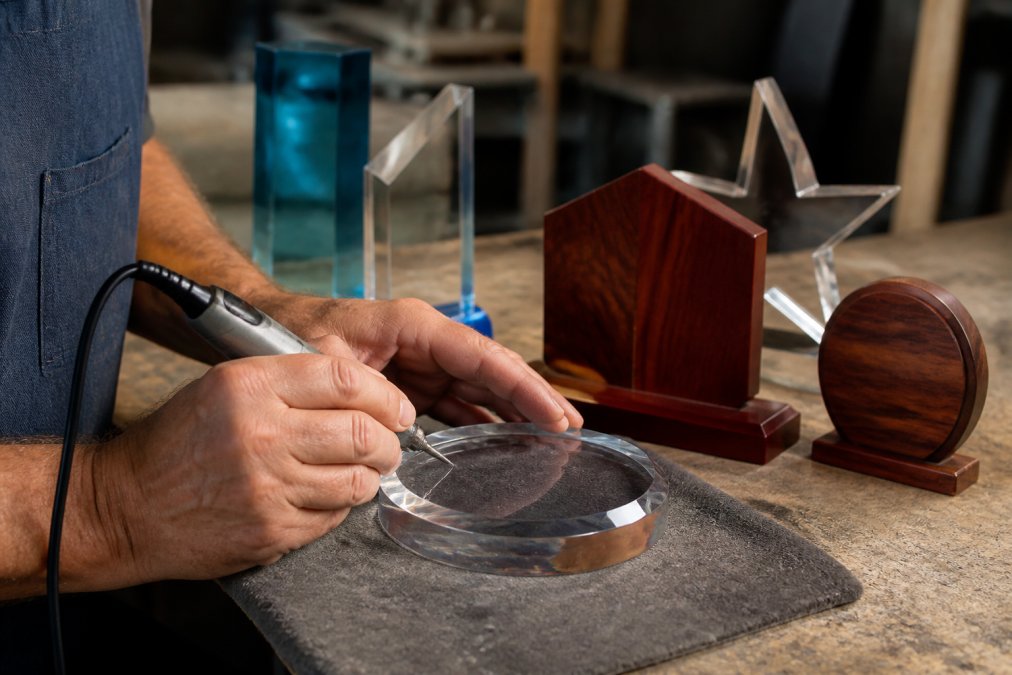
The 2026 budget trick competitors ignore: tier your materials. A common pattern among cost-conscious HR teams is to buy one hero crystal piece for the top award, three glass pieces for runner-ups, and twenty acrylic pieces for participation or tenure milestones. This 'pyramid approach' keeps your total line item flat while making the top award feel genuinely premium.
The DIY vs. professional sourcing angle most guides skip: If your budget is limited, consider a hybrid route. You can source plain acrylic or wood blanks and then find a local laser engraver. This works well for a single event with fewer awards. However, once you exceed a certain number of pieces or need consistent color logos, a professional awards supplier with on-site engraving can be more efficient than managing the process yourself. The hidden cost of DIY is not just the blank, it is the time spent managing proofs, fixing alignment, and re-engraving mistakes.
Sustainable materials are no longer a premium add-on. Several U.S. suppliers offer recycled acrylic (often made from post-industrial offcuts) and Forest Stewardship Council (FSC)-certified wood (fsc.org). If your small business has published sustainability goals, that small premium is often recoverable through the marketing story you tell when you present the award. A simple line in your press release, 'Our 2026 recognition program uses recycled acrylic, diverting an estimated 40 pounds of plastic from landfills', turns a procurement decision into a brand asset.
The trade-off matrix most competitors never show you:
| Material | Per-Unit Cost (25-50 pcs) | Perceived Value | Lead Time | Best For |
|---|---|---|---|---|
| Acrylic (recycled) | $8-$18 | Moderate | 5-7 days | High-volume internal recognition |
| Wood + plate | $15-$35 | High | 7-10 days | Service awards, team milestones |
| Glass (etched) | $25-$60 | High | 10-14 days | Client appreciation, leadership |
| Crystal | $50-$150+ | Premium | 14-21 days | Top performer, executive retirement |
Your brand image matters, but so does the shelf life of the award. A tech startup celebrating a product launch might favor sleek acrylic because the team will iterate quickly and the award is a moment-in-time token. A law firm honoring a partner's 25 years calls for glass or crystal because that piece will sit on a shelf for decades.
Custom Glass Awards for Corporate Events: When They're Worth It
Custom glass awards for corporate events earn their place when the occasion carries real weight. Annual galas, executive retirements, and major client milestones justify the higher per-unit cost because the recipient keeps the piece on a desk for years.
Glass and crystal also photograph well, which matters when your event generates public relations content. For internal quarterly wins or high-volume employee recognition, reserve glass for the top tier and use acrylic or wood for the rest.
That said, glass requires longer lead times for engraving and proofing. If your corporate event is inside two weeks, confirm availability before designing around it.
Award Personalization Best Practices That Prevent Costly Mistakes
Personalization is where most orders go wrong, and award personalization best practices exist to stop typos before they become permanent. Always request a digital proof and read every name, date, and logo out loud against your original list.
A common mistake is assuming the manufacturer will catch a misspelled recipient name. They won't, because they engrave what you submit. Build a two-person review process: one person checks names against HR records, the second verifies the proof against the final list. This catches errors before approval.
Affordable Corporate Recognition Ideas That Still Feel Premium
You can build affordable corporate recognition ideas around materials and presentation rather than sheer size. Treat the award not just as a cost, but as a marketing asset you can measure. Here is how to make recognition feel premium on a micro-business budget, and then prove it was worth the spend.
The 'less is more' rule, quantified. A 4-inch crystal piece with precise, deep-etched engraving and a polished edge consistently outperforms a 10-inch generic trophy with a glued-on plate (inc.com). Recipients keep smaller, heavier pieces on their desks, while oversized trophies end up in storage. Spend 70% of the award budget on the top 3 pieces and 30% on the remaining 20-30 participants, that imbalance makes the top award feel genuinely exclusive.
Perpetual plaques with interchangeable plates: the math that works. A perpetual plaque with interchangeable plates can be a cost-effective solution for recurring recognition programs. Replacement nameplates are typically a lower cost than individual awards. Over time, a perpetual plaque can offer significant savings compared to ordering many individual awards, and it creates a permanent visual anchor in your lobby or break room. The catch: perpetual plaques only work for recurring programs (monthly MVP, quarterly safety award, annual service milestones). For one-off events, consider combining a modest glass piece with a framed certificate, the certificate adds perceived value.
Quantity discounts shift the math more than most guides admit. Ordering a full year of service awards in one batch (e.g., 12 pieces for 12 months of tenure milestones) typically lowers per-unit cost by 15-25% versus ordering monthly. It also secures consistent design across all levels of tenure. If cash flow is tight, ask your supplier about a split-shipment arrangement: order all pieces at once for the discount, but request delivery in two or three batches aligned to your event calendar.
The post-award ROI tracking gap, claim this angle. No top-ranking competitor tells you how to measure whether the award was worth the cost. Here is a simple framework for treating recognition as a retention and marketing investment:
- Track the 'photo moment'. After your ceremony, count how many recipients post a photo of the award on LinkedIn or Instagram within 7 days. Each post has a marketing value in earned social reach for a small business. If 5 of 20 recipients post, that is $250-$750 in organic exposure, potentially more than the award cost itself.
- Measure retention lift. Compare voluntary turnover in the 6 months following a recognition event against the prior 6 months. If you recognize employees and retain even one who was considering leaving, the average cost of replacing a salaried employee (including recruiting and training) can be substantial, potentially dwarfing your entire award budget.
- Ask for the 'desk check.' Thirty days after the event, ask your HR team or office manager to note how many awards are still visible on desks or office shelves. A piece that disappears into a drawer within a month signals a material or design mismatch. A piece that stays visible for a year is a daily brand reminder for the recipient and every visitor who walks by.
A 2026-specific idea competitors ignore: the 'recognition line item' in your marketing budget. Instead of pulling award costs from a generic 'employee appreciation' account, categorize your top-tier awards under marketing. When a client or partner receives a crystal piece with your logo, that is a client-retention expense, not an HR expense. This reclassification makes the budget conversation with your accountant or board easier when you can show the marketing value of a $300 crystal piece that a client keeps for a decade.
The DIY vs. professional threshold, revisited for premium feel. If your total budget is limited and you need fewer pieces, a local trophy shop or online supplier can deliver a professional result. Below a certain threshold, DIY rarely saves enough to justify the coordination time. For larger budgets, a professional supplier with on-site manufacturing can be a clear winner because they handle proofing, quality control, and consistent engraving depth, the three factors that separate a 'premium feel' from a 'craft fair' look.
Compare Lead Times and Proofing Processes Before You Order
Lead time is the silent killer of award budgets. Rush fees and expedited shipping can erase the savings you earned by choosing economical materials. Confirm the production schedule and the proofing timeline before you commit, not after.
Ask three questions of any supplier: How many proof revisions are included? What is the production time after approval? What is the shipping window? A supplier with on-site manufacturing, like Gino's Awards, Inc., often shortens that timeline because the engraving never leaves the facility.
| Decision Point | What to Ask | Why It Matters |
|---|---|---|
| Proofing | How many revisions are free? | Prevents surprise fees on corrections |
| Production | How many days after approval? | Determines if rush shipping is needed |
| Shipping | Is delivery included in the quote? | Avoids a 20% cost jump at checkout |
Why Sourcing Custom Awards In-House Beats DIY for Most Businesses
DIY awards seem cheaper until you price your own labor. Designing, sourcing blanks, finding an engraver, and managing quality control consumes hours that a professional supplier handles in one conversation. For most businesses, sourcing in-house from a specialist delivers better quality for comparable cost.
A family-owned provider with on-site manufacturing offers a distinct advantage: accountability. You speak directly to the people cutting and engraving your order, not a middleman. Nearly 75 years of experience means the proofing process has been refined to catch issues before they reach you.
Conclusion
Choosing recognition pieces on a small business budget comes down to locking your numbers first, matching materials to the moment, and building a review process that prevents costly errors. The right supplier turns a logistical chore into a strategic asset for your brand.
Gino's Awards, Inc. has crafted custom awards since 1950 with on-site manufacturing, free personalization, and fast turnaround from our Cleveland facility. Call (216) 831-6565 to get started on recognition that reflects your standards.
Frequently Asked Questions
What is the minimum order quantity for custom awards on a small business budget?
Minimum order quantities vary widely by provider. Some online retailers require as few as one piece, while others offer quantity discounts starting at 10 or more units. For a small business budget, ask about pricing tiers before you commit. Quantity discounts are often available for larger orders, so it pays to plan your recognition needs for the full year rather than ordering one award at a time.
How can I create a custom award that fits a limited budget?
Focus your spending on the areas recipients will notice most: engraving quality and material finish. Choose a mid-range material like acrylic or wood instead of glass or crystal, and skip complex multi-color logos. A clean, well-executed design with precise text reads as more premium than a busy, low-quality print. Request a digital proof before production to catch errors early.
What materials offer the best value for custom corporate awards?
Acrylic and wood offer the best balance of cost and perceived quality for most corporate recognition programs. Acrylic can be shaped and laser-engraved with crisp detail at a lower price point than glass. Wood provides a classic, warm feel that suits service awards. Glass and crystal cost more but deliver a heavier, high-end feel for executive-level honors or annual galas.
What are the best practices for ordering custom awards online?
Always request a digital proof and review every name, date, and title against your original spreadsheet before approving. Confirm the lead time in writing, and ask whether shipping is included or added at checkout. Check the provider's policy on errors made after proof approval. A reputable shop will stand behind its workmanship, but you are responsible for approving the final proof.