


High Quality Employee Recognition Awards: A 2026 Guide
Table of Contents
- Why High Quality Employee Recognition Awards Matter
- Types of Recognition Awards That Drive Results
- Employee Service Anniversary Award Ideas That Stick
- Meaningful Employee Appreciation Award Wording
- Best Practices for Employee Recognition Programs
- Customization and Materials: What Makes Awards Premium
- Recognition Strategy for Remote and Hybrid Teams
- Conclusion
- Frequently Asked Questions
Last Updated: September 4, 2026
Why High Quality Employee Recognition Awards Matter
Employee recognition awards are tangible symbols of appreciation that reinforce the behaviors and achievements an organization values most. According to SHRM's research on employee recognition, consistent recognition programs directly support retention and workplace culture, yet many companies still treat awards as an afterthought. At Gino's Awards, Inc., we have spent over 75 years crafting these symbols, and we have seen the difference between a generic gift and a meaningful keepsake.
A high quality employee recognition award communicates that you noticed the effort, value the person, and consider the milestone worth celebrating. The physical award becomes a permanent artifact sitting on a desk or shelf for years, cheap acrylic that scratches in a week sends the opposite message.
Types of Recognition Awards That Drive Results
The best recognition awards align with the achievement and the recipient's taste. Understanding your options is the first step toward a thoughtful program.
Engraved Plaques and Trophies
Engraved plaques and trophies remain the gold standard for formal recognition. A classic wood or walnut plaque suits leadership recognition, while a custom trophy works for department MVP awards or sales excellence milestones.
Crystal and Glass Awards
Crystal and glass awards offer a premium feel for executive recognition and major career achievements. The material itself signals significance and photographs well.
Acrylic and Metal Awards
Acrylic awards deliver a modern look at an accessible price point for quarterly programs. Metal awards bring timeless quality for athletic achievements and long-service honors.
Employee Service Anniversary Award Ideas That Stick
Service anniversaries are the most common reason companies order high quality awards. Scale the award with the milestone:
- 1-5 years: A personalized acrylic or glass award with the employee's name and start date
- 10 years: An engraved plaque or crystal piece with a personalized message from leadership
- 15-20 years: A larger custom trophy or premium crystal award with a more detailed engraving
- 25+ years: A top-tier award in a premium material, presented publicly at a company event
Consistency matters: when employees see a thoughtful award at year five, they understand what year ten will bring, building engagement and retention.
Meaningful Employee Appreciation Award Wording
The difference between a memorable award and a forgettable one comes down to wording. Generic phrases like "Employee of the Month" fail to capture why the person earned the honor.
Strong wording includes the specific achievement, quality demonstrated, and team impact. Instead of "Sales Excellence Award," try "For exceeding quarterly targets through consistent client relationship building and closing a record-breaking $2M deal." For service anniversaries: "In recognition of 15 years of dedicated service and mentorship to new team members."
Match wording to the recipient's personality: behind-the-scenes contributors prefer language about reliability; public-facing leaders appreciate vision and influence.
Best Practices for Employee Recognition Programs
An effective recognition program is a system, not a single event. Success depends on understanding recognition psychology and avoiding structural traps that undermine credibility.
Specificity and immediacy matter. Specific, behavior-focused recognition ("You debugged that integration issue in three nights, preventing a $50K outage") triggers sustained motivation better than generic praise. Delayed recognition loses impact; awards work best within weeks of the achievement, paired with a written or verbal explanation.
Avoid inconsistent criteria. If one department's award is based on sales while another's is based on attendance, the program breeds resentment. Publish clear, department-specific criteria in advance. A sales team knows their award recognizes 120% of quota; a customer service team knows theirs recognizes NPS above 70 and zero escalations. Transparent criteria make awards feel earned, not political.
Make recognition frequent. Annual awards alone do not build appreciation culture. Peer-to-peer recognition and manager shoutouts between formal awards keep the practice alive, creating a narrative arc.
Tie awards to company values. An innovation award that names the behavior you want repeated turns recognition into an incentive program that drives performance.
Involve peers in nominations. Peer nominations carry more weight than management-only awards, surface overlooked contributions, and distribute the cognitive load of recognition.
Measure the outcome and adjust. Track retention rates, engagement survey scores, and voluntary turnover by department before and after implementing a structured program. According to Gallup's research on workplace recognition, employees who receive regular recognition are more likely to stay engaged and productive. The data will tell you whether your program is working or needs adjustment. If retention improves in one department but not another, the difference often lies in how consistently managers are executing the program.
Avoid popularity contests. If the same person wins every quarter or awards go to the loudest voices, the program breeds resentment. Rotate the selection committee or add peer-nomination rounds to surface behind-the-scenes contributions.
Increase visibility. Feature award winners in internal newsletters, company meetings, or team standups. This amplifies impact beyond manager recognition to the broader organization, especially important for remote teams.
Customization and Materials: What Makes Awards Premium
Premium materials and customization separate a keepsake from a trinket. For HR managers scaling recognition across hundreds of employees, material choice affects how the award integrates with your talent management system.
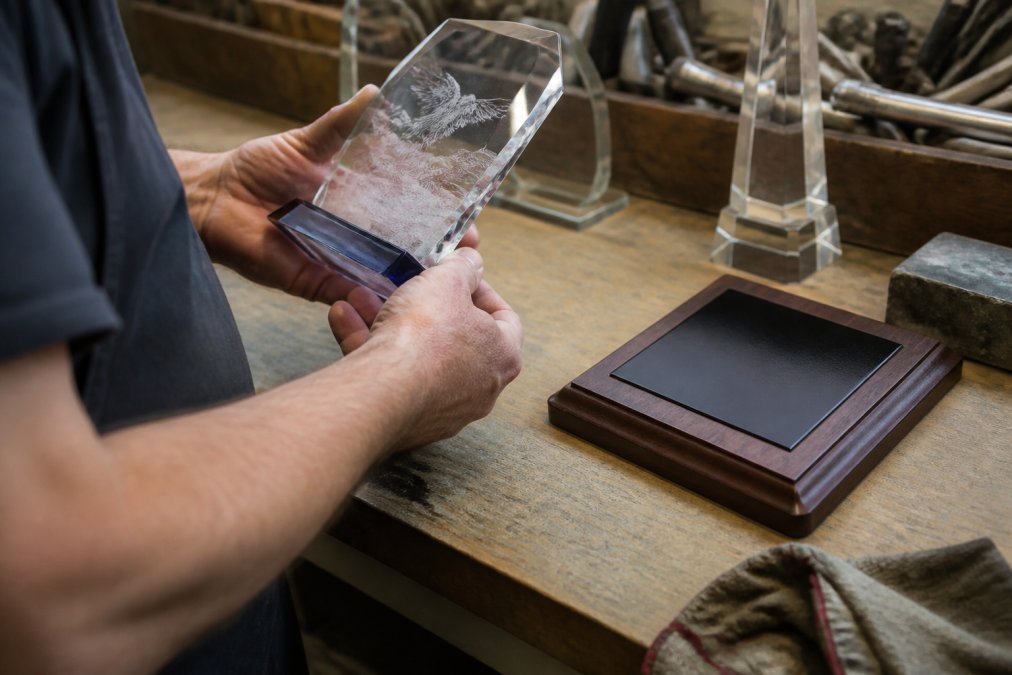
Material quality. Laser engraving delivers crisp text and logos that hold up over time. Deep etching into crystal creates a dimensional effect; engraved plaques offer a classic finish.
Material quality affects longevity: premium crystal resists chipping, hardwood plaques hold their finish for decades, and quality acrylic stays clear rather than yellowing.
Integrating physical awards with HR software and recognition platforms. Modern HR departments use recognition platforms like Bonusly, Kudos, or built-in features in systems like Workday and SuccessFactors to track peer recognition, manager nominations, and award history. High quality employee recognition awards work best when they are the physical culmination of a digital recognition workflow. Here is how to structure this integration:
-
Nomination and approval in the platform. Managers or peers nominate candidates in your HR system, which routes the nomination for approval and documents the achievement. This creates an audit trail and prevents duplicate awards.
-
Award selection based on platform data. Use your recognition platform to identify top nominees, then order the physical award once the decision is final. Many providers allow you to export nomination data and match it to award orders, so you have a complete record of who received what and when.
-
Engraving that references the platform record. Include the achievement date, the nominator's name (if appropriate), or a QR code on the award that links to the digital recognition record. This bridges the physical and digital worlds and allows the recipient to revisit the full context of their recognition.
-
Batch ordering and tracking. If you run a quarterly or annual recognition cycle, batch your orders to reduce per-unit costs and simplify logistics. Work with your award provider to establish a standing order template, same materials, same engraving format, different names and dates. This reduces turnaround time and ensures consistency.
Sustainability. Responsibly sourced wood, recycled glass, and locally manufactured awards reduce environmental footprint while maintaining quality. Some organizations offset shipping costs or donate a portion to aligned charities, signaling commitment to both recognition and responsibility.
Customization for diverse teams. Consider workforce preferences: some prefer desk-sized awards, others prefer certificates or digital badges for professional visibility. Ask your provider about:
- Engraving in multiple languages for global teams
- Award designs that reflect company branding or industry-specific imagery
- Packaging that is gift-ready for presentation to remote employees
- Modular designs that allow you to add to an award over time (e.g., a base plaque with removable inserts for multiple years of service)
For a truly premium result, work with a provider that controls manufacturing in-house. On-site facilities mean every piece is crafted and inspected by the same team, with free personalization on every order.
Recognition Strategy for Remote and Hybrid Teams
Remote and hybrid work has changed how recognition happens. The team-wide applause in a conference room is gone, replaced by video calls and Slack channels. High quality employee recognition awards need to work in this new reality.
Ship to home. A physical award delivered to a home office carries more weight than a digital badge and becomes part of their workspace.
Make presentation an event. Schedule a video call where the manager and team share specific reasons for the award. Record and share with the broader company.
Coordinate with the manager. For remote employees, ensure the manager is prepared to speak genuinely about the achievement before presentation.
Consider sustainability. As remote recognition grows, many companies are asking about sustainable award materials and sourcing. Responsibly sourced wood, recycled glass, and locally manufactured awards reduce the environmental footprint of your program while maintaining quality.
Conclusion
Building a recognition program around high quality employee recognition awards requires intention, consistency, and attention to detail. The award itself is the centerpiece, but the strategy around it determines whether employees feel genuinely valued or simply processed.
At Gino's Awards, Inc., we have helped organizations craft these moments since 1950, combining nearly 75 years of experience with fast turnaround and free personalization. Whether you need engraved plaques for a service anniversary, crystal awards for an executive milestone, or custom trophies for a sales team, our family-owned shop delivers pieces that feel as significant as the achievement itself.
Call (216) 831-6565 to start planning your recognition program with a team that treats every order like it matters, because we know it does.
Frequently Asked Questions
What materials make the best high quality employee recognition awards?
Crystal, glass, acrylic, and metal are the industry standards. Crystal and glass convey premium quality and permanence, making them ideal for major milestones. Acrylic offers a modern look at a more accessible price point. Metal bases add weight and presence. The best choice depends on your budget and the occasion, service anniversaries typically warrant crystal or engraved plaques, while peer recognition can use lighter acrylic designs. Quality matters because employees display these awards in offices and homes for years.
How do you write meaningful employee appreciation award wording?
Effective wording is specific, personal, and ties the achievement to company values. Instead of 'Great Work,' write 'For 10 Years of Dedication to Customer Excellence and Team Leadership.' Include the employee's name, the specific accomplishment or tenure milestone, the date, and the company name. Avoid generic phrases and focus on measurable impact or behavioral examples. The wording should feel intentional and genuine, it's a permanent record of why this person matters to your organization.
What are the best employee service anniversary award ideas?
Service anniversaries deserve tangible recognition that marks the milestone. Five-year awards work well as engraved plaques or custom trophies. Ten-year and beyond should escalate in quality, premium crystal or personalized gifts tied to employee interests. Pair physical awards with public recognition at company events and a handwritten note from leadership. Consider department-specific awards (e.g., 'Customer Service Excellence Award' for a decade in support roles). The key is making the award feel earned and exclusive, not routine.
How can small teams implement effective employee recognition without breaking the budget?
Start with a clear recognition program framework: define which milestones get awards (5, 10, 15 years), establish consistent award quality standards, and automate reminders so no anniversary is missed. Batch orders of similar awards to reduce per-unit costs. Use customization strategically, free personalization with names and dates keeps costs down while maintaining premium feel. Pair physical awards with peer-to-peer recognition practices that cost nothing but drive engagement. Focus spending on the most significant milestones rather than spreading budget thin across many small gestures.
This article was written using GrandRanker