


Glass vs Acrylic Awards for Employees: Complete Comparison
Table of Contents
- Glass vs Acrylic Awards: Key Differences at a Glance
- Material Composition and Lead Content
- Durability, Impact Resistance, and Longevity
- Optical Clarity and Light Refraction
- Cost of Corporate Awards and Budget Considerations
- Customization, Engraving, and Design Versatility
- How to Choose Employee Awards for Your Organization
- Maintenance, Cleaning, and Long-Term Care
Last Updated: August 12, 2026
Glass vs Acrylic Awards: Key Differences at a Glance
Glass conveys permanence and prestige. Acrylic offers flexibility and accessibility. Both materials perform well, but they serve different organizations and budgets.
At Gino's Awards, Inc., we've spent over 75 years helping companies choose the right recognition solution. The material you select shapes not just the award itself, but how employees perceive the recognition they receive. This guide breaks down where each material excels, covering material composition, durability, optical clarity, cost, customization options, and maintenance.
Material Composition and Lead Content
Glass awards are typically made from borosilicate glass or soda-lime glass, often with lead content (10-30%) added to increase refractive index and optical clarity. This composition creates the weight and perceived value that makes glass feel like serious recognition.
Acrylic awards are cast from polymethyl methacrylate (PMMA), a transparent thermoplastic polymer. Acrylic is lighter than glass, contains no lead, and transmits light more directly than glass bends it.
A glass award of the same size as an acrylic award will weigh roughly 2-3 times more. Employees who receive a glass award often comment on the weight, signaling investment and permanence. An acrylic award, lighter and more delicate-feeling, sends a different message: accessibility and modern design.
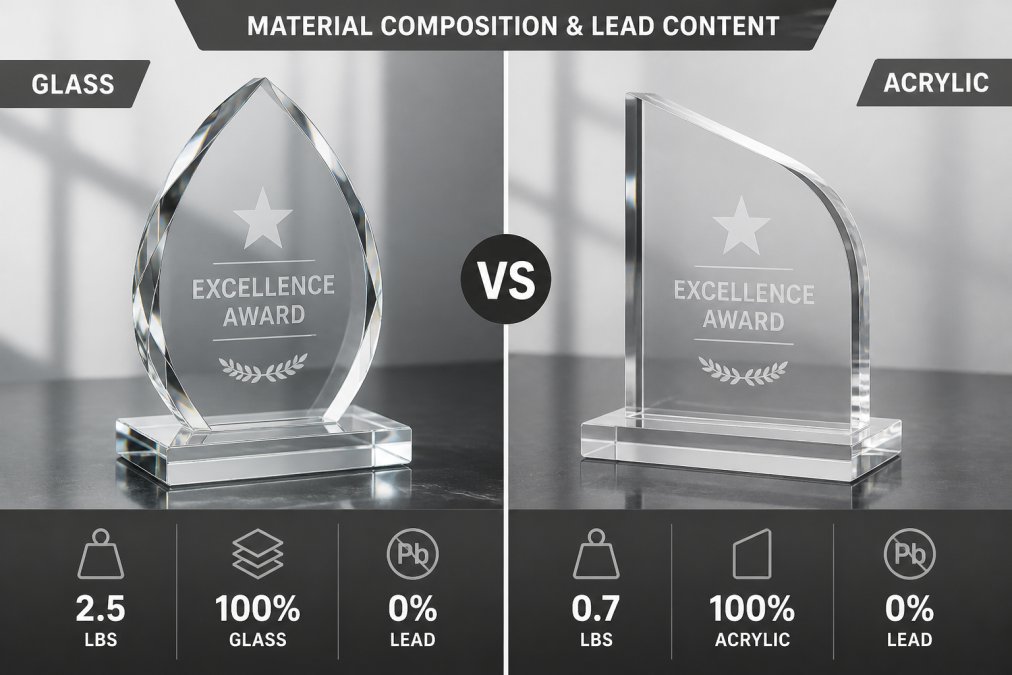
Neither material contains harmful lead in the final product when manufactured responsibly. Both materials are safe for office environments and employee homes.
Durability, Impact Resistance, and Longevity
Glass awards are more scratch-resistant than acrylic but more brittle. Drop a glass award from waist height onto a hard floor, and it will likely shatter or chip. However, if treated carefully, which most recipients do, it will outlast acrylic by decades. Glass doesn't yellow, cloud, or degrade under UV light. A glass award from 1980 looks nearly identical today.
Acrylic is more impact-resistant than glass and won't shatter if dropped. However, acrylic scratches easily and yellows under prolonged UV exposure. An acrylic award left in direct sunlight for several years will develop a visible amber tint and loss of optical clarity.
For corporate recognition programs where awards sit on shelves in offices, glass typically outlasts acrylic by 20-30 years with no visible degradation. Acrylic remains clear and attractive for 5-10 years in normal indoor office lighting.
The durability calculation depends on use case. For permanent recognition (service anniversaries, retirement), glass is the longevity winner. For high-volume recognition where awards might be handled frequently, acrylic's impact resistance becomes more valuable.
Optical Clarity and Light Refraction
Glass awards, especially those with lead content, have a higher refractive index than acrylic. Light bends more dramatically when it passes through the material, creating that signature sparkle and light dispersion. When you tilt a glass award under office lighting, it catches light in multiple directions simultaneously. This optical effect is what makes glass feel premium.
Acrylic has a lower refractive index. Light passes through more directly. Acrylic is optically clear with minimal distortion, but it doesn't sparkle the way glass does. Some organizations prefer this clarity and modern aesthetic. Others perceive acrylic as less visually impressive because it lacks that light-catching quality.
For photography and video, glass awards photograph dramatically. The light refraction translates to visual impact on camera. Acrylic photographs clearly but less impressively.
This factor matters most if visual impact and photography are priorities in your recognition program. If you're highlighting award recipients in company communications, glass creates more striking imagery.
Cost of Corporate Awards and Budget Considerations
Acrylic awards cost significantly less than glass awards of comparable size and customization complexity. For organizations with tight budgets or high-volume recognition programs, acrylic is the practical choice. If you're recognizing 100 employees annually, acrylic allows you to maintain recognition quality without straining budget.
Glass awards cost more upfront. However, the cost difference must be weighed against longevity. A glass award purchased today might still be on an employee's shelf 30 years from now. An acrylic award will likely yellow or be replaced within a decade.
For one-time recognition or milestone awards (retirement, 25-year service anniversaries, major achievement), glass's higher upfront cost often justifies itself through longevity. For annual recognition programs where you're awarding dozens or hundreds of employees each year, acrylic's lower cost-per-unit becomes the controlling factor.
Pricing depends on quantity, customization complexity, rush turnaround, and material grade. For current pricing and quotes tailored to your specific needs, Gino's Awards, Inc. can provide detailed estimates based on your order volume and customization requirements.
Customization, Engraving, and Design Versatility
Glass awards are typically customized through engraving, sandblasting, or UV printing. Engraving on glass creates clean, precise lines ideal for text and logos. Sandblasting creates a frosted effect that contrasts with clear glass. These techniques produce professional, lasting results that won't fade or wear away.
Acrylic can be engraved, sandblasted, or printed, but with different results. Engraving on acrylic requires careful technique to avoid micro-cracking. Sandblasting works well and creates a similar frosted effect. UV printing, applying colored ink directly to acrylic, is increasingly popular and allows for full-color logos and detailed designs.
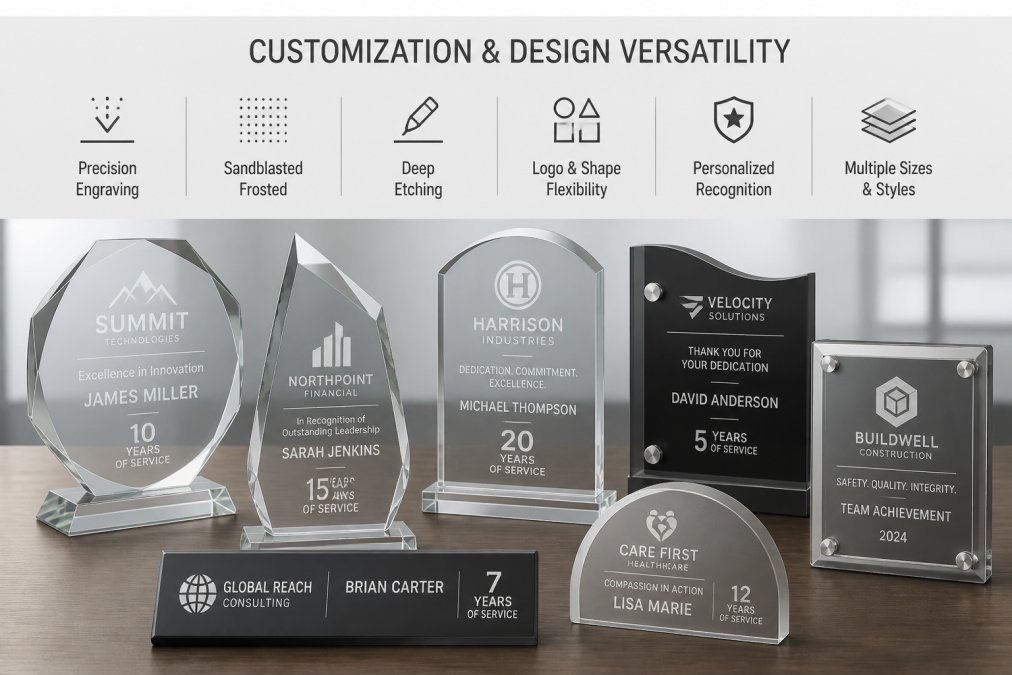
For design versatility, acrylic wins. You can achieve more visual variety, color, gradients, and detailed imagery on acrylic than on glass. If your recognition program emphasizes modern branding or colorful logos, acrylic's customization flexibility is valuable.
Glass's advantage is precision and permanence. Engraved text on glass stays crisp and legible indefinitely. For classic, timeless recognition pieces, especially service anniversaries or retirement awards, glass's customization durability matters.
Acrylic can typically be customized faster than glass. If you need 50 custom plaques with employee names in 10 days, acrylic is more likely to meet that timeline. Gino's Awards, Inc. specializes in fast turnaround without sacrificing quality; call (216) 831-6565 to discuss your timeline and customization needs.
How to Choose Employee Awards for Your Organization
The decision between glass and acrylic awards depends on answering four core questions about your recognition program.
Question 1: What message do you want the award to send?
Glass signals permanence, prestige, and serious investment in recognition. Acrylic signals modernity, accessibility, and practical recognition.
Question 2: What's your budget and recognition volume?
If you're recognizing 10-20 employees annually for major milestones, glass is feasible. If you're recognizing 100+ employees annually, acrylic's lower cost becomes necessary unless your budget is unlimited.
Question 3: How long do you want the award to remain in good condition?
For 25-year service anniversaries or retirement, you're investing in something that should last 30+ years. Glass's resistance to yellowing makes it the right choice. For annual performance or project completion, acrylic's 5-10 year clarity window is acceptable.
Question 4: How important is visual impact and photography?
If you're featuring award recipients in company newsletters, social media, or awards ceremonies, glass's light refraction creates more striking images. If photography isn't a priority, this factor becomes neutral.
Most organizations benefit from a hybrid approach: glass for major milestone recognition and acrylic for routine annual recognition programs.
Maintenance, Cleaning, and Long-Term Care
Glass awards require minimal maintenance. They can be cleaned with any glass cleaner or warm water and a soft cloth. Glass doesn't scratch easily with proper technique and remains optically clear over decades. The main risk is breakage from impact.
Acrylic requires more careful maintenance. Never use harsh chemicals or abrasive cloths. Clean acrylic with a soft microfiber cloth and mild soap and water. Avoid prolonged exposure to direct sunlight, which accelerates yellowing.
For long-term preservation, glass requires only basic handling care. Acrylic requires active management of light exposure and cleaning technique to maintain appearance over time.
Selecting between glass vs acrylic awards for employees ultimately reflects your organization's values around recognition. Glass says permanence and premium quality. Acrylic says accessibility and modern design. Neither is objectively better; they serve different purposes and budgets.
For organizations committed to meaningful employee recognition with longevity, glass awards from Gino's Awards, Inc. deliver the permanence and optical impact that make recipients feel genuinely valued. Our family-owned operation has crafted recognition awards since 1950, and we specialize in fast turnaround and free personalization to ensure your achievements are commemorated with superior quality. Call (216) 831-6565 to discuss your recognition program and get a custom quote.
Frequently Asked Questions
What are the main differences between glass and acrylic awards?
Glass awards offer superior optical clarity and perceived value due to their weight and refractive properties, while acrylic awards provide better impact resistance and shatter protection. Glass typically has higher material density and creates stronger light dispersion, giving it a premium aesthetic. Acrylic is lighter, more durable for high-traffic environments, and safer for awards displayed in active workplaces. Both materials support excellent customization through engraving and UV printing, but glass generally delivers a more prestigious appearance.
Are acrylic awards cheaper than glass awards?
Acrylic awards generally cost less per unit than comparable glass awards, though pricing depends on quantity, size, customization complexity, and delivery timeline. The material itself is less expensive, and acrylic manufacturing often requires fewer finishing steps. However, bulk orders and fast turnaround times can shift the economics. For accurate pricing on custom employee awards, contact a manufacturer directly for a quote based on your specific needs and order volume.
Which material is more durable for employee trophies: glass or acrylic?
Acrylic is more durable in high-volume workplace settings because it resists shattering and handles accidental drops better than glass. Glass offers superior scratch resistance and maintains optical clarity longer with proper maintenance. For awards displayed on desks or shelves in offices, glass durability is excellent. For awards in busy break rooms, warehouses, or environments with frequent handling, acrylic's impact resistance makes it the more practical choice. Both materials can last decades with appropriate care.
How do you clean and maintain acrylic awards compared to glass?
Glass awards can be cleaned with standard glass cleaner and a soft cloth without risk of scratching. Acrylic requires gentler care: use a microfiber cloth and avoid harsh chemicals that can cloud or crack the material. Both benefit from regular dusting to prevent buildup. Store awards in dust-free environments away from direct sunlight. Acrylic may yellow slightly over decades, while glass maintains its appearance indefinitely. For corporate recognition programs with dozens of awards, acrylic's lower maintenance demands can be a practical advantage.
Does glass or acrylic offer better clarity for custom engraving?
Glass delivers superior optical clarity and light refraction, making engraved text and logos appear sharper and more vibrant, especially when light passes through the material. The refractive index of quality glass creates a premium visual effect. Acrylic also supports crisp engraving and UV printing but lacks the light-dispersing qualities of glass. For awards where visual impact and perceived value matter most, glass engraving produces more striking results. Both materials work well for sandblasting, carving, and personalization techniques.
This article was written using GrandRanker