



Tips for Writing Employee Award Inscriptions
Table of Contents
- Why Employee Award Inscriptions Matter
- Essential Elements of an Award Inscription
- Employee Recognition Award Wording Examples
- Years of Service Award Script and Milestone Recognition
- Best Practices for Employee Recognition Inscriptions
- Common Mistakes to Avoid in Award Inscriptions
- Psychology of Recognition and Impact
- Conclusion
Last Updated: August 16, 2026
Why Employee Award Inscriptions Matter
An award is only as meaningful as the words engraved on it. The inscription transforms a physical object into a permanent record of achievement, turning a moment of recognition into something a recipient will display for decades. At Gino's Awards, Inc., we've seen firsthand how the right inscription can make an employee feel genuinely valued, and how a poorly written one can diminish even the most expensive plaque.
The words you choose carry weight. They communicate what the organization values, who deserves recognition, and why that person matters. A generic "Employee of the Year" feels obligatory. A specific inscription that names the exact contribution, "For innovative process improvements that reduced production time by 20%", demonstrates that someone actually noticed and cared enough to document it.
This is where many organizations stumble. They invest in quality awards but rush the inscription, treating it as an afterthought. The result is vague language, spelling errors, or tone-deaf phrasing that undermines the entire gesture. The inscription is not filler. It's the core message.
Essential Elements of an Award Inscription
Every strong award inscription contains three core components that work together to create a complete recognition message. Missing any one of these elements leaves the inscription feeling incomplete or unclear.
Recipient Name and Award Title
Start with clarity. The recipient's name and the award title must be immediately visible and unmistakable. This is not the place for abbreviations, nicknames, or creative spelling. Use the full legal name as the employee prefers to be recognized, ask if you're unsure.
The award title should be specific enough to mean something. "Employee of the Year" tells the recipient they were chosen, but it doesn't tell them why they were chosen. "Excellence in Customer Service" or "Leadership in Innovation" connects the award to a value or behavior. If your organization has formal award categories, use those exact titles. Consistency across years and recipients builds credibility and shows the award program is intentional, not random.
Specific Achievement or Recognition
This is the section that transforms a generic award into a meaningful recognition. Describe what the person actually did. Reference a specific project, outcome, or behavior that earned the award.
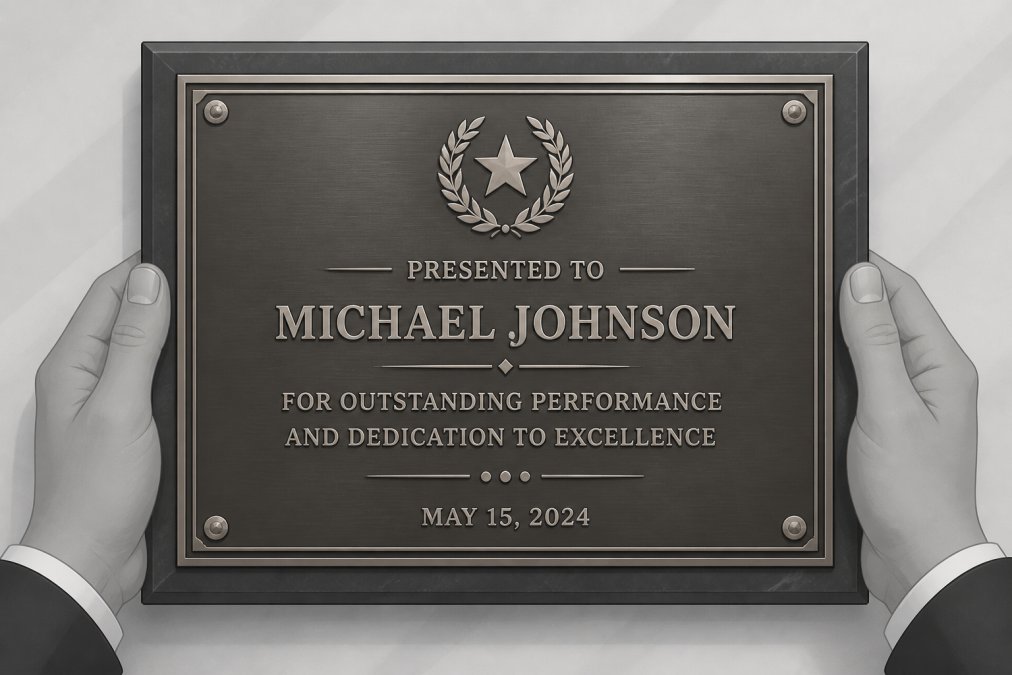
Instead of: "For outstanding performance" Write: "For leading the product launch team that delivered three months ahead of schedule"
Instead of: "For dedication to teamwork" Write: "For mentoring five junior staff members who all received promotions within 18 months"
The specificity matters psychologically. It tells the recipient that their particular contribution was noticed and valued. It also creates a record, five years from now, the plaque hanging in someone's office will remind them of what they accomplished, not just that they were recognized.
Date and Organization Name
Include the year the award was given. This dates the achievement and creates a historical record. Many organizations also include the full organization name or department. If the award is company-wide, use the company name. If it's department-specific, include the department.
Format this information clearly at the bottom of the inscription. Alignment matters, centered text looks formal and polished, while left-aligned text reads more casually. Consistency across all awards in your program creates a professional appearance.
Employee Recognition Award Wording Examples
Real inscriptions work better than abstract guidelines. Here are examples across common award categories, showing how to structure language that feels sincere without sounding generic.
Service Anniversary Recognition
Service anniversaries are milestone moments. The inscription should acknowledge the duration while highlighting what that tenure means to the organization.
10-Year Anniversary: "In recognition of 10 years of dedicated service and outstanding contributions to [Company Name]. Your commitment to excellence has made a lasting impact on our team and our mission."
20-Year Anniversary: "Twenty years of leadership, integrity, and excellence. Thank you for building the foundation that continues to guide our organization. Your legacy inspires us all."
25-Year Anniversary: "For 25 years of unwavering dedication and service to [Company Name]. Your contributions have shaped our culture, mentored countless colleagues, and set the standard for excellence we all aspire to reach."
The language shifts subtly with tenure. Five years emphasizes commitment and growth potential. Ten years acknowledges established value. Twenty-five years honors legacy and influence. Match the tone to the milestone.
Outstanding Performance and Leadership
Performance awards recognize specific accomplishments. The inscription should name the achievement and its impact.
Sales Achievement: "For exceptional sales performance and client relationship management, generating $1.2M in new revenue and maintaining a 98% client retention rate. Your dedication drives our growth."
Innovation Award: "For developing the automated reporting system that reduced monthly data compilation time from 40 hours to 4 hours, freeing our team to focus on strategic analysis. Your innovation makes us stronger."
Leadership Excellence: "In recognition of visionary leadership during our company expansion. Your strategic direction, mentorship of emerging leaders, and unwavering commitment to our core values have positioned us for continued success."
These examples include numbers where relevant. Specific metrics make the achievement concrete and verifiable. They also remind the recipient exactly what they did that mattered.
Teamwork and Collaboration
Collaboration awards recognize people who lift others up. The inscription should emphasize the relational and collective impact.
Team Project: "For outstanding collaboration and leadership of the cross-functional team that successfully launched our new product line ahead of schedule and under budget. Your ability to unite diverse perspectives created a model for future initiatives."
Mentorship: "In recognition of your generous mentorship and support of your colleagues. Your willingness to share knowledge, encourage growth, and celebrate others' success has strengthened our entire department."
Community Builder: "For fostering a culture of inclusivity, respect, and belonging. Your consistent efforts to welcome new team members, bridge departmental silos, and celebrate our diversity make our workplace better every day."
Years of Service Award Script and Milestone Recognition
Years of service awards follow a predictable structure, but the specifics make them memorable. The "script" is really a formula: acknowledgment + duration + impact + gratitude.
Start with a direct acknowledgment: "In recognition of [number] years of service to [Organization]."
Add a specific impact statement that reflects what that tenure has meant: "Your consistent excellence, reliability, and commitment to our mission have been instrumental in [specific area of organizational success]."
Include a forward-looking element if appropriate: "As we move into our next chapter, we look forward to your continued leadership and partnership."
Close with gratitude: "Thank you for your dedication, your integrity, and your impact on our team and our community."
The entire inscription should feel like it's speaking directly to the person being honored. Avoid corporate jargon that sounds impersonal. Use "your" language. Make it about them, not about filling space on a plaque.
Best Practices for Employee Recognition Inscriptions
Writing effective award inscriptions requires attention to tone, specificity, and inclusivity. These practices elevate an inscription from acceptable to meaningful.
Choosing the Right Tone
Tone is the difference between an inscription that feels warm and one that feels stiff. Professional doesn't mean formal. Sincere doesn't mean flowery. The goal is authentic appreciation expressed clearly.
Match your tone to your organizational culture. A startup might use language like "For disrupting the way we think about customer success" while a nonprofit might use "For embodying our commitment to serving those in need." Neither is wrong, they're different.
Avoid superlatives that sound hollow. "The best employee ever" feels exaggerated. "A consistent contributor who raises the performance of everyone around them" feels earned. Avoid clichés like "going the extra mile" or "thinking outside the box." These phrases have lost meaning through overuse.
Use active voice and specific verbs. Instead of "was responsible for," write "led," "created," "transformed," or "launched." Active voice makes the accomplishment feel more real and more impressive.
Personalization and Specificity
Generic inscriptions are worse than no inscription. The moment an employee sees the same language they've seen on five other plaques, the recognition feels like a checkbox exercise, not genuine appreciation.
Invest time in gathering details. Ask the nominator or manager: What exactly did this person do? What was the outcome? What made this contribution different or notable? Use these details in the inscription.
Include the recipient's name spelled correctly and formatted as they prefer. If someone goes by a nickname professionally, use it. If they prefer their full legal name, use that. This small personalization signals that someone paid attention.
Reference specific projects, clients, or outcomes when possible. "For your leadership of the Johnson account retention initiative" beats "For leadership." The specificity makes it real.
Inclusive Language and Character Limits
Inclusive language ensures the inscription feels appropriate and respectful across your diverse workforce. Avoid gendered language, cultural assumptions, or references that exclude. Use "their" instead of "his or her." Avoid military or sports metaphors that may not resonate with everyone.
Character limits are a practical constraint. Most plaques have physical space limitations, typically 300-500 characters for a standard 8x10 plaque. Work within these limits by being concise. Every word should earn its place.
Cut unnecessary words. "In recognition of" can become "For." "We are pleased to acknowledge" can become "We recognize." Tight writing is more powerful anyway.
Test your inscription by reading it aloud. Does it flow? Does it sound like something a real person would say, or does it sound like a template? If it sounds like a template, rewrite it.
Common Mistakes to Avoid in Award Inscriptions
The difference between a strong inscription and a weak one often comes down to avoiding predictable errors. Here are the mistakes we see most frequently.
Vague language. "For your hard work and dedication" could apply to anyone. It says nothing specific. Always include a concrete detail, a project name, a measurable outcome, or a specific behavior.
Spelling and grammar errors. A typo on a permanent plaque is permanent. Proof your inscription multiple times. Have someone else read it. Misspelled names or words undermine the entire recognition gesture and can damage trust.
Inconsistent formatting across awards. If you're engraving multiple awards, use the same structure and style for all of them. Consistency looks intentional and professional. Inconsistency looks careless.
Overcomplicated language. Avoid jargon, acronyms, or inside references that might not make sense in five years. Write for clarity. The inscription should be understandable to anyone reading it.
Tone mismatches. Don't use overly casual language on a formal plaque, and don't use stiff corporate language in a casual workplace culture. Match the tone to your organization.
Too much text. More words don't make better recognition. Concise, specific language is more powerful than a paragraph of generic praise. Leave white space. Let the words breathe.
Focusing on the award instead of the achievement. The inscription is about what the person did, not about the award itself. Don't say "This award is given to..." Say what they accomplished.
Psychology of Recognition and Impact
Recognition works because it addresses a fundamental human need: to be seen and valued. The psychology of effective recognition is straightforward but often overlooked in practice.
When someone receives recognition, their brain registers two things: that they matter to the organization, and that their specific actions have value. Generic recognition fails at both. Specific recognition succeeds at both.
The permanence of an engraved award amplifies this effect. A verbal compliment fades. An email gets archived and forgotten. A plaque on the wall is a daily reminder that someone noticed, cared enough to memorialize it, and spent money to make it real. That creates lasting motivation.
Recognition also influences culture. When other employees see what gets recognized, they understand organizational values in action. If teamwork gets recognized with specific stories about collaboration, employees learn that collaboration matters. If innovation gets recognized with vague language, the message is muddled.
The timing of recognition matters too. Present the award close to the achievement. If someone led a successful project in January and gets recognized in December, the connection weakens. The impact is strongest when recognition is timely and specific.
Inclusivity in recognition programs builds trust. If the same people get recognized repeatedly while others are overlooked, recognition becomes a status symbol rather than a motivational tool. Effective programs recognize diverse contributions, not just sales numbers, but also mentorship, process improvement, cultural building, and quiet reliability.

Writing meaningful employee award inscriptions requires specificity, authenticity, and attention to detail. The inscription is your opportunity to make recognition permanent and personal. At Gino's Awards, Inc., we understand that the words matter as much as the award itself. Our team specializes in helping organizations craft inscriptions that feel genuine and look professional, with fast turnaround times and free personalization to ensure your recognition is exactly right. Ready to create awards your team will treasure? Call (216) 831-6565 to discuss your recognition program with our experienced team.
Frequently Asked Questions
What should I include in an employee award inscription?
A strong employee award inscription includes the recipient's name, the specific award title, what they accomplished or are being recognized for, and the date. Include your organization's name and consider adding a brief statement about their impact or core values they exemplified. Keep the text concise but meaningful so it reads well when engraved.
How do I write a sincere years of service award script?
Focus on the employee's tenure, specific contributions, and dedication. Example: 'In recognition of 10 years of outstanding service and unwavering commitment to excellence.' Mention their role, impact on the team, and gratitude for their loyalty. Personalize it with details about their accomplishments or leadership to make it feel genuine rather than generic.
What are common mistakes to avoid when writing award inscriptions?
Avoid generic language, misspellings, and vague descriptions. Don't make the inscription too long for the plaque's character limit. Skip clichés and focus on specific accomplishments instead. Double-check spelling of names, titles, and dates before approval. Avoid overly casual language that doesn't fit a professional award, and ensure the tone matches your organization's culture.
How can I personalize an award inscription for different employee types?
Tailor the language to reflect each person's unique role and achievements. For long-term employees, emphasize dedication and milestones. For high performers, highlight specific projects or results. For team leaders, focus on impact and mentorship. Use inclusive language that resonates across different backgrounds and career stages. Reference specific accomplishments or core values relevant to that individual's work.
This article was written using GrandRanker