


Why Use Personalized Gifts for Employee Motivation
Most American companies see a direct effect when recognition goes beyond generic gestures. Studies show that personalized awards can increase employee engagement by over 40 percent compared to standard gifts. When HR managers in American organizations seek meaningful ways to appreciate achievements, customized recognition offers deeper connection and long-lasting motivation. This article highlights how thoughtful personalization transforms workplace morale and drives measurable benefits in employee satisfaction.
Table of Contents
- What Makes A Gift Personalized?
- Types Of Personalized Awards And Gifts
- How Personalized Gifts Drive Motivation
- Key Benefits Over Generic Recognition
- Best Practices For Maximizing Impact
- Measuring Roi And Organizational Value
Key Takeaways
| Point | Details |
|---|---|
| Personalized Gifts Enhance Connection | Gifts that reflect individual achievements foster emotional connections and make recipients feel valued. |
| Custom Awards Boost Engagement | Personalized recognition significantly increases employee motivation and retention compared to generic approaches. |
| Strategic Implementation is Key | Tailor recognition strategies to individual preferences and maintain flexibility for maximum impact. |
| Measure Effectiveness Holistically | Use both quantitative and qualitative metrics to evaluate the ROI and emotional value of personalized recognition programs. |
What Makes a Gift Personalized?
A truly personalized gift goes far beyond simply adding a name or monogram. It represents a thoughtful connection that transforms an ordinary object into a meaningful experience. Research shows that personalization creates a profound psychological impact by invoking what experts call vicarious pride in gift recipients.
At its core, a personalized gift demonstrates intentionality and emotional investment. This means incorporating elements uniquely significant to the recipient such as:
- Their name or initials
- Specific professional achievements
- Personal interests or hobbies
- Memorable dates or milestones
- Custom colors or design preferences
- Meaningful quotes or messages
The key distinction lies in the effort and personal attention communicating that the gift was selected or created with genuine understanding. Customization turns an item from a generic transaction into a memorable gesture that makes the recipient feel genuinely seen and appreciated.
Psychological research confirms that personalized gifts generate stronger emotional connections compared to standardized offerings. When employees receive gifts that reflect their individual identity, they experience heightened self-esteem and feel more valued by their organization. The subtle message conveyed is not just “you work here” but “we recognize and appreciate you as a unique individual”.
Pro tip: When personalizing employee gifts, focus on meaningful details that demonstrate authentic knowledge about the individual rather than generic customization.
Types of Personalized Awards and Gifts
Personalized awards and gifts represent a strategic approach to employee recognition that goes beyond traditional one-size-fits-all acknowledgments. Organizations can choose from a diverse range of options that transform standard recognition into meaningful, memorable experiences. Custom research awards demonstrate how tailored recognition can highlight individual achievements and professional contributions.
The most effective personalized awards typically fall into several key categories:
- Professional Achievement Awards
- Engraved plaques commemorating project milestones
- Custom trophies recognizing exceptional performance
- Personalized certificates with specific achievement details
- Performance Recognition Items
- Customized desk accessories
- Branded items with employee names or accomplishments
- Professional-grade equipment with personalized engravings
- Milestone Celebration Gifts
- Work anniversary commemorative items
- Retirement recognition packages
- Long-service acknowledgment gifts
What distinguishes these awards is the thoughtful integration of personal details that transform a generic item into a powerful motivational tool. A simple engraving, a specific reference to an achievement, or a custom design that reflects the recipient’s unique contributions can dramatically enhance the emotional impact of the recognition.
Companies are increasingly recognizing that personalized awards boost employee engagement by creating a sense of individual value. The psychological effect goes beyond the physical gift, communicating that the organization sees and appreciates each employee’s distinct contributions.
Pro tip: Select personalized awards that reflect the individual’s specific achievements and professional identity, ensuring the recognition feels genuine and meaningful.
How Personalized Gifts Drive Motivation
Personalized gifts are not just symbolic gestures but powerful psychological tools that fundamentally transform employee motivation. Vicarious pride mechanisms reveal how these thoughtful recognitions create deep emotional connections that go far beyond traditional reward systems.
The motivation-driving impact of personalized gifts can be understood through several key psychological principles:
- Emotional Validation: Recognizing individual contributions
- Self-Esteem Boost: Reinforcing personal worth and achievements
- Sense of Belonging: Creating stronger organizational connections
- Performance Acknowledgment: Directly linking effort with recognition
Research demonstrates that when employees receive gifts tailored to their specific achievements and personalities, they experience a profound sense of being truly seen and valued. This recognition triggers intrinsic motivation by communicating that their unique contributions matter more than generic, standardized acknowledgments.

Moreover, customized recognition strategies activate psychological triggers that transform external rewards into internal motivation. The emotional investment demonstrated through personalization creates a ripple effect of increased engagement, loyalty, and discretionary effort. Employees who feel genuinely appreciated are more likely to go above and beyond their basic job requirements, seeing their work as a collaborative journey rather than a transactional experience.
The most effective personalized gifts tap into individual motivational drivers by demonstrating deep understanding of an employee’s professional identity, personal interests, and specific accomplishments. This approach transforms recognition from a mere transaction into a meaningful dialogue that communicates respect, appreciation, and genuine organizational investment.
Pro tip: Design personalized recognition experiences that reflect individual employee achievements, ensuring the gift feels authentic and personally meaningful.
Key Benefits Over Generic Recognition
Personalized recognition transcends traditional reward methods by creating deeper, more meaningful connections between organizations and employees. Emotional response research reveals that personalized gifts generate substantially more impactful outcomes compared to generic acknowledgments.
The key advantages of personalized recognition include:
- Psychological Depth
- Targets individual emotional needs
- Communicates genuine understanding
- Demonstrates intentional appreciation
- Motivational Impact
- Increases intrinsic motivation
- Reinforces personal achievement
- Creates lasting engagement
- Organizational Benefits
- Enhances employee retention
- Strengthens workplace relationships
- Promotes a culture of individual recognition
Unlike standardized rewards that often feel impersonal and transactional, personalized gifts communicate a nuanced message of respect and individual value. They signal that the organization views employees as unique professionals with distinct contributions, not interchangeable resources.
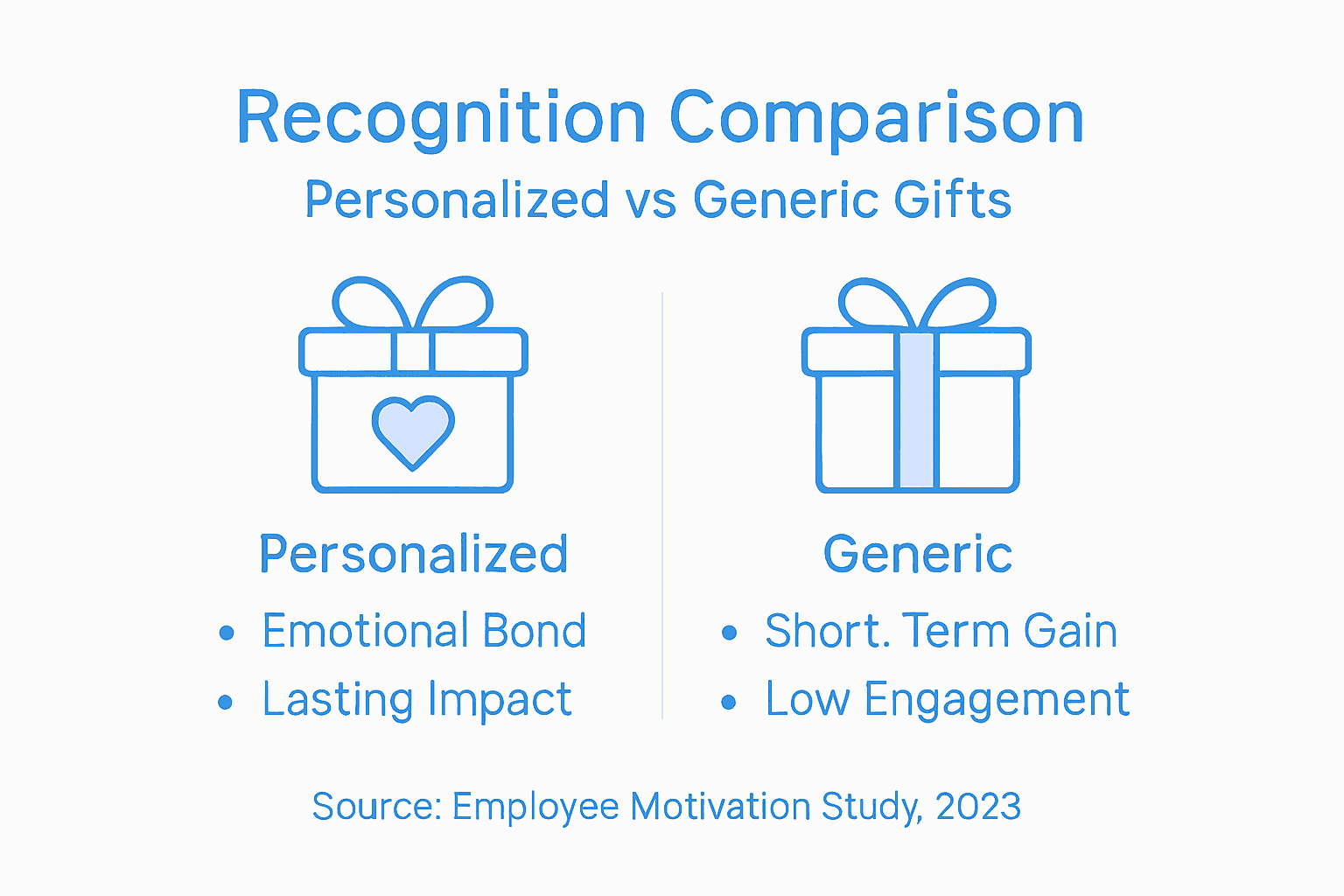
The differentiation becomes clear when comparing generic versus personalized approaches. A generic gift might momentarily acknowledge an achievement, but a personalized recognition creates an emotional resonance that can motivate an employee for months or even years. By tailoring rewards to individual preferences, achievements, and professional identities, organizations transform simple gestures into powerful motivational tools.
Here’s a summary of how personalized and generic employee recognition approaches differ:
| Recognition Type | Emotional Impact | Employee Engagement | Retention Effect |
|---|---|---|---|
| Personalized | Deep, lasting connection | High, motivates extra effort | Strong, reduces turnover |
| Generic | Temporary acknowledgment | Limited, often short-lived | Minimal, little loyalty boost |
Pro tip: Invest time in understanding each employee’s unique professional journey to create truly meaningful personalized recognition experiences.
Best Practices for Maximizing Impact
Successful personalized recognition requires strategic planning and thoughtful execution. Employee recognition strategies must be carefully designed to create meaningful connections that genuinely motivate and inspire workforce engagement.
Key best practices include:
- Personalization Depth
- Conduct individual preference assessments
- Understand unique professional motivators
- Align gifts with personal achievements
- Recognition Approach
- Balance public and private acknowledgments
- Highlight specific contributions
- Ensure consistent, timely recognition
- Strategic Implementation
- Integrate recognition into company culture
- Create structured reward frameworks
- Maintain program flexibility
Understanding individual preferences becomes critical in designing effective recognition programs. Some employees thrive on public celebrations, while others prefer private, more intimate forms of acknowledgment. Personalized recognition techniques demonstrate that the most impactful approaches are those tailored to individual communication and appreciation styles.
Consistent measurement and adaptation are essential. Organizations should regularly collect feedback, track employee responses, and refine their recognition strategies. This iterative approach ensures that personalized gifts remain meaningful, relevant, and aligned with evolving workforce dynamics.
Pro tip: Create a flexible recognition framework that allows for individual customization while maintaining consistent organizational values and standards.
Measuring ROI and Organizational Value
Quantifying the impact of personalized recognition requires a strategic and comprehensive approach. Corporate gifting metrics provide critical insights into the tangible and intangible benefits of employee recognition programs, moving beyond simple cost calculations.
Key performance indicators for measuring organizational value include:
These are key metrics organizations can use to evaluate their personalized recognition programs:
| Metric Category | Example Indicators | Insights Provided |
|---|---|---|
| Quantitative | Retention rates, participation levels | Tracks direct business outcomes |
| Qualitative | Sentiment analysis, survey results | Measures emotional response |
| Financial | Cost savings, productivity gains | Assesses ROI and value creation |
- Quantitative Metrics
- Employee retention rates
- Productivity improvement percentages
- Reduced recruitment costs
- Program participation levels
- Qualitative Assessment
- Employee engagement survey results
- Sentiment analysis
- Feedback quality
- Cultural alignment indicators
- Financial Impact Tracking
- Direct cost savings from reduced turnover
- Productivity value generated
- Indirect benefits of improved workplace morale
- Long-term talent attraction potential
Successful measurement demands a holistic approach that captures both numerical data and nuanced emotional responses. Organizations must develop sophisticated tracking mechanisms that go beyond surface-level metrics, diving deep into the psychological and operational impacts of personalized recognition.
The most effective evaluation frameworks create a comprehensive narrative that demonstrates how targeted recognition directly contributes to organizational success. By connecting individual acknowledgments to broader strategic objectives, companies can transform recognition from a peripheral activity to a core business strategy.
Pro tip: Develop a multidimensional measurement framework that balances quantitative metrics with qualitative insights to capture the full value of personalized recognition.
Elevate Employee Motivation with Personalized Recognition Solutions
The article highlights a common challenge organizations face: how to genuinely motivate employees through recognition that goes beyond generic gifts. Personalized awards and gifts create emotional validation, boost self-esteem, and build a stronger sense of belonging by clearly showing employees that their individual contributions matter. If your goal is to inspire deeper engagement and lasting loyalty, then selecting meaningful, custom-made awards is essential.
At Gino’s Awards Inc. you will find a wide selection of custom awards, recognition plaques, and personalized gift items designed to perfectly capture the specific achievements and professional identities of your team members. With our easy-to-navigate website and expert customization services, creating impactful recognition that truly resonates has never been easier.
Ready to transform your employee recognition into a powerful motivator today? Explore our extensive catalog of personalized awards and gifts on Gino’s Awards Inc. and discover how thoughtful customization can make all the difference. Start crafting meaningful recognition experiences that boost morale and show genuine appreciation now by visiting our homepage. For tailored plaques and trophies that celebrate individual success, browse custom awards and plaques.
Frequently Asked Questions
What are the psychological benefits of giving personalized gifts to employees?
Personalized gifts invoke vicarious pride and emotional validation, resulting in stronger emotional connections between employees and the organization, which can enhance self-esteem and motivation.
How do personalized gifts differ from generic recognition methods?
Personalized gifts create deeper emotional resonance and a sense of individual value, whereas generic recognition tends to feel impersonal and may not foster lasting engagement or loyalty.
What types of personalization can be included when creating gifts for employees?
Personalization can include specific achievements, memorable dates, the employee’s name or initials, personal interests, and custom designs or messages that reflect their professional identity.
How can organizations measure the effectiveness of personalized recognition programs?
Organizations can track retention rates, employee engagement survey results, and sentiment analysis, as well as evaluate the financial impact by assessing cost savings and productivity improvements.
Recommended
- Why Personalize Awards: Boost Employee Engagement – Gino’s Awards, Inc.
- What Is a Personalized Gift and Why It Matters – Gino’s Awards, Inc.
- How Corporate Recognition Awards Can Improve Employee Retention? – Gino’s Awards, Inc.
- From Sports Teams to Corporate Awards: The Importance of Engraved Trop – Gino’s Awards, Inc.