


Why Use Promotional Gifts for Corporate Success
Every marketing executive knows that finding the right promotional gifts can make all the difference in shaping lasting client relationships. In a business climate where every touchpoint is scrutinized for impact, a promotional gift serves as more than just a token—it becomes a strategic tool that aligns with your brand values and speaks to recipient expectations. Understanding their purpose, ethical guidelines, and the potential business outcomes ensures your gifting investments drive measurable brand visibility and genuine loyalty for your American corporation.
Table of Contents
- Defining Promotional Gifts And Key Concepts
- Popular Types And Customization Options
- How Promotional Gifts Build Relationships
- Impact On Brand Awareness And Loyalty
- Important Cost Factors And Roi Considerations
- Risks, Common Mistakes, And Best Practices
Key Takeaways
| Point | Details |
|---|---|
| Strategic Intent | Promotional gifts should be purposefully selected to reflect your brand values and strengthen professional relationships. |
| Ethical Compliance | Establish clear policies regarding gift value limits and ensure gifts are distributed without influencing business decisions. |
| Customization Importance | Tailor promotional gifts to suit the recipient’s role and preferences for greater impact and effectiveness. |
| Measure Impact | Track measurable outcomes such as client retention and employee satisfaction to connect gifting efforts to business results. |
Defining Promotional Gifts and Key Concepts
Provisioning for corporate relationships requires a clear understanding of what promotional gifts actually are and how they function within your business strategy. A promotional gift is a tangible item of value given to clients, prospects, employees, or partners in connection with your organization’s business activities. Unlike generic merchandise or impulse purchases, promotional gifts serve a specific purpose: they create a lasting touchpoint that reinforces your brand message while building goodwill. The key distinction lies in intent. These items aren’t random freebies. They’re strategically selected to represent your company’s values and strengthen professional relationships.
What separates promotional gifts from other corporate offerings is their compliance framework and intended impact. Promotional gifts must adhere to ethical guidelines that prevent conflicts of interest and maintain organizational integrity. When you’re selecting or distributing these items, they cannot be intended to influence business decisions or compromise anyone’s impartiality. This is why many mid-sized corporations establish clear policies about gift value limits and appropriate distribution practices. The goal remains straightforward: acknowledge relationships and visibility without crossing ethical lines. Customized awards, engraved plaques, branded desk accessories, and personalized recognition items all fall into this category when distributed with the right intentions and documentation.
Key concepts you should understand include brand alignment, recipient appropriateness, and measurable outcomes. Brand alignment means your chosen gift actually reflects what your company stands for. If your organization emphasizes innovation and forward-thinking solutions, distributing outdated or generic items sends mixed signals. Recipient appropriateness ensures the gift suits the relationship level and industry context. A client in the financial sector might appreciate a high-quality desk accessory more than a casual tech gadget. Measurable outcomes involve tracking how these gifts influence client retention, employee satisfaction, or brand recall. Many organizations overlook this element, but the real value of promotional gifts emerges when you can connect them to business results.
The distinction between general corporate gifts and promotional gifts matters for your strategy. While all promotional gifts are corporate tokens of appreciation, not every corporate gift serves a promotional function. A promotional gift specifically aims to increase brand visibility, strengthen client loyalty, or enhance recognition. Understanding the diverse functions that promotional items serve helps you select options that deliver actual business value rather than simply consuming your budget. This targeted approach transforms gifts from nice gestures into strategic business tools that your marketing team can measure and refine over time.
Pro tip: Start by documenting your gift distribution recipients and timing to identify patterns in which gifts generate the strongest client engagement or employee retention impact, then adjust future selections based on these data points rather than choosing items based solely on appearance or cost.
Popular Types and Customization Options
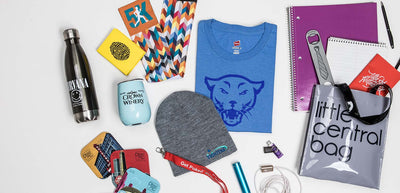
Your choice of promotional gift matters far more than simply picking something budget-friendly and calling it done. The market offers a wide range of options, and understanding which categories resonate most with your target audience directly impacts your return on investment. Apparel, drinkware, and stationery consistently rank as top performers across industries, but that’s only part of the story. Popular promotional products include pens, tote bags, and branded apparel, with effectiveness tied closely to how well these items align with your audience’s daily routines. A pen someone uses three times a week delivers far more brand exposure than a novelty item that sits in a drawer. Think about what your clients and employees actually interact with on a regular basis, and you’ve found your strongest gift category.
Customization transforms generic products into powerful brand ambassadors. Rather than distributing off-the-shelf merchandise, smart corporations add their logo, company message, or even personalized employee names to create items that feel intentional and valuable. Industry research highlights customization options like logos and targeted messaging as critical factors in maximizing effectiveness and ensuring recipients actually keep and use these gifts. This is where Gino’s Awards Inc. excels in providing options that go beyond simple logo placement. Consider these popular customization approaches:
- Engraved plaques and awards for recognition programs or client appreciation events
- Branded desk accessories with company logos for office environments
- Custom drinkware featuring your company name or motivational messaging
- Personalized pens and stationery for professional networking or client packages
- Embroidered apparel for team uniforms, client gifts, or event merchandise
Sustainability has shifted from nice-to-have to expected. Your audience increasingly values brands that demonstrate environmental responsibility, which means eco-friendly and sustainable promotional options are gaining significant market traction. Offering recycled material items, reusable products, or sustainably sourced gifts appeals to modern corporate values while reducing your environmental footprint. A high-quality, durable tote bag made from organic cotton or recycled materials sends a stronger message about your company’s values than a cheap plastic alternative that ends up in a landfill.
The key to successful customization lies in matching the level of personalization to your audience tier. A top client might receive a customized award or premium desk set with detailed engraving. Mid-level contacts could receive branded drinkware or quality apparel. New prospects might get practical items like pens or notepads. This tiered approach stretches your budget while ensuring each recipient feels appropriately valued. The customization options available through professional award and gift providers allow you to create items that genuinely reflect the relationship quality and your company’s commitment to recognition.
Here is a summary of how various promotional gift types deliver value across relationship tiers:
| Audience Tier | Gift Type | Typical Customization | Business Impact |
|---|---|---|---|
| Top Clients | Custom awards, desk sets | Detailed engraving, logo | Strengthens loyalty, retention |
| Mid-level Contacts | Branded apparel, drinkware | Embroidery, company name | Boosts brand recall, exposure |
| New Prospects | Pens, notepads | Basic logo placement | Drives initial engagement |
| Employees | Recognition plaques | Personalized names, message | Improves morale, satisfaction |
Pro tip: Test your chosen gift type with a small sample audience first before ordering in bulk, tracking which items receive the most positive feedback and actually get used, then scale up your selection based on real response data rather than assumptions about what recipients prefer.
How Promotional Gifts Build Relationships
Provisioning for corporate relationships requires a clear understanding of what promotional gifts actually are and how they function within your business strategy. A promotional gift is a tangible item of value given to clients, prospects, employees, or partners in connection with your organization’s business activities. Unlike generic merchandise or impulse purchases, promotional gifts serve a specific purpose: they create a lasting touchpoint that reinforces your brand message while building goodwill. The key distinction lies in intent. These items aren’t random freebies. They’re strategically selected to represent your company’s values and strengthen professional relationships.
What separates promotional gifts from other corporate offerings is their compliance framework and intended impact. Promotional gifts must adhere to ethical guidelines that prevent conflicts of interest and maintain organizational integrity. When you’re selecting or distributing these items, they cannot be intended to influence business decisions or compromise anyone’s impartiality. This is why many mid-sized corporations establish clear policies about gift value limits and appropriate distribution practices. The goal remains straightforward: acknowledge relationships and visibility without crossing ethical lines. Customized awards, engraved plaques, branded desk accessories, and personalized recognition items all fall into this category when distributed with the right intentions and documentation.
Key concepts you should understand include brand alignment, recipient appropriateness, and measurable outcomes. Brand alignment means your chosen gift actually reflects what your company stands for. If your organization emphasizes innovation and forward-thinking solutions, distributing outdated or generic items sends mixed signals. Recipient appropriateness ensures the gift suits the relationship level and industry context. A client in the financial sector might appreciate a high-quality desk accessory more than a casual tech gadget. Measurable outcomes involve tracking how these gifts influence client retention, employee satisfaction, or brand recall. Many organizations overlook this element, but the real value of promotional gifts emerges when you can connect them to business results.
The distinction between general corporate gifts and promotional gifts matters for your strategy. While all promotional gifts are corporate tokens of appreciation, not every corporate gift serves a promotional function. A promotional gift specifically aims to increase brand visibility, strengthen client loyalty, or enhance recognition. Understanding the diverse functions that promotional items serve helps you select options that deliver actual business value rather than simply consuming your budget. This targeted approach transforms gifts from nice gestures into strategic business tools that your marketing team can measure and refine over time.
Pro tip: Start by documenting your gift distribution recipients and timing to identify patterns in which gifts generate the strongest client engagement or employee retention impact, then adjust future selections based on these data points rather than choosing items based solely on appearance or cost.
Impact on Brand Awareness and Loyalty
Brand awareness doesn’t happen by accident, and loyalty certainly doesn’t develop overnight. Every touchpoint matters, which is why strategic promotional gifting creates measurable momentum in how clients and employees perceive your organization. When someone receives a well-chosen, personalized gift from your company, it registers mentally as a gesture of respect and investment in the relationship. This isn’t about manipulation or transactional thinking. It’s recognition that human beings remember how companies make them feel, and a thoughtful gift communicates that your organization values them as more than just another transaction. The tangible nature of promotional gifts makes them stick in memory far longer than digital marketing messages that disappear after a few seconds of scrolling.

Brand awareness extends beyond simple name recognition. It encompasses how your company is perceived, what feelings arise when someone sees your logo, and whether they think positively about recommending you to others. Promotional gifts encourage repeat engagement by providing incremental incentives that build long-term commitment, shifting how people evaluate your company from one-time consideration to ongoing relationship potential. Consider the mathematics of this reality: a client who receives a quality engraved award or branded item sees your company name multiple times weekly. That repeated exposure, coupled with the positive emotion attached to receiving something valuable, compounds brand awareness exponentially. Where traditional advertising might reach someone once and hope it sticks, promotional gifts work as constant, subtle reminders that your organization exists and matters enough to be remembered.
Loyalty represents the ultimate business outcome, and it flows directly from accumulated positive experiences. Strategic promotional gifting at events and through sponsorships strengthens brand loyalty by improving attitudes toward your organization, particularly when gifts align with recipient values and self-image. Here’s what makes this powerful: when your gift strategy feels authentic rather than generic, recipients develop positive self-congruity with your brand. They see themselves as the type of person who works with or supports your company. This psychological alignment translates directly into repeat business, extended contract negotiations, and enthusiastic referrals. The difference between a client who tolerates working with you and one who actively advocates for you often hinges on whether they feel genuinely valued. Promotional gifts, when strategically chosen and thoughtfully distributed, communicate that valuation clearly.
The relationship between repeated brand exposure and purchasing decisions operates through both rational and emotional channels. A prospect might initially contact you based on a referral or advertisement, but decision-making often hinges on whether your company feels familiar and trustworthy. Promotional gifts accelerate familiarity while simultaneously building emotional trust. When combined with high-quality service delivery, they create what psychologists call “consistency bias,” where people unconsciously favor companies they already perceive positively. This bias works powerfully in your favor once established. Your marketing team can amplify this effect by tracking which gifts generate the strongest engagement metrics, then doubling down on those categories for future campaigns.
Measuring the impact requires connecting gifting investments to actual business outcomes. Track client retention rates before and after launching a promotional gift strategy, monitor how many referrals come from previous gift recipients compared to other cohorts, and survey clients directly about their perception of your brand and likelihood to recommend you. This data transforms promotional gifts from a nice-to-have expense category into a quantifiable component of your customer acquisition and retention strategy.
Pro tip: Schedule your highest-value promotional gifts for moments when client relationships typically cool down, such as three to six months after project completion, to reignite engagement and signal continued investment in the relationship.
Important Cost Factors and ROI Considerations
Provisioning a promotional gift strategy without understanding the financial mechanics is like driving blind. Your executive team wants numbers, not vague promises about relationship building. The good news is that promotional gifts deliver measurable returns when you approach them strategically. Promotional products generate an average return of $5.65 for every dollar spent, which significantly outperforms many traditional marketing channels. That means a $5,000 investment in quality promotional items across your client base could reasonably generate $28,250 in additional revenue through increased loyalty, repeat purchases, or expanded contract value. But that baseline assumes you’re making smart choices about what you purchase and how you distribute it.
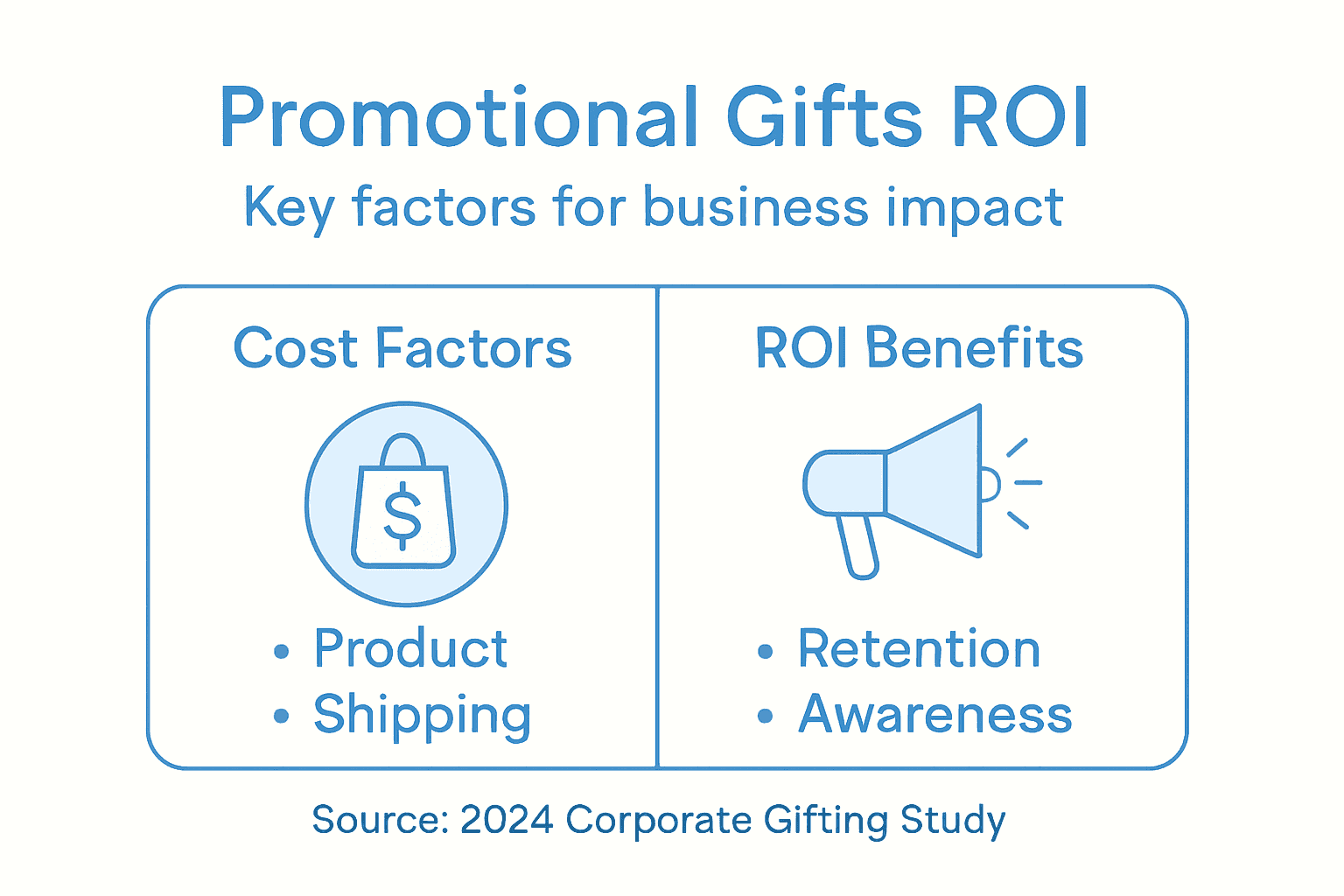
Understanding cost factors requires breaking down where your budget actually goes. The item itself represents only part of the expense. You also account for customization work, such as engraving, embroidery, or logo application. Packaging and branding materials add additional costs. Shipping and distribution logistics multiply depending on whether you’re sending gifts internationally or managing local delivery. For mid-sized corporations, these hidden costs often consume 30-40 percent of your total promotional gift budget. A $15 promotional item with $8 in customization and distribution costs suddenly becomes a $23 investment per unit. This is where strategic selection matters enormously. You’re not just buying something cheap; you’re buying something that will actually sit on a client’s desk or get used regularly rather than immediately discarded.
Quality and durability directly influence ROI outcomes. Item type, customization level, and product durability determine how effectively promotional gifts generate returns through prolonged brand exposure. A cheap plastic pen that breaks after three weeks provides minimal return on your investment. A quality engraved pen or custom award that remains functional and visible for years compounds your returns exponentially. Here’s the calculation that matters: a high-quality item costing 40 percent more than the budget alternative but lasting five times longer actually costs 8 percent less per year of use while generating substantially better brand recall. This is why award providers like Gino’s Awards Inc. emphasize product quality and customization options. The investment in better items pays dividends through extended visibility and stronger client perception.
Calculating return on investment requires accounting for both direct costs and indirect benefits against business outcomes generated. Direct costs include production, customization, and distribution. Indirect benefits include improved client retention, increased referral volume, enhanced employee morale, and amplified brand recognition. Here’s how to measure actual ROI for your organization:
- Track client retention rates before and after implementing your promotional gift strategy, then calculate the revenue value of retained clients
- Monitor referral sources to identify what percentage of new business comes from previous gift recipients versus other channels
- Survey recipient satisfaction with both your gift quality and your organization’s overall service
- Calculate cost per lead for promotional gifts compared to your advertising spend on digital or traditional media
- Measure brand recall through periodic surveys asking clients to identify your company name when shown your promotional item
Most marketing executives discover that promotional gifts deliver stronger ROI than expected because they address a gap in traditional marketing. Digital advertising costs per engagement continue rising while conversion rates often decline. Promotional gifts reverse this trend by creating memorable, physical touchpoints that persist long after initial distribution. A client who receives a quality branded item experiences multiple exposures to your company name and message over months or years. Each interaction reinforces brand familiarity and trust, ultimately influencing purchasing decisions when your services align with their needs.
Budget allocation strategy matters as much as item selection. Rather than spreading limited resources thin across low-quality gifts for everyone, concentrate investment in high-value clients and strategic prospects. A top 20 client receives a premium engraved award. Mid-tier contacts receive quality branded items. New prospects might receive practical promotional products at lower price points. This tiered approach maximizes impact per dollar spent while ensuring appropriate positioning for different relationship levels. Your annual budget becomes more efficient, and your clients receive gifts that feel calibrated to relationship value rather than generic.
Compare leading cost factors and their effect on ROI for promotional gifts:
| Cost Factor | Description | ROI Influence | Strategy Tip |
|---|---|---|---|
| Item Quality | Durability, perceived value | Higher retention, recall | Invest in premium options |
| Customization | Engraving, logo, personalization | Greater brand visibility | Match to recipient role |
| Distribution | Shipping, packaging | Reduces net returns if high | Centralize or localize distribution |
| Documentation | Recordkeeping, compliance | Safeguards against risks | Automate gift tracking |
Pro tip: Calculate your exact cost per unit including all customization and distribution expenses, then divide that into the average revenue value per client relationship to determine precisely how many repeat purchases or contract extensions you need to achieve positive ROI, then set that as your measurement benchmark for each promotional gift campaign.
Risks, Common Mistakes, and Best Practices
Provisioning promotional gifts without understanding the ethical landscape can create serious organizational problems. The risks aren’t theoretical either. A well-intentioned gift strategy that crosses ethical boundaries can damage your reputation, create legal complications, and undermine the very relationships you’re trying to strengthen. The primary risk centers on perception. If a client receives an expensive gift right before signing a major contract, it raises legitimate questions about whether the gift influenced the decision. Even if your intentions were pure, the appearance of impropriety can be just as damaging as actual impropriety. This is why understanding and establishing clear guidelines matters more than choosing the fanciest items.
Avoiding conflicts of interest requires transparent policies, clear value limits, and refusal or reporting of inappropriate gifts that could influence decisions. Smart organizations establish specific thresholds, such as limiting individual gifts to $100 or $250 depending on industry norms and client relationship type. They document all gifts distributed, maintaining records that demonstrate consistent application of standards. They avoid giving gifts from vendors or entities with active business contracts unless explicitly approved through proper channels. They ensure their teams understand that promotional gifts should acknowledge existing relationships, not attempt to create influence or obligate recipients to make business decisions. This isn’t being paranoid; it’s being professional.
Common mistakes emerge when organizations treat promotional gifts as shortcuts to business development rather than relationship recognition tools. The first mistake involves gift timing. Sending an expensive gift right before a major pitch or proposal creates obvious conflict of interest concerns. Better practice involves timing gifts for moments like project completion, client anniversaries, or holiday periods when no immediate business decision looms. The second mistake involves inconsistency. If your top client receives a $150 custom award but a mid-level contact receives nothing, or if you give gifts only to clients who purchase specific services, you create favoritism patterns that breed resentment. Consistent, documented policies applied uniformly prevent these problems.
The third mistake involves selecting items that communicate the wrong message. A luxury gift might seem impressive, but it can make recipients uncomfortable if they work in industries with strict gift acceptance policies. A cheap novelty item communicates disrespect. The solution lies in selecting quality, useful items that align with professional norms. Establishing value thresholds, transparent approval processes, and employee training prevents conflicts of interest and preserves organizational integrity. Your team members should understand which gifts are appropriate, when they can be distributed, and what documentation is required. This clarity prevents mistakes born from confusion rather than malice.
Best practices create a framework where promotional gifts deliver value without creating risk:
- Document everything - maintain records of all gifts distributed, recipients, dates, and business purpose
- Set clear value limits - establish maximum acceptable gift values and stick to them consistently
- Avoid gift timing during negotiations - distribute gifts after business decisions are complete, not during active sales cycles
- Never give to decision-makers on active proposals - wait until projects conclude or relationships are established
- Choose items aligned with professional standards - research industry norms to ensure appropriateness
- Train your team - ensure marketing and sales staff understand ethical guidelines and proper procedures
- Require transparency - implement approval processes for higher-value items to prevent unauthorized spending
- Evaluate gift appropriateness - consider whether recipients could face complications accepting the gift based on their organization’s policies
When working with professional award and gift providers like Gino’s Awards Inc., you gain access to expertise in selecting items that balance impact with professional appropriateness. Custom awards and recognition items inherently communicate respect and achievement rather than influence, making them safer choices than generic promotional merchandise. Engraved plaques, quality desk accessories, and branded items that emphasize recognition align naturally with ethical gifting practices.
The strongest organizations view promotional gifts as part of a comprehensive relationship strategy rather than as standalone tactics. Gifts amplify existing value delivered through excellent service, not replace service quality with gift value. This distinction makes all the difference. A client who receives a quality promotional item after experiencing exceptional service reinforces their positive perception. The same gift given to a client with mediocre service experiences creates cognitive dissonance rather than loyalty.
Pro tip: Before launching any promotional gift campaign, have your legal or compliance team review your gift policy, value limits, and planned distribution strategy, then create a simple one-page checklist your team can reference to confirm each gift decision meets your organizational standards before distribution.
Elevate Corporate Success with Custom Promotional Gifts
The challenge of choosing promotional gifts that truly build brand loyalty, enhance recognition, and reflect your company values should never be underestimated. The article highlights that strategic gifting, focusing on brand alignment, recipient appropriateness, and measurable outcomes, is essential to transforming simple giveaways into powerful business tools. At Gino’s Awards Inc., we understand the importance of quality, customization, and ethical gifting practices to help you avoid common pitfalls while maximizing your return on investment.
Our extensive catalog offers personalized awards, engraved plaques, and branded promotional items designed to fit every client tier and corporate occasion. Whether you want to honor top clients with distinct custom awards or engage prospects with useful branded merchandise, our expertly crafted products help you create tangible, memorable connections aligned with your goals. Discover how our custom awards and recognition plaques can strengthen your relationships and make your brand unforgettable.
Make your promotional gifts stand out with meaningful customization and an easy online shopping experience. Visit Gino’s Awards Inc. today to explore premium options that combine quality, personalization, and professional impact.
Ready to transform your promotional gifting strategy?
Start now by browsing our collection of personalized corporate gifts that deliver measurable brand recognition and loyalty. Act quickly to seize the advantage of strategic gifting for your next corporate milestone at Gino’s Awards Inc…
Frequently Asked Questions
What are promotional gifts and how do they work in corporate strategies?
Promotional gifts are tangible items given to clients, employees, or partners with the intention of reinforcing brand messages and building goodwill. They are strategically selected to align with company values and strengthen professional relationships.
How can I measure the effectiveness of promotional gifts?
To measure the effectiveness of promotional gifts, track outcomes such as client retention rates, employee satisfaction, and brand recall. Analyzing these metrics can help you connect gift distributions to tangible business results and refine future strategies.
What types of promotional gifts are most effective?
Effective promotional gifts include items that recipients interact with frequently, such as quality drinkware, branded apparel, and engraved awards. Customization plays a key role, making gifts more valuable and memorable.
What are some common mistakes to avoid when giving promotional gifts?
Common mistakes include failing to adhere to ethical guidelines, inconsistent gift value across recipients, and selecting inappropriate items. It’s essential to follow established policies, choose gifts that reflect professional standards, and ensure gifts are distributed judiciously.
Recommended
- The Importance of Corporate Awards: Recognizing Excellence and Inspiring Success – Gino’s Awards, Inc.
- What Is a Corporate Gift and Why It Matters – Gino’s Awards, Inc.
- Function of Promotional Items: Boosting Recognition and Engagement – Gino’s Awards, Inc.
- How Corporate Recognition Awards Can Improve Employee Retention? – Gino’s Awards, Inc.
- Top Leather Bags for Gifts – Expert Comparison 2026