


7 Ways to Choose the Best Award Engraving
Table of Contents
- 1. Start With the Award's Purpose and Recipient
- 2. Match the Material to the Message
- 3. Laser Engraving vs Diamond Drag Engraving: Pick the Right Method
- 4. Best Practices for Award Inscription Wording
- 5. Nail the Typography, Logo Clarity, and Layout
- 6. Custom Plaque Engraving Turnaround Time: What to Expect
- 7. Budget, Proofing, and Long-Term Care
- Frequently Asked Questions
Last Updated: September 11, 2026
1. Start With the Award's Purpose and Recipient
Award engraving is the process of cutting or etching text, logos, and artwork permanently into a plaque, trophy, or keepsake so that the recognition lasts as long as the object itself, and this award engraving work starts with two questions: who is receiving this, and what is the occasion? Getting that process right starts with two questions: who is receiving this, and what is the occasion? This guide walks through the seven decisions that separate a professional-looking award from one that sits in a drawer.
A retirement keepsake, a years-of-service plaque, and a gala trophy each demand different choices. A wall-mounted recognition piece rewards a formal citation and generous engraving space. A handheld trophy needs short, bold text that reads at arm's length.
2. Match the Material to the Message
Material choice drives both aesthetic appeal and material durability. Acrylic reads modern and handles high-contrast engraving well. Wood brings warmth and suits traditional service awards. Metal, including brass and aluminum, carries layered metallic accents and holds fine detail. Glass and crystal deliver a premium feel but demand careful handling.
A common mistake is choosing material by looks alone. A nonprofit donor recognition wall, for example, needs something that survives years of cleaning and sunlight. In practice, wood and metal plaques outlast delicate substrates in high-traffic lobbies.
3. Laser Engraving vs Diamond Drag Engraving: Pick the Right Method
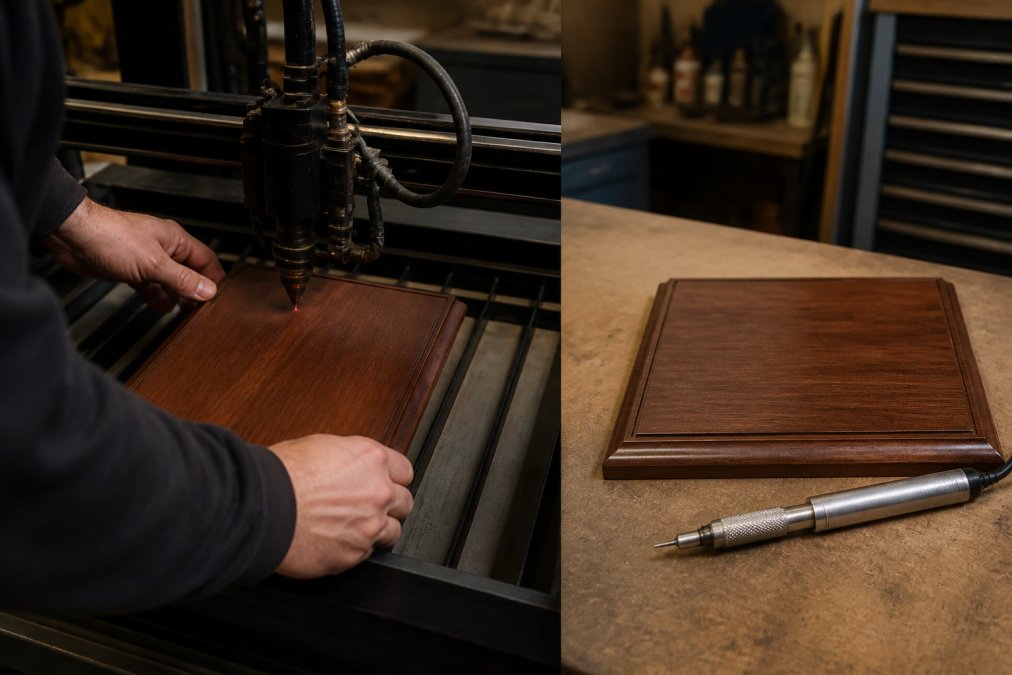
Laser engraving uses a focused beam to vaporize or mark the surface, producing fine detail on wood, acrylic, and coated metals (peer-reviewed research). Diamond drag engraving cuts a precise groove into bare metal with a diamond-tipped stylus (sciencedirect.com). Both differ from sandblasting, which abrades a masked surface to create a deep, frosted finish on glass and stone (osha.gov).
| Method | Best For | Detail Level | Durability |
|---|---|---|---|
| Laser engraving | Wood, acrylic, coated metal | High | Good |
| Diamond drag | Bare metal, brass, aluminum | Very high | Excellent |
| Sandblasting | Glass, stone, crystal | Medium | Excellent |
| Rotary engraving | Deep cuts, industrial plates | Medium | Excellent |
4. Best Practices for Award Inscription Wording
Award inscription wording should lead with the recipient's name, follow with the achievement, and close with the presenter and date. Keep formal citations tight. A clean structure reads better than a paragraph crammed into a small engraving space.
Follow these rules:
- Put the recipient's name first and in the largest text
- State the achievement in one clear line
- Include the presenting organization and the date
- Avoid abbreviations the recipient won't recognize
- Proofread names against an official source, never from memory
5. Nail the Typography, Logo Clarity, and Layout
Font legibility is where most awards quietly fail. Serif fonts read as formal; sans-serif fonts read as modern and stay legible at small sizes. Cap height, letter spacing, and stroke weight all affect how text survives engraving depth.
For logo clarity, submit vector artwork rather than a screenshot. A raster logo loses edge definition once engraved. Vertical design layouts suit tall trophies, while horizontal layouts fit traditional award plaques.
6. Custom Plaque Engraving Turnaround Time: What to Expect
Custom plaque engraving turnaround time depends on three things: order quantity, design complexity, and proof approval speed. A single personalized piece typically moves faster than a batch of fifty matching awards. Rush options exist, but they require a clean, approved proof before production starts.
The biggest delay is almost never the engraving itself. It's the back-and-forth on the proof. Approve your digital proof quickly and the whole timeline compresses.
7. Budget, Proofing, and Long-Term Care
Budget allocation should cover material, engraving method, and quantity, not just the base item. Proof approval is your last checkpoint before production, so review spelling, dates, and logo placement carefully. After the event, simple maintenance keeps awards looking new: dust with a soft cloth, avoid abrasive cleaners, and keep glass and crystal out of direct sunlight.
For teams that want this handled end to end, Gino's Awards, Inc. has produced custom awards and engraved plaques since 1950, with on-site manufacturing, free personalization, and free shipping on orders over $50.
Frequently Asked Questions
How do I choose the right font for award engraving?
Font legibility is critical. For engraved awards, serif fonts like Times New Roman or Garamond work well for formal citations, while sans-serif fonts like Arial or Helvetica offer a clean, modern look. Avoid overly decorative scripts that can become unreadable when scaled down. Test your font at the actual engraving size, and ensure high contrast between the text and the award surface. For logos, provide vector artwork to maintain clarity.
What is the difference between laser engraving and rotary engraving?
Laser engraving uses a focused beam to vaporize the surface, creating fine detail and high-contrast marks on materials like wood, acrylic, and coated metals. Rotary engraving uses a mechanical cutter to carve into the material, which is ideal for deep, durable marks on brass, aluminum, and plastic. Diamond drag engraving, a type of rotary method, produces precise, scratch-like lines on metal. Your choice depends on material, desired depth, and design complexity.
How long does professional award engraving take?
Custom plaque engraving turnaround time varies by complexity and quantity. Rush options exist. Always confirm lead time before ordering, especially for large events. Providing vector artwork and approving proofs quickly helps avoid delays.
What information should be included on a corporate award?
A corporate award should include the recipient's full name, the specific achievement or milestone, the date, and the awarding organization's name and logo. For years-of-service awards, mention the number of years. Keep the wording concise and formal. Use best practices for award inscription wording: avoid jargon, double-check spelling, and ensure the layout is balanced. A clear, professional inscription enhances recipient recognition.
Can you provide some examples of award engraving ideas?
Engraving ideas include a classic plaque with a laser-etched logo and serif text, a crystal trophy with sandblasted deep etching, or a perpetual plaque with layered metallic accents. For a modern touch, use vertical design and high-contrast engraving on acrylic. Incorporate a meaningful quote or the recipient's initials. Always prioritize legibility and aesthetic appeal to make the award memorable.
Choosing the right award engraving comes down to matching purpose, material, method, and wording before a single cut is made. Gino's Awards, Inc. handles that entire process in-house, from free personalization and digital proofing to fast turnaround on custom plaques and trophies. With nearly 75 years of family-owned experience and made-in-the-USA production, the team can turn a last-minute recognition order into something worth displaying. Call (216) 831-6565 to get started.