


Why Personalize Corporate Gifts for Employee Engagement
Recognizing employees in a way that feels authentic can challenge even the most seasoned American event planner or HR manager. Personalized corporate gifts offer a fresh solution, transforming generic rewards into meaningful acknowledgments grounded in fairness, sincerity, and timeliness. With nearly 90 percent of North American companies adopting recognition programs, intentional customization has become vital for building trust, deepening engagement, and fostering a strong company culture.
Table of Contents
- Defining Personalized Corporate Gifts And Recognition
- Types Of Personalized Corporate Gifts For Employees
- How Personalization Drives Engagement And Morale
- Key Benefits Over Standard Corporate Gifts
- Strategies For Effective Gift Personalization
- Measuring ROI And Impact On Company Culture
Key Takeaways
| Point | Details |
|---|---|
| Personalized Corporate Gifts Enhance Recognition | Custom gifts focus on individual achievements, increasing their impact compared to standard gifts. |
| Engagement Boosts Through Personalization | Tailored recognition strategies drive higher employee motivation and improve overall workplace morale. |
| Effective Personalization Requires Understanding | Organizations must be attuned to each employee’s unique preferences and experiences to create meaningful recognition moments. |
| Measuring Impact Is Crucial | Implementing comprehensive metrics is essential for evaluating the effectiveness of personalized gift programs and their influence on company culture. |
Defining Personalized Corporate Gifts and Recognition
Corporate gifts represent strategic tools designed to recognize, motivate, and appreciate employees beyond standard compensation. A personalized corporate gift transforms a generic item into a meaningful acknowledgment of an individual’s unique contributions. Unlike standard rewards, these gifts are intentionally customized to reflect an employee’s specific achievements, personal interests, or professional milestones.
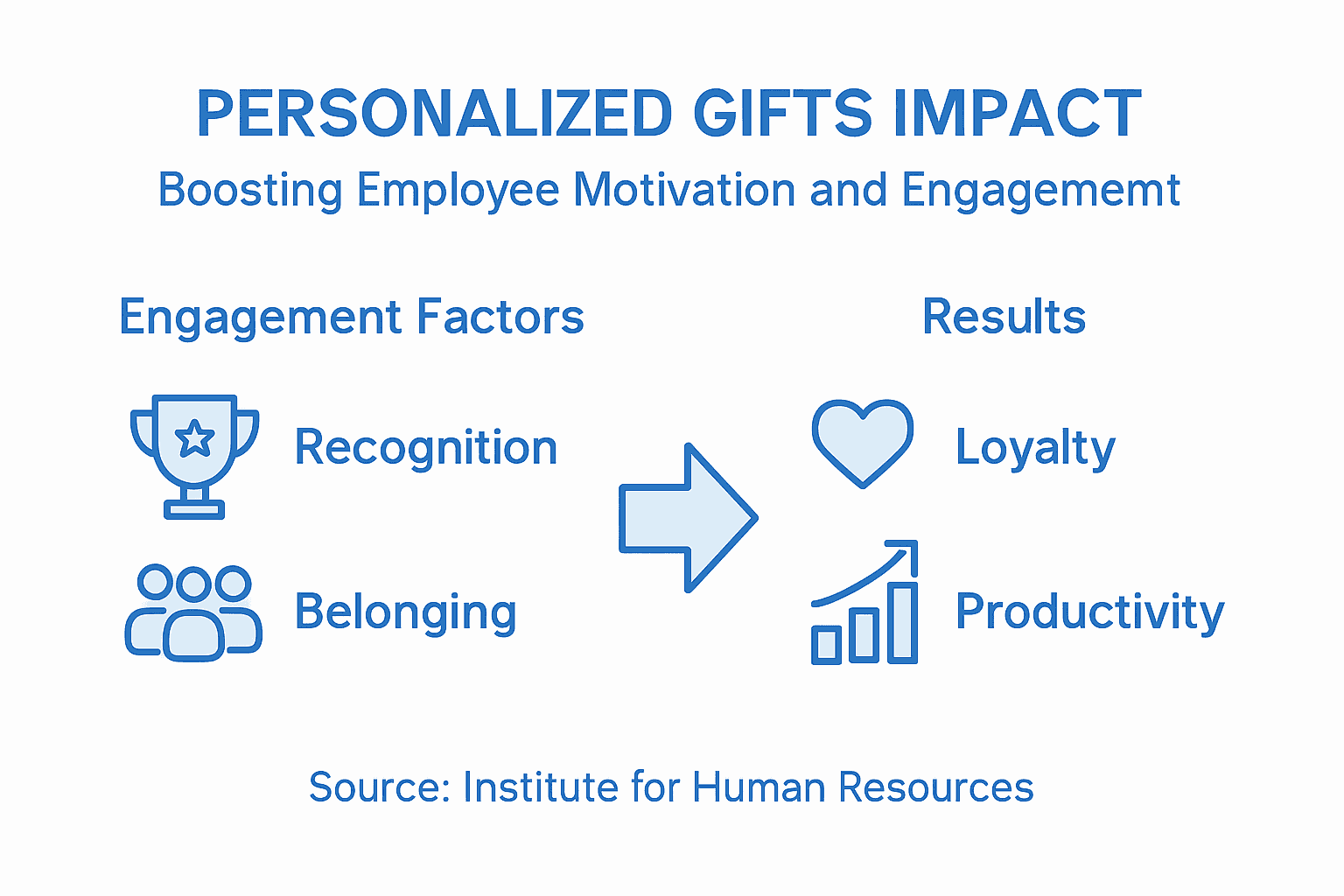
According to research from the Institute for Human Resources, recognition programs are prevalent in North America, with nearly 90% of companies implementing some form of employee acknowledgment strategy. Personalized gifts play a critical role in these programs by providing tangible evidence of an organization’s appreciation. The key difference lies in the intentional customization - a gift that speaks directly to an individual’s experience feels more genuine and impactful.
Effective personalized corporate gifts typically demonstrate three core characteristics: relevance, timeliness, and sincerity. They go beyond generic merchandise by incorporating elements that show careful consideration - such as referencing a specific project achievement, matching an employee’s personal hobby, or highlighting a unique professional contribution. Organizations that master this approach create deeper emotional connections, transforming simple transactions into meaningful recognition moments that boost morale and reinforce positive workplace behaviors.
Pro Tip: When selecting personalized corporate gifts, prioritize understanding individual employee preferences and focus on thoughtful customization that feels authentic rather than formulaic.
Types of Personalized Corporate Gifts for Employees
Personalized corporate gifts encompass a wide range of thoughtful recognition tools designed to celebrate individual employee achievements and contributions. These gifts go far beyond generic merchandise, transforming standard recognition into meaningful experiences that resonate with each team member’s unique personality and professional journey. By carefully selecting items that reflect an employee’s interests, accomplishments, or personal preferences, organizations can create powerful moments of connection and appreciation.
Companies have numerous options for personalization, ranging from professional achievements to more personal commemorations. Professional recognition gifts might include personalized awards based on individual preferences, such as custom trophies highlighting specific project contributions, engraved plaques celebrating milestone achievements, or professional development resources tailored to an employee’s career trajectory. These gifts demonstrate a nuanced understanding of an individual’s professional growth and potential.
Beyond professional recognition, personal personalization strategies can include custom gifts that reflect an employee’s hobbies, interests, or lifestyle. Federal regulations provide guidelines for appropriate gift-giving, ensuring that personalized corporate gifts remain meaningful yet compliant. Examples might include curated gift baskets matching an employee’s favorite snacks, experience vouchers aligned with personal interests, or tech accessories customized with an individual’s name or department. The key is creating a gift that feels intentional and demonstrates genuine appreciation for the employee’s unique contributions and personality.
Pro Tip: Develop an employee preference survey to gather specific information about individual interests, enabling more targeted and meaningful gift personalization.
How Personalization Drives Engagement and Morale
Personalization has emerged as a powerful strategy for transforming workplace dynamics, moving far beyond traditional one-size-fits-all recognition approaches. At its core, personalization builds meaningful workplace connections by acknowledging each employee’s unique contributions, aspirations, and individual worth. This nuanced approach demonstrates that organizations value employees not just as workers, but as distinct individuals with specific talents, interests, and professional goals.
Psychological research reveals that personalized recognition triggers profound emotional responses that significantly impact employee motivation. When employees receive gifts or acknowledgments tailored specifically to their achievements and preferences, they experience a deeper sense of being genuinely seen and appreciated. This emotional validation creates a positive feedback loop where increased recognition directly correlates with higher engagement, improved job satisfaction, and enhanced organizational loyalty. The subtle art of personalization communicates that an organization is willing to invest time and resources into understanding each team member’s individual journey.

The impact of personalization extends beyond momentary appreciation, fundamentally reshaping workplace culture and interpersonal dynamics. By implementing strategic personalization techniques, companies can create environments where employees feel deeply connected to their work and their organizational community. These approaches might include customized recognition programs, individualized professional development opportunities, or rewards that reflect an employee’s specific interests and career aspirations. The underlying principle remains consistent: genuine recognition that speaks directly to an individual’s unique professional identity and personal motivations.
Pro Tip: Develop a comprehensive employee preference database that tracks individual interests, achievements, and personal milestones to enable more authentic and meaningful personalization efforts.
Key Benefits Over Standard Corporate Gifts
Personalized corporate gifts represent a transformative approach to employee recognition that significantly outperforms traditional, generic gift-giving strategies. Unlike standard corporate gifts that often feel impersonal and transactional, experiential gifts create deeper emotional connections by demonstrating genuine understanding and appreciation of individual employee contributions. These thoughtfully curated gifts transcend mere material exchange, becoming powerful tools for building meaningful workplace relationships and fostering a culture of authentic recognition.
The psychological impact of personalized gifts extends far beyond momentary appreciation. Standard corporate gifts typically follow a uniform, predictable pattern that fails to acknowledge the unique qualities and achievements of individual team members. In contrast, personalized gifts signal that an organization is willing to invest time and effort in understanding each employee’s specific contributions, interests, and professional journey. This approach transforms gift-giving from a routine administrative task into a strategic engagement tool that communicates respect, value, and genuine recognition.
Research consistently demonstrates that personalized gifts generate substantially higher engagement and emotional resonance compared to standardized corporate gifts. By aligning gifts with individual preferences, achievements, and personal milestones, organizations can create powerful moments of connection that reinforce positive workplace behaviors. These tailored recognition strategies not only boost morale but also contribute to long-term employee retention, motivation, and organizational commitment. The key differentiator lies in the intentional customization that makes each gift feel like a unique, meaningful acknowledgment rather than a generic corporate obligation.
Here’s a comparison of personalized vs. standard corporate gifts and their workplace impact:
| Criteria | Personalized Gifts | Standard Corporate Gifts |
|---|---|---|
| Employee Engagement | Drives stronger motivation | Often results in neutral response |
| Emotional Resonance | High—recognizes unique contributions | Low—feels generic and impersonal |
| Retention Impact | Improves long-term retention | Rarely affects retention |
| Organizational Loyalty | Builds deep connections | Limited effect |
Pro Tip: Implement a structured feedback mechanism that allows employees to provide insights about their preferences, enabling more precise and impactful personalization of future recognition efforts.
Strategies for Effective Gift Personalization
Successful personalization requires a strategic and nuanced approach that goes beyond surface-level customization. Organizations must develop a comprehensive framework that builds trust through meaningful disclosure and demonstrates genuine understanding of individual employee experiences. This means moving beyond generic demographic data and creating gift strategies that reflect deep, contextual knowledge of each team member’s unique professional journey and personal aspirations.
Design thinking offers a powerful methodology for developing personalized gift strategies. By treating employee recognition as a human-centered design challenge, organizations can create more meaningful and impactful gift experiences. This approach involves conducting systematic interviews, developing employee personas, and prototyping recognition strategies that feel authentically tailored. Critical steps include gathering candid employee insights, mapping individual preferences, and creating flexible gifting frameworks that can adapt to diverse workforce needs and expectations.
Effective personalization requires establishing robust feedback mechanisms and continuous learning systems. Companies should implement structured processes for collecting employee preferences, tracking gift impact, and iteratively refining their recognition approaches. This might involve creating preference surveys, conducting periodic recognition experience reviews, and developing dynamic databases that capture evolving employee interests and achievements. The goal is to transform gift-giving from a transactional exercise into a dynamic, relationship-building process that communicates genuine appreciation and organizational commitment.
Pro Tip: Create a comprehensive employee preference profile that captures not just basic demographic information, but nuanced insights about individual professional goals, personal interests, and meaningful life milestones.
Measuring ROI and Impact on Company Culture
Measuring the return on investment for personalized corporate gifts requires a sophisticated, multidimensional approach that goes beyond traditional metrics. Organizations must develop comprehensive assessment frameworks that analyze high-impact employee behaviors and their correlation with recognition strategies. This involves creating robust measurement systems that capture both quantitative performance indicators and qualitative cultural shifts resulting from personalized gift initiatives.
A holistic measurement strategy should incorporate multiple data points that demonstrate the broader organizational impact of personalized recognition. Key performance indicators might include employee retention rates, engagement survey scores, productivity metrics, and internal mobility rates. Qualitative assessments should capture nuanced insights through employee feedback, sentiment analysis, and detailed interviews that explore how personalized gifts influence workplace motivation, team dynamics, and individual professional experiences. By triangulating these diverse data sources, organizations can develop a comprehensive understanding of how recognition strategies translate into tangible cultural and performance outcomes.
Successful ROI measurement requires establishing clear baseline metrics and implementing systematic tracking mechanisms. This might involve creating sophisticated dashboards that track recognition program effectiveness, conducting periodic culture audits, and developing predictive models that correlate personalized gift strategies with long-term organizational performance. The goal is to transform gift-giving from a subjective practice into a data-driven strategic intervention that can be precisely measured, refined, and optimized to support broader organizational objectives.
Below is a summary of effective data sources for measuring the ROI of personalized gift initiatives:
| Data Source | Metric Example | Value to Organization |
|---|---|---|
| Employee Surveys | Engagement scores | Tracks morale and satisfaction |
| Retention Analytics | Turnover rates | Quantifies retention improvement |
| Productivity Metrics | Output per employee | Measures business performance |
| Sentiment Analysis | Feedback and tone | Assesses culture and motivation |
Pro Tip: Develop a standardized recognition impact scorecard that combines quantitative performance metrics with qualitative cultural indicators to provide a comprehensive view of personalized gift program effectiveness.
Elevate Employee Engagement with Personalized Corporate Gifts
Recognizing the unique achievements and personalities of your employees is key to boosting motivation and loyalty. As highlighted in the article, the challenge many organizations face is making recognition feel genuine and tailored rather than generic and transactional. At Gino’s Awards Inc., we understand this need to provide meaningful, personalized corporate gifts that show sincere appreciation and create lasting emotional impact.
Explore our wide selection of custom awards and recognition plaques designed to celebrate individual accomplishments.
Unlock the full potential of your employee recognition program today with gifts that resonate personally and professionally. Visit Gino’s Awards Inc. now to browse quality, customizable trophies, plaques, and gift items. Take advantage of free personalization and fast shipping to transform routine gift-giving into powerful moments of engagement. Start making a difference in your workplace culture with personalized recognition that truly matters.
Frequently Asked Questions
What are personalized corporate gifts?
Personalized corporate gifts are customized items designed to recognize and appreciate employees by reflecting their unique contributions, interests, or professional milestones.
How do personalized corporate gifts impact employee engagement?
Personalized corporate gifts create meaningful emotional connections, leading to higher motivation, job satisfaction, and organizational loyalty among employees.
What are the key characteristics of effective personalized corporate gifts?
Effective personalized corporate gifts should be relevant, timely, and sincere, incorporating specific achievements or personal interests to show thoughtful consideration.
How can companies measure the success of their personalized gift initiatives?
Success can be measured through key performance indicators such as employee retention rates, engagement survey scores, and productivity metrics, along with qualitative insights from employee feedback.
Recommended
- Why Use Personalized Gifts for Employee Motivation – Gino’s Awards, Inc.
- What Is a Personalized Gift and Why It Matters – Gino’s Awards, Inc.
- What Is a Corporate Gift and Why It Matters – Gino’s Awards, Inc.
- How Corporate Recognition Awards Can Improve Employee Retention? – Gino’s Awards, Inc.
- 7 bewährte Tipps für bessere Kundenbindung im E-Commerce | aLIVE Support