


Why Use Custom Awards for Employee Recognition
Every United States event coordinator knows the routine of handing out generic trophies that barely reflect true achievement. When it comes to motivating teams and honoring real contributions, these off-the-shelf options often fall flat. Custom awards do more than mark a milestone—they become powerful tools that reinforce organizational behaviors and highlight what truly matters to your company. Discover how personalized recognition can energize your employee programs and deepen your team’s sense of belonging.
Table of Contents
- Defining Custom Awards And Recognition
- Most Popular Types Of Custom Awards
- How Personalization Enhances Impact
- Real-World Corporate Use Cases
- Comparing Custom Awards To Generic Options
- Budgeting And Ordering Considerations
Key Takeaways
| Point | Details |
|---|---|
| Custom Awards Enhance Recognition | Custom awards align with organizational values and provide personalized acknowledgment, boosting employee engagement and connection. |
| Types of Awards Matter | Recognize specific achievements with appropriate award types, such as spot, performance, service, or honorary awards, to communicate organizational priorities. |
| Personalization Drives Impact | Tailored awards that reflect individual contributions create memorable recognition experiences, fostering loyalty and motivation among employees. |
| Investing in Customization Pays Off | While custom awards have higher upfront costs, they offer greater emotional resonance, increased retention, and align recognition with organizational goals. |
Defining Custom Awards and Recognition
When you talk about custom awards for employee recognition, you’re talking about something more specific than just ordering generic trophies off a shelf. Custom awards are tangible acknowledgments designed specifically for your organization, your values, and your people. They go beyond standard trophy designs to reflect your company’s culture, achievements, and the individual contributions you want to celebrate. Think of them as physical representations of what matters to your organization and what your employees have earned through their work.
At their core, custom awards function as powerful tools that reinforce organizational behaviors and boost employee engagement. They’re not just shiny objects sitting on a desk. A well-designed custom award tells a story about your company’s priorities. For instance, if innovation drives your business forward, your custom award might feature design elements that reflect that value. If collaboration is central to your culture, the award might include space for team names or a design that symbolizes teamwork. The customization options are genuinely extensive: you can choose materials like crystal, wood, or metal; add company logos or department insignias; include personalized engraving with names and dates; and even select shapes and designs that align with your recognition theme.
The distinction between formal and informal recognition matters here too. Formal recognition typically involves structured programs where an employee recognition committee oversees the selection process, criteria, and award presentation. Informal recognition might happen more spontaneously but can still benefit from custom awards. Both approaches work best when your custom awards reflect your departmental mission and core values. Whether you’re recognizing a sales milestone, years of service, safety achievement, or innovation, having awards specifically designed for those accomplishments creates a stronger emotional connection than generic recognition products. Your team members understand that someone invested thought and resources into creating something meaningful just for them.
Pro tip: When designing your custom awards, involve your employee recognition committee or a representative group from different departments in the design process. This ensures your awards resonate across your organization and align with what actually matters to your workforce, not just what management assumes is important.
Most Popular Types of Custom Awards
Event coordinators at mid-sized corporations typically work with four main categories of custom awards, each serving a distinct purpose in your recognition strategy. Understanding these types helps you match the right award to the right achievement. The most common types include spot awards, performance awards, service awards, and honorary awards, each designed to address different moments and milestones in your employee’s career. Getting this distinction right matters because it sends a clear message about what your organization values.
Spot awards are your go-to option for recognizing immediate, short-term achievements or specific efforts that deserve quick acknowledgment. Think of an employee who jumped in to solve a client crisis or a team member who contributed an innovative idea during a brainstorm session. These awards work best when presented shortly after the accomplishment, while the impact is still fresh. Performance awards recognize sustained accomplishments and excellence over time. These might celebrate exceeding sales targets consistently over a quarter, maintaining perfect attendance, or demonstrating exceptional quality in project delivery. Service awards honor employee tenure and loyalty, typically presented at milestone years like 5, 10, or 20 years with your organization. These awards carry special weight because they acknowledge someone’s commitment to growing alongside your company.
Beyond these categories, you might also consider specialty awards that align with your organizational goals. Some companies create custom awards for innovation, customer service excellence, safety achievements, or team collaboration. The physical format you choose matters too. You can select from plaques, trophies, and acrylic awards, each offering different visual impacts and customization possibilities. Plaques work exceptionally well for displaying in offices or common areas, making them great for recognition that you want visible to the broader team. Trophies create that traditional ceremonial feel perfect for major achievements. Acrylic awards offer modern aesthetics and durability, ideal for contemporary corporate environments. The key is matching the award type and format to your company’s culture and the significance of the achievement you’re recognizing.
Here’s how the main custom award types differ by purpose and business impact:
| Award Type | Recognition Purpose | Typical Occasion | Business Impact |
|---|---|---|---|
| Spot Award | Immediate contribution | Crisis resolution | Boosts real-time engagement |
| Performance | Sustained excellence | Quarterly/annual review | Rewards ongoing achievement |
| Service | Tenure & loyalty | Milestone anniversaries | Enhances retention and morale |
| Honorary | Exceptional distinction | Career-defining moments | Inspires aspiration and respect |
Pro tip: Before selecting your award types and formats, audit your past recognition efforts to identify patterns in what you celebrate most frequently, then build your custom award lineup around those core achievement categories.
How Personalization Enhances Impact
Here’s what separates recognition that lands from recognition that gets a polite nod and forgotten by Friday. Personalization. When you hand someone a generic award with their name printed on it, you’re checking a box. When you hand someone an award designed specifically for their achievement, reflecting what they actually accomplished and what matters to your company, you’re creating a moment they remember. The difference is psychological. Tailoring rewards to individual preferences increases trust, honesty, and motivation, which strengthens employee engagement and loyalty far beyond what any off-the-shelf trophy can accomplish.
Personalization works because it communicates value at a deeper level. When your event coordinator presents a custom award engraved with specific metrics (like “Top Sales Growth, Q3 2024: 32% Increase”), the recipient knows you tracked their work, measured their impact, and invested time creating something meaningful just for them. This creates a stronger emotional connection than handing over a trophy labeled “Employee of the Month.” You can personalize at multiple levels: the award design itself can reflect the achievement (perhaps incorporating company colors, department logos, or achievement-specific imagery), the engraving can highlight specific accomplishments, and the presentation context can acknowledge the person’s unique contribution to your team. Some coordinators even include brief personal notes or tie the award presentation to career development conversations, making the recognition feel less like a ceremony and more like genuine acknowledgment.

The practical impact matters too. Recognition aligned with individual aspirations boosts employee motivation by making the recognition relevant and meaningful. Consider this scenario: One employee values public recognition, so you present their award during a company all-hands meeting with their team applauding. Another employee prefers quieter acknowledgment, so you present theirs during a one-on-one conversation with their manager, then display it in their office. The award itself might be identical, but the personalization of how you deliver it transforms the impact. This approach also builds institutional knowledge about what drives each person. Over time, you learn who wants what, and your recognition becomes increasingly effective at motivating the behaviors and outcomes your organization needs.
Pro tip: Create a simple preference form when implementing your recognition program, asking employees how they prefer to be recognized (public vs. private, achievement type they value most, physical space where they’d display awards), then reference this data when designing personalized awards and presentations.
Real-World Corporate Use Cases
When you look at how actual corporations deploy custom awards, you see patterns that reveal what really works in practice. A mid-sized technology company implements structured monthly awards for excellence across five departments, with custom acrylic awards engraved each month during a brief team celebration. The program costs relatively little but has measurable impact: employee engagement scores increased, and turnover in high-performing teams dropped noticeably. The key was consistency and clear criteria. Everyone knows what earns recognition, so it feels fair and achievable rather than arbitrary.
Consider a financial services firm that blends multiple award types into one cohesive program. They use spot awards for quick wins (think “saved a client relationship during a crisis”), quarterly performance awards for sustained excellence in revenue targets or customer satisfaction scores, and annual service awards celebrating tenure milestones. Each award type uses different design elements so recipients and observers can instantly understand what achievement level they’re recognizing. One team member might receive a crystal performance award in Q2, then a plaque for mentoring junior staff in Q4. The variety keeps recognition fresh and acknowledges different ways people contribute to organizational success.
A manufacturing company with safety as a core value created custom awards specifically for safety achievements and near-miss reporting, making it clear that protecting people matters as much as meeting production goals. They discovered that spot awards work particularly well here because immediate recognition reinforces the right behaviors at precisely the right moment. When someone reports a potential hazard, they get recognized within days, not months. This approach sends a powerful message about organizational priorities. Meanwhile, their annual service awards feature engraved plaques displayed in the main lobby, creating visible reminders of long-term commitment and building cultural narrative around loyalty.
These examples share common threads. First, structured programs with clear goals and performance periods consistently outperform ad-hoc recognition. Second, matching award type to achievement type (spot awards for immediacy, performance awards for sustained effort, service awards for tenure) creates clearer meaning. Third, investment in physical custom awards signals genuine importance more powerfully than digital recognition alone.
Pro tip: Start with one award category and one recognition cadence (like monthly performance awards), measure the impact on engagement and retention for three months, then expand once you understand what resonates with your specific workforce.
Comparing Custom Awards to Generic Options
The difference between ordering generic trophies and investing in custom awards comes down to this: emotional resonance and perceived value. A generic trophy sitting on a shelf looks identical to thousands of others distributed across different companies. Your recipient might display it, but they could just as easily mistake it for someone else’s award or forget where it came from. A custom award tells a story. It says someone cared enough to think specifically about this person’s achievement. That matters more than you might think, and the research backs it up. Personalized recognition reflects understanding of individual contributions and communicates genuine appreciation in ways generic awards simply cannot match.
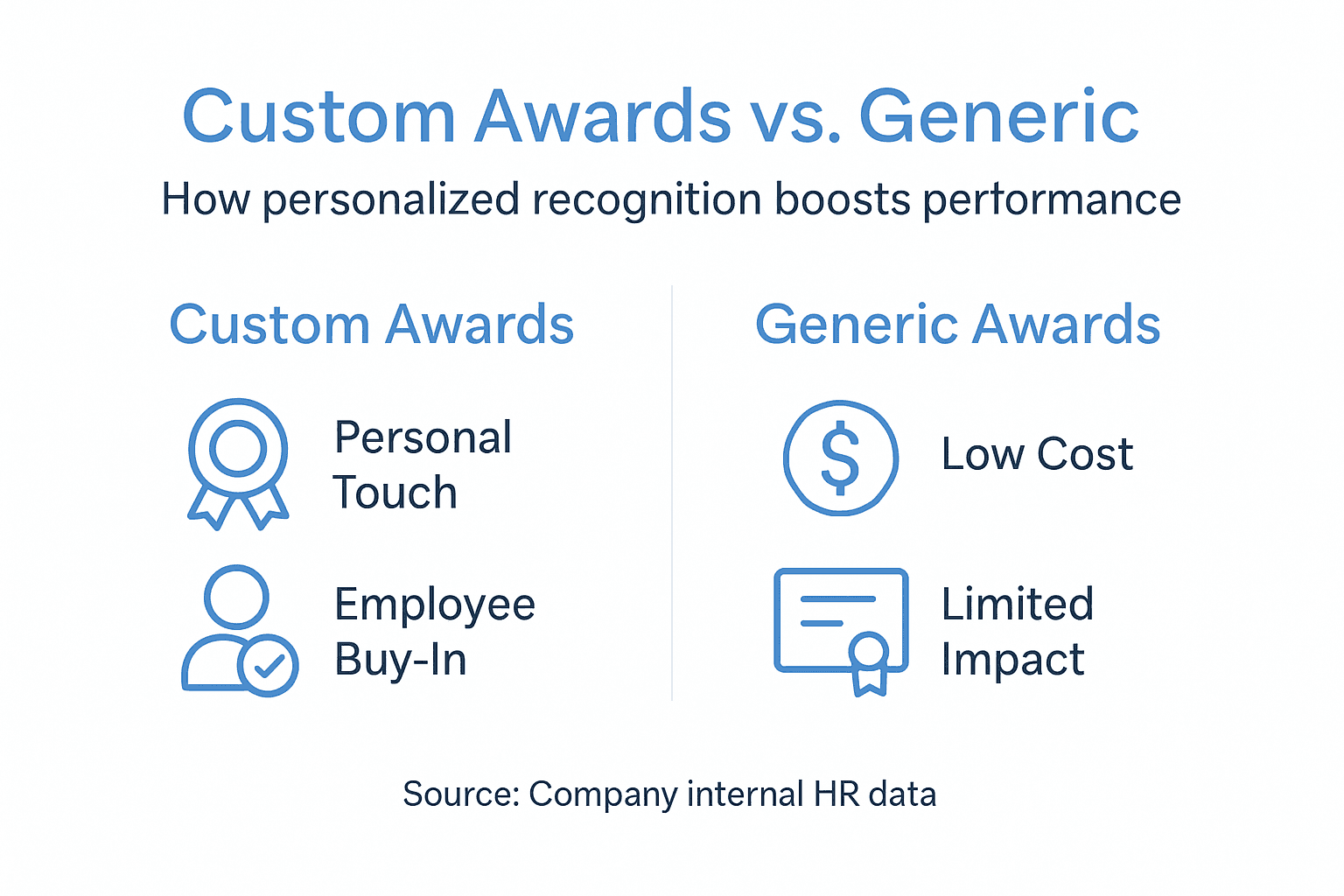
Let’s talk about the practical differences. Generic awards offer speed and low cost. You order in bulk, add names via basic engraving, and you’re done. They work when you need recognition to happen and nothing custom exists in your current workflow. But here’s what you lose: alignment with your organization’s values, customization to specific achievement types, and the psychological impact of personalization. A generic “Employee of the Month” plaque fails to distinguish what made this month special. Did someone solve a critical problem? Hit an ambitious sales target? Mentor a struggling team member? The generic approach lumps all achievements into one category, which actually dilutes motivation because high achievers can’t see why their specific contribution earned recognition. Custom awards offer meaningful recognition that aligns with employee preferences and organizational values, creating deeper emotional investment in the recognition itself.
Consider the display and retention aspect. When someone receives a custom award specifically designed for innovation or customer service or safety achievement, they’re more likely to display it prominently. It becomes a career artifact they reference. Generic trophies tend to migrate to storage shelves or closets. Additionally, custom awards create consistency in your recognition messaging. When all service awards feature a specific design, all innovation awards feature another, employees understand the achievement categories your company values most. This structural clarity actually improves motivation because people understand exactly what they need to do to earn each type of recognition.
The cost difference surprises many coordinators. Yes, custom awards cost more per unit than bulk generic options. But when you factor in reduced turnover, increased engagement, and stronger retention of high performers, the return on investment becomes clear. You’re not comparing trophy A to trophy B. You’re comparing the cost of maintaining talented employees against the cost of replacing them. In that calculation, custom awards become a bargain.
See how cost, customization, and employee response differ between custom and generic awards:
| Feature | Custom Awards | Generic Awards |
|---|---|---|
| Unit Cost | Higher per award | Low, bulk pricing |
| Customization | Company values & achievements | Minimal, standard engraving |
| Employee Retention | Often increases | Seldom impacts retention |
| Display Likelihood | Frequently displayed | Often stored or forgotten |
Pro tip: Start by comparing retention rates in your organization before implementing custom awards versus your competitors using generic recognition, then track the same metrics quarterly for six months after launching custom awards to quantify the actual business impact.
Budgeting and Ordering Considerations
Budgeting for custom awards requires thinking beyond the unit cost. You need to balance meaningful recognition with fiscal responsibility. Start by determining your annual recognition budget. How many employees will you recognize? How often? What tier of awards makes sense? A typical mid-sized corporation might allocate 0.5 to 1.5 percent of payroll for recognition programs, though this varies widely by industry and company philosophy. Award programs should align levels with employee performance ratings and distribute recognition across your workforce appropriately. This means you might set aside more substantial budgets for annual top performers and smaller budgets for spot awards that happen more frequently. The key is creating a sustainable system where recognition feels regular without straining finances.
Break down your budget by award type. Spot awards typically cost less per unit because they’re smaller and presented more frequently, reinforcing behaviors throughout the year. Performance awards cost more because they’re presented less often but carry greater significance. Service awards, often presented annually, should reflect the milestone being recognized. A 20-year service award deserves more investment than a 5-year award. Within each category, consider material choices. Crystal awards command higher prices but convey prestige. Acrylic offers good value with modern aesthetics. Plaques fall somewhere in between. Customization adds cost too. Custom engraving is standard and relatively inexpensive. Custom shapes, specialized materials, or logo integration cost more. When planning, get quotes from multiple vendors for the specific types you want. Prices vary considerably, and you might find surprising value in higher-quality suppliers.
Timing and volume matter significantly. Ordering in advance typically reduces unit costs. If you know you’ll recognize 12 monthly performance award winners annually, ordering all 12 awards at once costs less per unit than ordering one each month. However, you need the cash flow to support advance ordering and secure storage space for inventory. Award amounts and distribution should balance fiscal responsibility with meaningful recognition to maintain program sustainability. Many coordinators negotiate volume discounts or establish annual contracts with suppliers, which provides budget certainty and lower per-unit costs. Additionally, consider lead times. Custom awards often require 2 to 4 weeks for production and personalization. Plan your ordering calendar to account for this, especially around major recognition events like year-end celebrations or annual meetings.
Pro tip: Start by documenting your actual recognition spending over the past 12 months, including all purchases and time invested in recognition activities, then use that baseline to build a realistic budget that accounts for custom award costs, lead times, and quantity discounts from Gino’s Awards or similar vendors.
Elevate Employee Recognition with Custom Awards Tailored to Your Company Culture
If your goal is to move beyond generic trophies and create truly meaningful recognition moments custom awards are the solution you need. The article highlights the challenge organizations face when trying to celebrate specific achievements while reinforcing company values. By choosing custom awards designed to match your organizational mission and individual accomplishments you can boost employee engagement, retention, and motivation. At Gino’s Awards Inc. we specialize in delivering personalized plaques, trophies, and awards that tell your workforce they are genuinely valued.
Discover how easy it is to create impactful recognition items that reflect your team’s unique contributions. Visit Gino’s Awards Inc. now to explore our wide selection of customizable awards and plaques. With free personalization on custom items and fast shipping you can start building a rewarding recognition program that motivates and inspires. Take the first step toward transforming your employee recognition today with custom awards crafted to make every accomplishment unforgettable. Your employees deserve nothing less.
Frequently Asked Questions
What are custom awards for employee recognition?
Custom awards are tailor-made acknowledgments designed specifically for an organization, reflecting its values and recognizing individual contributions, going beyond standard trophy designs.
Why is personalization important in employee recognition?
Personalization creates a deeper emotional connection, showing employees that their specific achievements are valued and recognized, which can enhance motivation and engagement.
How do different types of custom awards serve various recognition needs?
Custom awards can be categorized into spot awards for immediate achievements, performance awards for sustained excellence, service awards for tenure, and honorary awards for exceptional distinctions, each addressing different accomplishments and recognition moments.
What budgeting considerations should I take into account when ordering custom awards?
Consider the overall recognition budget, break it down by award type, and factor in customization costs. Ordering in advance and negotiating volume discounts can also help manage expenses effectively.
Recommended
- Importance of Personalized Awards for Team Morale – Gino’s Awards, Inc.
- Why Personalize Awards: Boost Employee Engagement – Gino’s Awards, Inc.
- Welcome & The Power of Employee Recognition – Gino’s Awards, Inc.
- How Corporate Recognition Awards Can Improve Employee Retention? – Gino’s Awards, Inc.
- Adward