



Employee Recognition Awards vs Cash Bonuses
Table of Contents
- Recognition Awards vs Cash Bonuses: Key Differences
- Comparison Table: Awards and Cash Side by Side
- Tax Implications of Employee Cash Bonuses
- The Psychological Impact: Intrinsic vs Extrinsic Motivation
- Employee Service Anniversary Award Ideas and Recognition Programs
- Best Practices for Employee Recognition Programs
- Which Option Should You Choose?
Last Updated: August 25, 2026
Recognition Awards vs Cash Bonuses: Key Differences
Employee recognition awards and cash bonuses shape how employees experience appreciation at work, directly affecting retention. Both reward performance but operate through different psychological mechanisms. Cash bonuses tap into extrinsic motivation, they're transactional and immediate, merging into paychecks and disappearing. Recognition awards operate through intrinsic motivation, serving as permanent reminders of achievement.
At Gino's Awards, Inc., we've spent over 75 years crafting recognition solutions for organizations that understand this distinction. The companies that win on retention aren't necessarily those spending the most on bonuses, they're those building programs that make employees feel genuinely valued.
The real question isn't which option is "better," but which solves your specific retention and engagement challenge, and whether you're using them in the right combination.
Comparison Table: Awards and Cash Side by Side
| Aspect | Recognition Awards | Cash Bonuses |
|---|---|---|
| Psychological Driver | Intrinsic (symbolic value, achievement) | Extrinsic (financial reward) |
| Longevity of Impact | Months to years (physical reminder) | Days to weeks (merges into finances) |
| Tangible Presence | Permanent desk/wall display | Spent or saved, invisible |
| Peer Recognition Value | High (visible accomplishment) | Low (private transaction) |
| Tax Treatment | Potential tax-free if under $1,600 annually | Fully taxable as income |
| Administrative Burden | Moderate (design, personalization, delivery) | Low (payroll integration) |
| Cost Predictability | Fixed per award | Variable with bonus structure |
| Retention Impact | Stronger (emotional attachment) | Weaker (temporary satisfaction) |
| Best For | Service anniversaries, milestone achievements | Performance metrics, sales targets |
This table reveals a critical insight: the two options don't compete directly. Cash bonuses excel at incentivizing specific behaviors. Recognition awards excel at building long-term attachment. The strongest programs use both strategically.
Tax Implications of Employee Cash Bonuses
Cash bonuses are fully taxable income. A $1,000 bonus doesn't net the employee $1,000, depending on tax bracket and state, they might see $650-$750 after withholding. The organization absorbs additional payroll tax burden.
Recognition awards occupy a different tax space. Under IRS guidelines, tangible personal property awards for length of service or safety achievement can be excluded from employee income, up to $1,600 per year per employee, if they meet specific conditions (irs.gov). The award must be tangible (not cash or cash equivalents), awarded for a qualified reason, and presented without creating a pattern of cash substitution.
A high-quality engraved plaque recognizing 10 years of service can be entirely tax-free to the employee if structured correctly. That $150 award delivers $150 of perceived value, not $100 after taxes. Gift cards and cash-equivalent awards don't qualify, the award must be something the employee keeps and displays.
The Psychological Impact: Intrinsic vs Extrinsic Motivation
Extrinsic motivation is fast-acting but short-lived. Cash bonuses trigger it: an employee works harder to hit the bonus target, receives the payout, and motivation resets. Intrinsic motivation builds over time and sticks. Recognition awards activate intrinsic motivation by making achievement visible and permanent. When an employee sees their service anniversary plaque daily, they're reminded that the organization values their contribution.

Research suggests overreliance on extrinsic rewards can undermine intrinsic motivation (peer-reviewed research). When employees expect cash for every achievement, non-monetary recognition feels cheap. When recognition awards are primary, they carry genuine weight.
Generational Differences in Recognition Preferences
Baby Boomers and Gen X tend to value service anniversary recognition and tangible awards heavily. A plaque symbolizes long-term commitment and organizational stability. They're more likely to display awards and view them as career artifacts.
Millennials show balanced preferences, appreciating both cash and non-cash recognition but valuing transparency and flexibility. They prefer recognition tied to specific achievements rather than tenure alone.
Gen Z shows distinct preference for experiences and digital recognition over physical awards. This generation values public recognition on social media or company channels, flexible rewards, and recognition aligned with personal values. They're more likely to share recognition digitally, amplifying its impact.
These patterns have practical implications. Organizations with majority Boomer and Gen X workforces should emphasize high-quality service anniversary awards and formal ceremonies. Mixed-generational organizations benefit from offering multiple recognition formats, allowing employees to choose between physical awards, gift cards, or charitable donations.
Peer-to-Peer Recognition and Social Proof
Peer-to-peer recognition amplifies psychological impact. When colleagues witness an award presented, they see organizational values in action. Cash bonuses are private and don't reinforce culture. The strongest programs offer both: formal quarterly recognition events where service anniversaries are acknowledged, plus ongoing digital peer-recognition channels where colleagues nominate each other.
The Motivation Decay Curve: Why Recognition Awards Outlast Cash
Cash bonus satisfaction peaks at receipt and declines sharply within days. Recognition awards follow a different curve. The initial impact is high when presented publicly, but the award creates ongoing reminders. Each time an employee sees their award, there's psychological reinforcement. This creates sustained motivation lasting months or years.
This explains why organizations emphasizing recognition awards often see better retention than those spending more on cash bonuses. The award creates psychological ownership, employees feel they belong to a community that values them specifically.
When Extrinsic Motivation Is Appropriate
Extrinsic motivation is appropriate for specific, measurable, short-term goals. A cash bonus works for hitting quarterly sales targets or completing projects by deadline. The best programs layer both approaches: cash bonuses incentivize specific performance, recognition awards build deeper emotional connection that keeps employees from leaving when competitors offer slightly slightly higher pay.
Employee Service Anniversary Award Ideas and Recognition Programs
Service anniversary recognition is where recognition awards shine. These milestones, 5, 10, 15, 20 years, mark genuine commitment. Acknowledging them with tangible awards signals the organization doesn't take loyalty for granted.
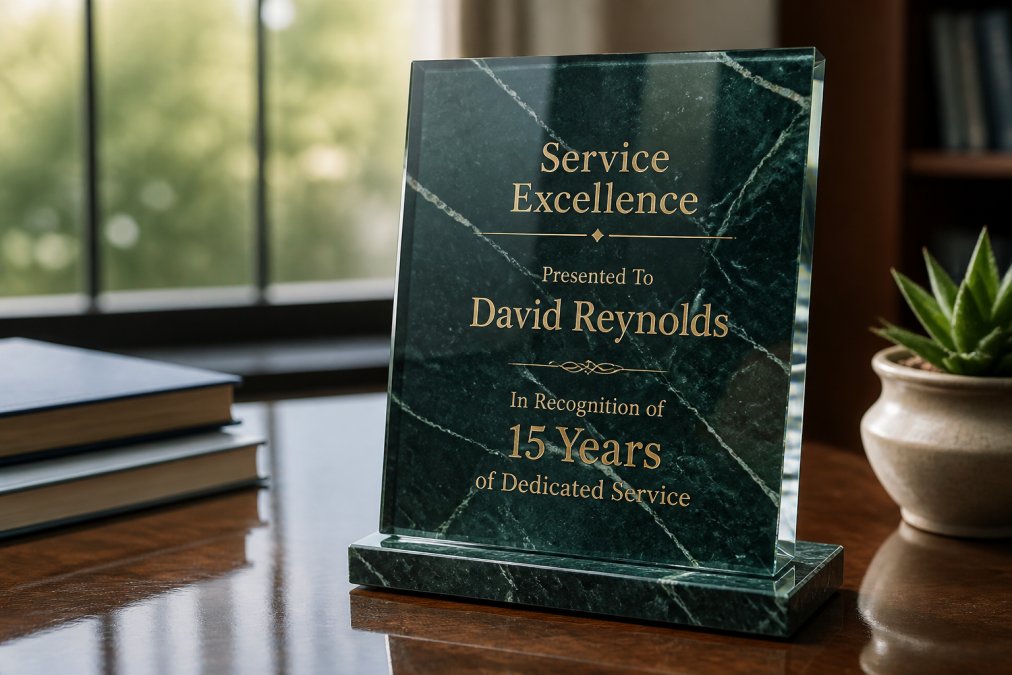
Effective programs follow core principles. First, the award must feel premium. High-quality materials, crystal, marble, engraved wood, or bronze, communicate that the milestone matters. Second, personalization is non-negotiable. A personalized award with the employee's name, specific milestone, and hire date becomes a unique artifact. Gino's Awards, Inc. includes free personalization and engraving on all awards. Third, presentation context matters as much as the award itself. A service anniversary award presented in a team meeting creates far more impact than one mailed home.
Common formats include engraved plaques, crystal or glass awards, personalized desk accessories, milestone certificates, and custom branded awards. Recognizing milestones at 5, 10, 15, and 20 years creates multiple touchpoints reinforcing the message: "We see you. Your time here matters."
Organizations implementing structured service anniversary programs report stronger retention around milestone years. Employees who receive public recognition are significantly less likely to job-hunt during those periods.
Best Practices for Employee Recognition Programs
Building effective recognition programs requires intentional design addressing three challenges: delivery logistics in hybrid environments, budget allocation across award types, and measurement frameworks proving ROI.
Defining Recognition Scope and Criteria
Clarify what you're recognizing and who decides. Are you recognizing years of service? Performance metrics? Company values? Different achievements warrant different approaches. Document criteria in writing, transparent criteria make recognition feel fair and defensible.
Frequency and Visibility: Building Momentum
Monthly or quarterly recognition becomes embedded in culture. A common pattern: quarterly all-hands recognition ceremonies for service anniversaries and major achievements, plus monthly peer-to-peer recognition through internal channels. For distributed teams, virtual recognition in company-wide calls, Slack channels, or newsletters creates the same cultural reinforcement as in-person ceremonies.
Hybrid and Remote Delivery Logistics
Physical awards present challenges for distributed workforces. Organizations manage this through three approaches:
-
Hybrid presentation model: Ship the award to the employee's home but present it virtually during an all-hands call. The employee opens the package on camera while colleagues watch.
-
Regional recognition events: Coordinate quarterly in-person ceremonies at each hub. Remote employees attend virtually or receive awards at local offices.
-
Digital-first with optional physical: Offer digital certificates and public recognition first, allowing employees to opt into receiving physical awards.
Budget Allocation Across Award Types
Allocate recognition budgets by segment:
- Service anniversaries (5, 10, 15, 20+ years): 40-50% of budget. A premium award at year 10 costs less than a cash bonus but delivers stronger retention impact.
- Performance-based recognition: 30-40% for cash bonuses or gift cards tied to metrics.
- Values-based and peer recognition: 10-20% for lower-cost, high-frequency recognition.
A company with a $10,000 annual budget can deliver four service anniversary awards, five performance bonuses, and $2,000 in peer recognition, creating more total recognition moments at lower cost than matching competitor cash bonuses.
Manager Empowerment and Training
Frontline managers execute recognition. They need to understand what behaviors warrant recognition, how to present awards authentically, and how to give recognition without creating resentment. When managers feel empowered to recognize achievement in real time, recognition becomes authentic rather than HR-dictated.
Measurement: Proving ROI
Track these metrics:
- Retention rate by recognition status: Compare voluntary turnover for employees who received recognition awards versus those who didn't. Organizations implementing service anniversary programs typically see lower turnover in the year following a milestone award.
- Engagement scores: Survey employees on whether they feel valued and recognized before and after implementing a structured program.
- Cost per retention: Calculate program cost divided by employees retained. Compare to replacement cost (typically 50-200% of annual salary) (shrm.org).
- Peer recognition velocity: Track monthly nominations. Increasing velocity signals cultural adoption.
Integration with Total Rewards
Recognition should reflect a coherent total rewards strategy where multiple forms of appreciation reinforce each other. Performance reviews should highlight achievements warranting recognition, compensation philosophy should explain how cash and non-cash rewards work together, and career development conversations should acknowledge milestones.
Which Option Should You Choose?
If your primary goal is incentivizing short-term performance, cash bonuses work. If your primary goal is retention and building emotional connection, recognition awards win. They cost less at equivalent perceived value, carry tax advantages, and create lasting impressions.
Most organizations benefit from using both. Recognition awards for service anniversaries and milestone achievements, cash bonuses for performance-based incentives, and peer-to-peer recognition for living company values.
A cash bonus says, "Here's payment for performance." A recognition award says, "We see you. You belong here. Your contribution matters." Those are fundamentally different messages.
For organizations serious about retention, recognition award strategy delivers measurable returns. Employees who receive public recognition for service anniversaries are significantly less likely to leave during milestone years.
When sourcing recognition awards, quality matters disproportionately. A premium award from a trusted provider like Gino's Awards, Inc., with free personalization, fast turnaround, and superior craftsmanship, signals the organization didn't cut corners. The employee receives a keepsake, not a trinket.
The choice between recognition awards and cash bonuses is a choice between two different strategies for building organizational culture. Cash bonuses optimize for immediate performance. Recognition awards optimize for long-term retention and belonging. The strongest organizations use both, deployed strategically.
For service anniversaries, milestone achievements, and cultural reinforcement, recognition awards deliver returns that cash bonuses can't match. Gino's Awards, Inc. provides high-quality, personalized awards that make employees feel genuinely valued. With nearly 75 years of experience, free personalization on every order, and fast turnaround times, we help organizations transform recognition into meaningful company culture. Call (216) 831-6565 to discuss your recognition strategy.
=== FAQ ANSWERS (audit these too, same rules) ===
[1] Q: Are employee recognition awards considered taxable income? A: Employee recognition awards are generally not taxable if they meet IRS requirements: they must be tangible personal property (not cash or cash equivalents), awarded for length of service or safety achievement, and not exceed $1,600 per year in value. Cash bonuses and gift cards typically are taxable as wages. Consult your tax advisor about your specific situation, as rules vary by award type and company policy.
[2] Q: What are some good employee service anniversary award ideas? A: Effective service anniversary awards include engraved plaques, crystal awards, custom desk accessories, and personalized gifts that commemorate the milestone. Tangible awards create lasting reminders of achievement and company appreciation. Consider pairing physical awards with public recognition, a personal message from leadership, or a special experience. High-quality, personalized awards from specialized providers demonstrate genuine value and enhance emotional impact compared to generic alternatives.
[3] Q: How do recognition awards affect employee retention differently than cash bonuses? A: Recognition awards build psychological ownership and long-term loyalty by creating emotional connection to the organization, while cash bonuses provide immediate financial benefit but fade quickly. Research shows tangible awards are displayed and remembered, reinforcing workplace culture and peer recognition. Combined with managerial feedback and peer-to-peer recognition, awards drive retention better than cash alone. The lasting, visible nature of awards strengthens workplace relationships and employee morale over time.
[4] Q: What are the best practices for employee recognition programs? A: Effective recognition programs combine multiple reward types: peer-to-peer recognition, manager-led feedback, tangible awards for milestones, and occasional cash incentives for specific performance goals. Ensure frequency and consistency, tie recognition to company values, make it visible to the team, and personalize each recognition. Include both relational recognition (appreciation and feedback) and transactional rewards (gifts or bonuses). Track engagement metrics and adjust based on employee feedback to maintain program relevance and impact.
Frequently Asked Questions
Q: Are employee recognition awards considered taxable income?
A: Employee recognition awards are generally not taxable if they meet IRS requirements: they must be tangible personal property (not cash or cash equivalents), awarded for length of service or safety achievement, and not exceed $1,600 per year in value. Cash bonuses and gift cards typically are taxable as wages. Consult your tax advisor about your specific situation, as rules vary by award type and company policy.
Q: What are some good employee service anniversary award ideas?
A: Effective service anniversary awards include engraved plaques, crystal awards, custom desk accessories, and personalized gifts that commemorate the milestone. Tangible awards create lasting reminders of achievement and company appreciation. Consider pairing physical awards with public recognition, a personal message from leadership, or a special experience. High-quality, personalized awards from specialized providers demonstrate genuine value and enhance emotional impact compared to generic alternatives.
Q: How do recognition awards affect employee retention differently than cash bonuses?
A: Recognition awards build psychological ownership and long-term loyalty by creating emotional connection to the organization, while cash bonuses provide immediate financial benefit but fade quickly. Research shows tangible awards are displayed and remembered, reinforcing workplace culture and peer recognition. Combined with managerial feedback and peer-to-peer recognition, awards drive retention better than cash alone. The lasting, visible nature of awards strengthens workplace relationships and employee morale over time.
Q: What are the best practices for employee recognition programs?
A: Effective recognition programs combine multiple reward types: peer-to-peer recognition, manager-led feedback, tangible awards for milestones, and occasional cash incentives for specific performance goals. Ensure frequency and consistency, tie recognition to company values, make it visible to the team, and personalize each recognition. Include both relational recognition (appreciation and feedback) and transactional rewards (gifts or bonuses). Track engagement metrics and adjust based on employee feedback to maintain program relevance and impact.
This article was written using GrandRanker